
Note
Go to the end to download the full example code.
The Carothers equation#
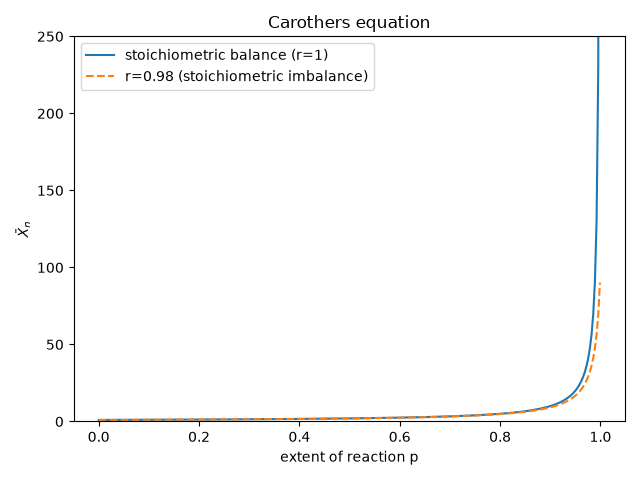
Step-growth polymerization’s number-average degree of polymerization follows the Carothers equation \(\bar X_n=1/(1-p)\), which diverges as the extent of reaction p approaches 1 – reaching a useful high molecular weight requires very high conversion. A stoichiometric imbalance between the two functional groups caps \(\bar X_n\) even at complete conversion of the limiting group.
import matplotlib.pyplot as plt
import numpy as np

from chemistrykit.polymer.systems.step_growth import (
    degree_of_polymerization,
    degree_of_polymerization_stoichiometric_imbalance,
    extent_of_reaction_for_DP,
)
from chemistrykit.polymer.visualizers.polymer_plots import plot_carothers_curve

for p in (0.5, 0.9, 0.95, 0.99, 0.999):
    print(f"p = {p:<6} -> Xn = {degree_of_polymerization(p):8.2f}")
p = 0.5    -> Xn =     2.00
p = 0.9    -> Xn =    10.00
p = 0.95   -> Xn =    20.00
p = 0.99   -> Xn =   100.00
p = 0.999  -> Xn =  1000.00
Reaching a modest Xn=100 requires 99% conversion, not 90%.
Extent of reaction needed for Xn=100: p = 0.9900
A stoichiometric imbalance (r < 1) caps the attainable Xn even as p -> 1.
p_scan = np.linspace(0.0, 0.999, 300)
Xn_balanced = degree_of_polymerization(p_scan)
Xn_imbalanced = degree_of_polymerization_stoichiometric_imbalance(p_scan, r=0.98)

Xn_balanced_at_p999 = degree_of_polymerization(0.999)
Xn_imbalanced_at_p999 = degree_of_polymerization_stoichiometric_imbalance(0.999, r=0.98)
print(f"\nAt p=0.999: Xn (balanced) = {Xn_balanced_at_p999:.1f}, Xn (r=0.98) = {Xn_imbalanced_at_p999:.1f}")
At p=0.999: Xn (balanced) = 1000.0, Xn (r=0.98) = 90.2
fig, ax = plt.subplots()
plot_carothers_curve(p_scan, Xn_balanced, ax=ax, label="stoichiometric balance (r=1)")
plot_carothers_curve(p_scan, Xn_imbalanced, ax=ax, linestyle="--", label="r=0.98 (stoichiometric imbalance)")
ax.set_ylim(0, 250)
ax.legend()
plt.tight_layout()
plt.show()
Total running time of the script: (0 minutes 0.036 seconds)