
Note
Go to the end to download the full example code.
Debye’s permanent dipole moments: polar and nonpolar molecules from geometry#
Peter Debye (1912) explained why some gases have a dielectric constant that falls with temperature: their molecules carry a permanent electric dipole moment \(\boldsymbol\mu = \sum_i q_i \mathbf r_i\), which thermal motion partly disorders. The measured moment tests a proposed shape. Water’s 1.85 D rules out a linear H-O-H, while carbon dioxide’s zero moment requires a linear O=C=O.
This example builds five molecules, adds up their bond dipoles with
bond_dipole_sum(), and
checks which ones cancel. It then uses
dipole_moment() to show how
water’s moment would change with its bond angle. The unit, the debye
(\(10^{-18}\) esu cm, about 0.208 e Å), is named after him.
import matplotlib.pyplot as plt
import numpy as np

from chemistrykit.structure.systems.dipole import E_ANGSTROM_IN_DEBYE, bond_dipole_sum, dipole_moment
from chemistrykit.structure.systems.vsepr import build_vsepr_molecule

# Approximate bond-dipole magnitudes in debye. Every bond in a molecule is
# the same kind, so each is taken to point along its bond from the central
# atom; the direction convention does not change whether they cancel.
molecules = {
    "H2O (bent)": (build_vsepr_molecule(4, 2, bond_length=0.958, central_symbol="O", ligand_symbol="H"), 1.51),
    "NH3 (pyramidal)": (build_vsepr_molecule(4, 1, bond_length=1.012, central_symbol="N", ligand_symbol="H"), 1.31),
    "CO2 (linear)": (build_vsepr_molecule(2, 0, bond_length=1.16, central_symbol="C", ligand_symbol="O"), 2.3),
    "BF3 (trigonal planar)": (build_vsepr_molecule(3, 0, bond_length=1.31, central_symbol="B", ligand_symbol="F"), 1.6),
    "CH4 (tetrahedral)": (build_vsepr_molecule(4, 0, bond_length=1.09, central_symbol="C", ligand_symbol="H"), 0.4),
}
moments = {}
for name, (mol, mu_bond) in molecules.items():
    vectors = mol.coordinates[1:] - mol.coordinates[0]
    moments[name] = float(np.linalg.norm(bond_dipole_sum(vectors, [mu_bond] * len(vectors))))
    print(f"{name:22s}: {len(vectors)} bond dipoles of {mu_bond} D -> molecular dipole {moments[name]:.2f} D")
assert moments["CO2 (linear)"] < 1e-9 and moments["BF3 (trigonal planar)"] < 1e-9 and moments["CH4 (tetrahedral)"] < 1e-9
H2O (bent)            : 2 bond dipoles of 1.51 D -> molecular dipole 1.74 D
NH3 (pyramidal)       : 3 bond dipoles of 1.31 D -> molecular dipole 1.31 D
CO2 (linear)          : 2 bond dipoles of 2.3 D -> molecular dipole 0.00 D
BF3 (trigonal planar) : 3 bond dipoles of 1.6 D -> molecular dipole 0.00 D
CH4 (tetrahedral)     : 4 bond dipoles of 0.4 D -> molecular dipole 0.00 D
VSEPR places water’s hydrogens at the ideal 109.47 degrees, which gives 1.74 D. At the measured 104.5 degrees the vector sum rises to 1.85 D, the experimental value. Water’s moment as a function of angle, from partial charges of -2q on O and +q on each H chosen to give 1.51 D per O-H bond:
r_oh = 0.958
q = 1.51 / (E_ANGSTROM_IN_DEBYE * r_oh)
angles = np.linspace(90.0, 180.0, 91)
mu = []
for theta in np.radians(angles):
    coords = [[0, 0, 0], [r_oh * np.sin(theta / 2), 0, r_oh * np.cos(theta / 2)], [-r_oh * np.sin(theta / 2), 0, r_oh * np.cos(theta / 2)]]
    mu.append(np.linalg.norm(dipole_moment(coords, [-2 * q, q, q])))
mu_at_1045 = np.interp(104.5, angles, mu)
print(f"\nwater at 104.5 deg: {mu_at_1045:.2f} D (measured 1.85 D); linear water would have {mu[-1]:.2f} D")

fig, (ax1, ax2) = plt.subplots(1, 2, figsize=(11, 4))
ax1.barh(list(moments), list(moments.values()), color=["C3" if v > 1e-6 else "C7" for v in moments.values()])
ax1.set_xlabel("dipole moment (D)")
ax1.set_title("Bond dipoles cancel in symmetric shapes")
ax2.plot(angles, mu, color="C0")
ax2.axvline(104.5, color="gray", linestyle="--", linewidth=0.8)
ax2.axhline(1.85, color="C3", linestyle=":", linewidth=1, label="measured 1.85 D")
ax2.set_xlabel("H-O-H angle (degrees)")
ax2.set_ylabel("dipole moment (D)")
ax2.set_title("Water's dipole depends on its shape")
ax2.legend()
fig.tight_layout()
plt.show()
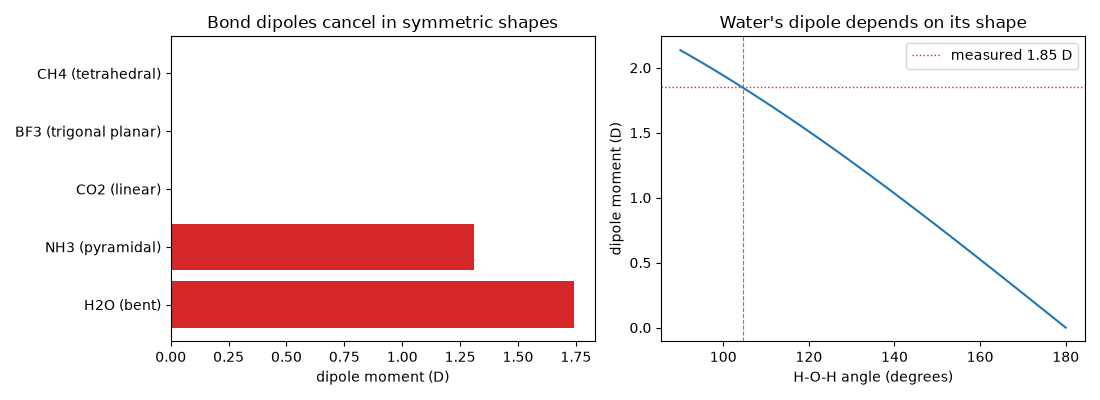
water at 104.5 deg: 1.85 D (measured 1.85 D); linear water would have 0.00 D
Total running time of the script: (0 minutes 0.063 seconds)