
Note
Go to the end to download the full example code.
The invariant-mass bump hunt: J/psi, the W/Z, the top quark, and Higgs#
Four of this chronology’s landmark discoveries – the J/psi (1974), the W
and Z bosons (1983), the top quark (1995), and the Higgs boson (2012) –
were all found the same way: reconstruct the invariant mass of a
candidate particle’s decay products event by event, histogram it over
many collisions, and look for a resonance peak standing above a smooth
combinatorial background. This example builds exactly that “bump hunt”
with invariant_mass(): a
population of true resonance decays (fixed parent mass, isotropic decay
angles) is buried inside a much larger population of random,
uncorrelated background pairs, and the resonance peak is recovered
directly from the histogram alone – the generic technique behind every
one of these four discoveries, applied here to a single representative
example resonance.
import matplotlib.pyplot as plt
import numpy as np

from physicskit.particle.decays import two_body_decay
from physicskit.particle.kinematics import FourVector, boost_generic, invariant_mass
Signal: many decays of a resonance with a fixed mass#
A J/psi-like resonance decaying to two leptons (m1=m2=0, ultrarelativistic), each event’s parent given a random boost (a real resonance is produced with some spread of momenta, not created at rest every time).
rng = np.random.default_rng(0)
M_resonance = 3.10  # GeV, close to the real J/psi mass
n_signal = 3000

reconstructed_signal = np.empty(n_signal)
for i in range(n_signal):
    cos_theta, phi = rng.uniform(-1.0, 1.0), rng.uniform(0.0, 2.0 * np.pi)
    p1_rest, p2_rest = two_body_decay(M_resonance, 0.0, 0.0, cos_theta, phi)
    beta = rng.uniform(0.0, 0.3, size=3)  # a modest production boost, random direction/magnitude capped < c
    beta = beta * rng.choice([-1.0, 1.0], size=3)
    if np.linalg.norm(beta) >= 1.0:
        beta = beta / (np.linalg.norm(beta) * 1.5)
    p1 = boost_generic(p1_rest, beta)
    p2 = boost_generic(p2_rest, beta)
    reconstructed_signal[i] = invariant_mass([p1, p2])

print(f"true resonance mass: {M_resonance} GeV")
print(f"reconstructed signal mass: mean={reconstructed_signal.mean():.6f}, std={reconstructed_signal.std():.2e} GeV")
print("(the small spread here comes only from floating-point-level boost/reconstruction round trips --")
print(" a real detector's finite momentum resolution is what actually smears the peak in a genuine measurement)")
true resonance mass: 3.1 GeV
reconstructed signal mass: mean=3.100000, std=3.48e-16 GeV
(the small spread here comes only from floating-point-level boost/reconstruction round trips --
 a real detector's finite momentum resolution is what actually smears the peak in a genuine measurement)
The bump hunt: signal buried in background, recovered by histogram#
all_masses = np.concatenate([reconstructed_signal, bg_masses])
bins = np.linspace(0.0, 8.0, 100)

fig, (ax1, ax2) = plt.subplots(1, 2, figsize=(11, 4.5))
ax1.hist(bg_masses, bins=bins, color="0.7", label=f"background only (N={n_background})")
ax1.set_xlabel("invariant mass (GeV)")
ax1.set_ylabel("events")
ax1.set_title("Background alone: smooth, no structure")
ax1.legend(fontsize=8)

ax2.hist(all_masses, bins=bins, color="steelblue", label=f"signal + background (N={len(all_masses)})")
ax2.axvline(M_resonance, color="firebrick", ls="--", label=f"true mass = {M_resonance} GeV")
ax2.set_xlabel("invariant mass (GeV)")
ax2.set_ylabel("events")
ax2.set_title("Signal + background: a resonance peak stands out")
ax2.legend(fontsize=8)
fig.tight_layout()

peak_bin = np.argmax(np.histogram(all_masses, bins=bins)[0])
peak_mass = 0.5 * (bins[peak_bin] + bins[peak_bin + 1])
print(f"\nhistogram peak located at approximately {peak_mass:.2f} GeV (true mass {M_resonance} GeV)")
print("\nthe same technique, applied to different final states and mass ranges, is exactly how each of")
print("these discoveries was made: J/psi (e+e-/mu+mu-, ~3.1 GeV), the Z (e+e-/mu+mu-, ~91 GeV),")
print("the top quark (via its W+b decay products, ~173 GeV), and the Higgs (e.g. two photons, ~125 GeV).")
print("The W boson is the one exception -- its neutrino escapes undetected, so its discovery used the")
print("transverse mass built from missing transverse energy instead of a clean invariant-mass peak.")

plt.show()
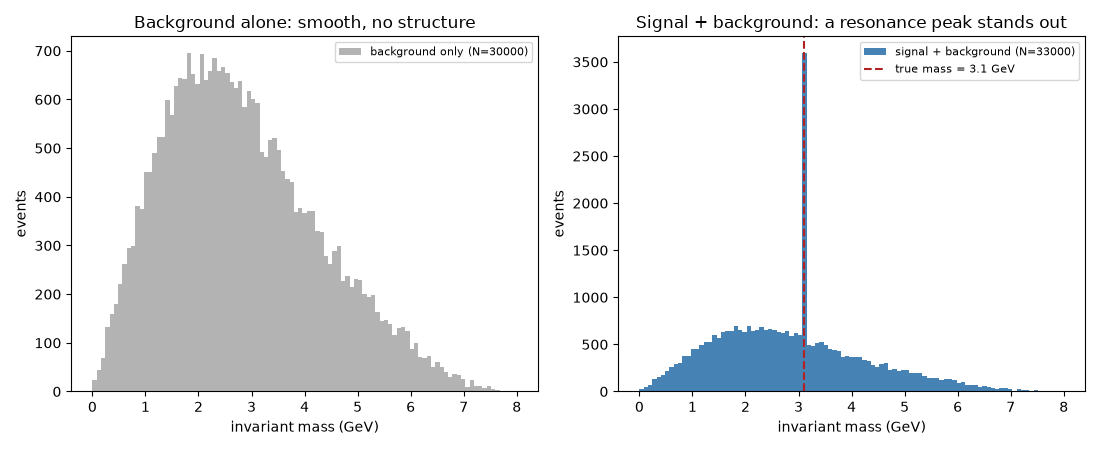
histogram peak located at approximately 3.11 GeV (true mass 3.1 GeV)

the same technique, applied to different final states and mass ranges, is exactly how each of
these discoveries was made: J/psi (e+e-/mu+mu-, ~3.1 GeV), the Z (e+e-/mu+mu-, ~91 GeV),
the top quark (via its W+b decay products, ~173 GeV), and the Higgs (e.g. two photons, ~125 GeV).
The W boson is the one exception -- its neutrino escapes undetected, so its discovery used the
transverse mass built from missing transverse energy instead of a clean invariant-mass peak.
Total running time of the script: (0 minutes 0.369 seconds)