
Instabilities#
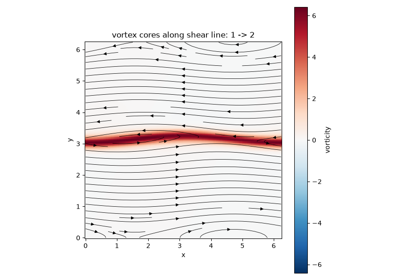
Some flows are unstable to any perturbation, no matter how small: the smallest ripple grows exponentially until it reorganizes the whole flow. Kelvin-Helmholtz instability needs nothing but shear – two layers sliding past each other supply their own energy to grow a ripple into a row of rolled-up vortex cores, the mechanism behind everything from billow clouds to a flapping flag. Rayleigh-Taylor instability needs nothing but an unstable density stratification – heavy fluid sitting on light fluid under gravity – and grows a rippled interface into the mushroom-shaped plumes seen in everything from a lava lamp to a supernova remnant. Both examples below compare the simulated early-time growth against the exact linear growth-rate law for that instability, then run well past the point where that linear theory stops applying, into the fully rolled-up nonlinear state.
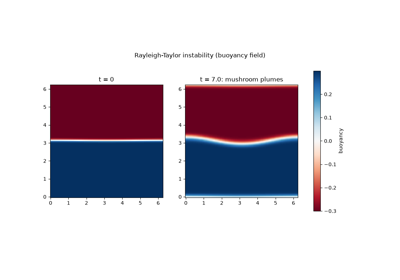
Rayleigh-Taylor plumes from a heavy-over-light interface