Examples#
Runnable scripts demonstrating the conceptual breakthroughs behind
physicskit.condensed, from Bloch’s band theory through topological
superconductors – see Breakthroughs in Condensed Matter Physics for the full
chronology each script illustrates.
See also the narrative tutorials:
Each script in this gallery is self-contained and can be run directly with
python examples/condensed/<section>/<script>.py. Every script also
carries an RST module docstring as its title/description and uses # %%
markers to split narrative text from code, which is exactly what
Sphinx-Gallery renders into the pages below – the script is the source
of truth for what you see, not a copy of it.
Sections#
tight_binding – the generic Bloch-Hamiltonian machinery: recovering the exact tight-binding dispersion from a real-space chain, a Hofstadter-like spectrum from Peierls-substituted Landau levels, and a two-orbital Slater-Koster LCAO band structure.
correlated – interacting-electron models: the BCS/Bogoliubov-de Gennes quasiparticle gap, Mott suppression of itinerant motion in the 1D Hubbard model, and the short-range antiferromagnetic spin correlations that model develops at half filling and strong coupling – the arena any theory of cuprate superconductivity has to live in.
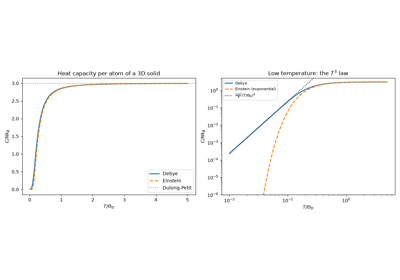
phonons – lattice vibrations: Born-von Karman phonon dispersion of 1D chains and the square lattice, and Debye’s \(T^3\) heat capacity.
transport – electronic transport: the Drude model’s conductivity and Hall effect, and Sommerfeld-Boltzmann transport with the Wiedemann-Franz law and the Mott thermopower.
spin_chains – exact diagonalization of spin-1/2 chains in their symmetry sectors: Bethe’s ansatz for the Heisenberg antiferromagnet, the free-fermion transverse-field Ising chain and its quantum critical point, and logarithmic (Calabrese-Cardy) versus area-law entanglement.
laughlin – the fractional quantum Hall effect: Metropolis-sampling Laughlin’s trial wavefunction directly via its plasma analogy, and the correlation hole and incompressible-droplet density profile that result.
topology – topological band theory: SSH edge states and the Zak phase, exactly quantized Chern numbers (TKNN) on both the Haldane model and the lattice (Harper-Hofstadter) route to the integer quantum Hall effect, the Haldane model’s zero-net-flux Chern insulator and its chiral edge states, unpaired Majorana zero modes in the Kitaev chain, graphene’s massless Dirac cone, the Kane-Mele/BHZ \(\mathbb{Z}_2\) topological insulators, Weyl semimetal Fermi arcs, and the tenfold-way classification tying the Chern, \(\mathbb{Z}_2\), and Majorana invariants together.
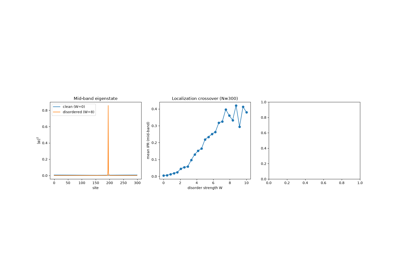
Anderson Localization#
The 1958 discovery that disorder alone, with no interactions, can halt diffusion: exponentially localized eigenstates on a disordered 1D chain, diagnosed by the inverse participation ratio and localization length.
Correlated Electrons#
Interacting-electron models: the BCS/Bogoliubov-de Gennes quasiparticle gap, and Mott suppression of itinerant motion in the 1D Hubbard model.
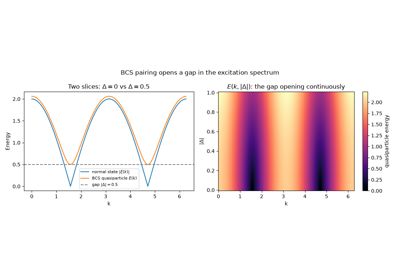
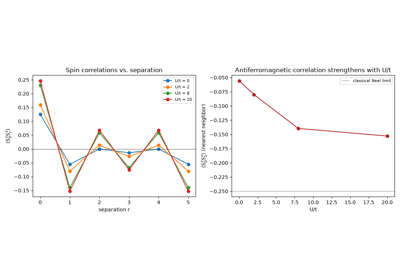
Cuprate Physics: Antiferromagnetism from the Strong-Coupling Hubbard Model
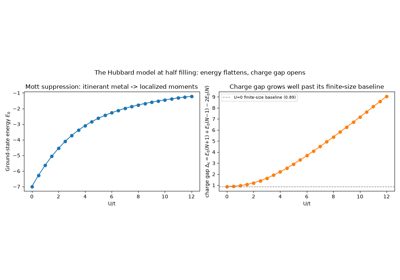
The Hubbard Model: Mott Suppression of Itinerant Motion
Ginzburg-Landau Theory#
The 1950 phenomenological free-energy theory of superconductivity: the equilibrium order parameter, the coherence length and penetration depth it sets, the Ginzburg-Landau parameter that separates Type I from Type II superconductors, and the exact order-parameter healing profile at a boundary.
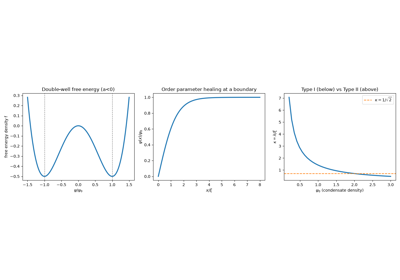
Ginzburg-Landau Theory: Healing Length and Type I vs Type II
Landau Levels#
The continuum quantization of a charged particle in a uniform magnetic field: equally spaced Landau levels, their macroscopic per-area degeneracy, and the disorder-broadened density of states whose filling factor sets the quantum Hall effect’s plateau sequence.
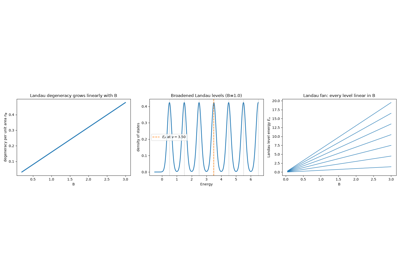
Landau’s 1930 Solution: Discrete Levels from a Continuous Field
Laughlin’s Wavefunction and the Fractional Quantum Hall Effect#
The 1982-1983 discovery of fractional quantum Hall plateaus and Laughlin’s many-body trial wavefunction that explains them: sampling \(|\Psi_m|^2\) directly by Metropolis Monte Carlo via its “plasma analogy,” and extracting the correlation hole and incompressible-droplet density profile that are its defining signatures.
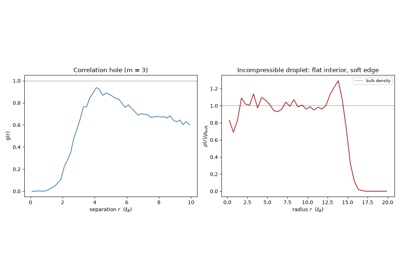
The Fractional Quantum Hall Effect: Laughlin’s Correlation Hole
Phonons#
Lattice vibrations: the phonon dispersion of 1D chains and a 2D square lattice with its acoustic sound speeds, and the heat capacity of the phonon gas, from Debye’s \(T^3\) law to the Dulong-Petit limit.
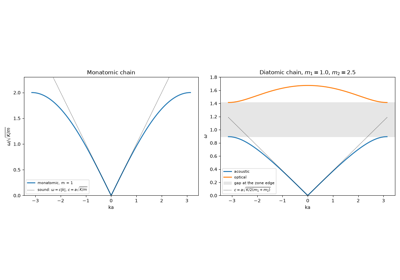
Born and von Karman: phonon dispersion of crystal lattices
Quantum spin chains#
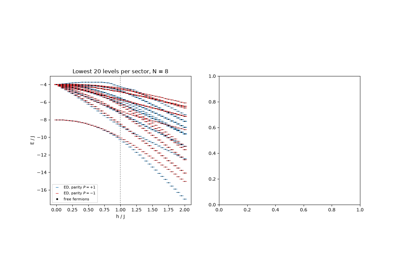
Exact diagonalization of spin-1/2 chains in their symmetry sectors, checked against the classic exact solutions: Bethe’s ansatz for the Heisenberg antiferromagnet, the free-fermion solution of the transverse-field Ising chain, and the Calabrese-Cardy logarithmic entanglement of a critical chain versus the area law of a gapped one.
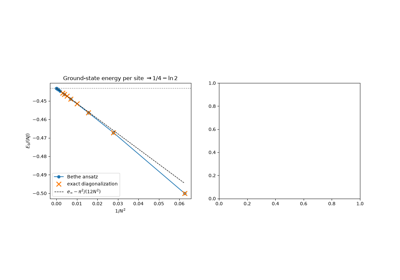
Bethe’s ansatz for the Heisenberg antiferromagnetic chain
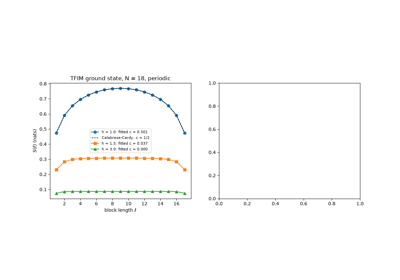
Calabrese-Cardy: logarithmic entanglement at criticality vs. the area law
Tight-Binding#
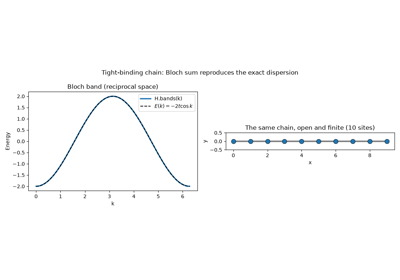
The generic Bloch-Hamiltonian machinery: recovering the exact tight-binding dispersion from a real-space chain, a Hofstadter-like spectrum from Peierls-substituted Landau levels, and a two-orbital Slater-Koster LCAO band structure.
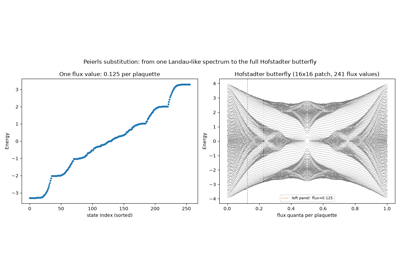
Peierls Substitution: A Hofstadter-Like Spectrum from Landau’s Physics
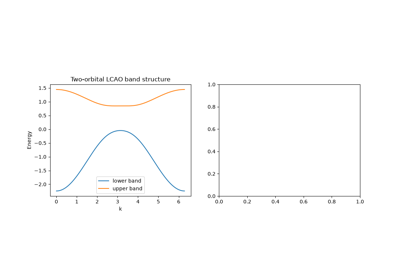
Slater-Koster LCAO: Empirical Multi-Orbital Band Structure
Topology#
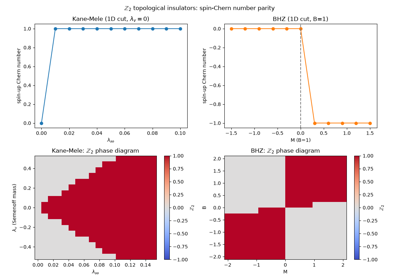
Topological band theory: SSH edge states and the Zak phase, exactly quantized Chern numbers (TKNN), the Haldane model’s zero-net-flux Chern insulator and its chiral edge states, unpaired Majorana zero modes in the Kitaev chain, graphene’s massless Dirac cone, and the Kane-Mele/BHZ \(\mathbb{Z}_2\) topological insulators.
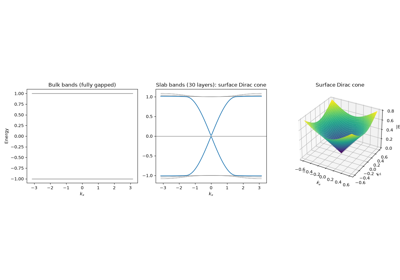
The 3D Topological Insulator: A Single Surface Dirac Cone
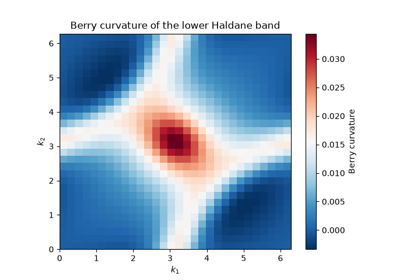
The TKNN Invariant: Exactly Quantized Chern Numbers
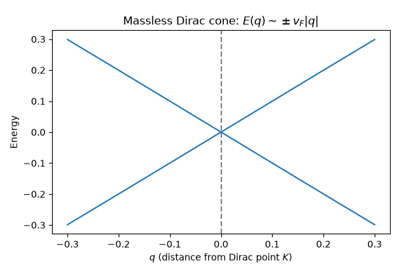
Graphene: A Massless Dirac Cone on a Honeycomb Lattice
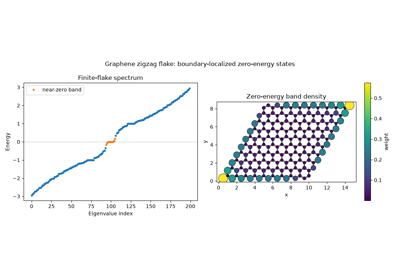
Graphene: Zero-Energy Edge States on a Zigzag-Terminated Flake
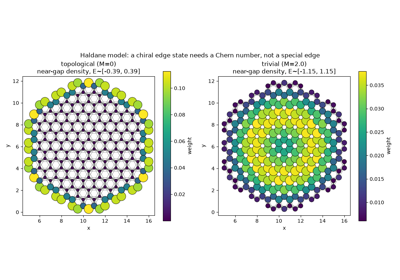
The Haldane Model: a Chiral Edge State on an Arbitrary Boundary
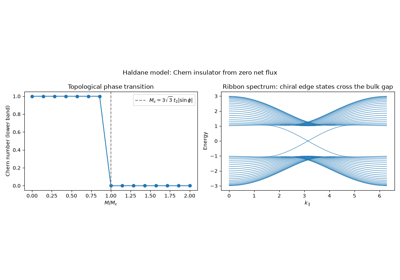
The Haldane Model: A Chern Insulator with Zero Net Flux
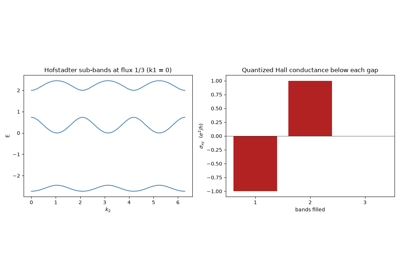
The Integer Quantum Hall Effect: Quantized Hall Conductance from Chern Numbers
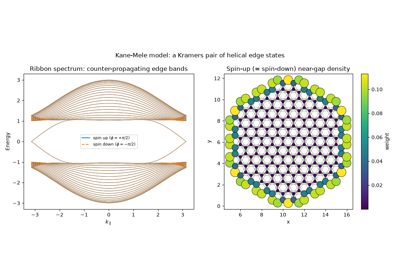
Kane-Mele: Helical Edge States from Two Time-Reversed Haldane Copies
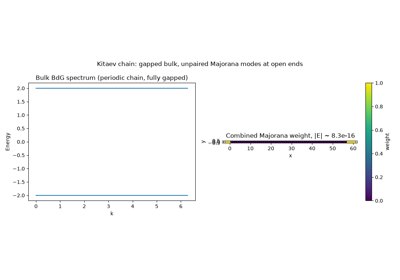
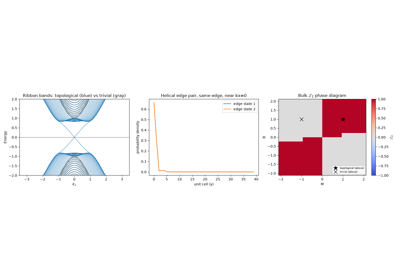
Quantum Spin Hall Effect: Konig et al.’s Helical Edge States
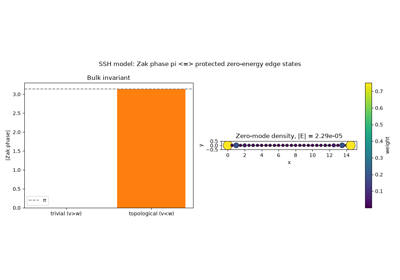
The SSH Model: Zak Phase and Protected Edge States
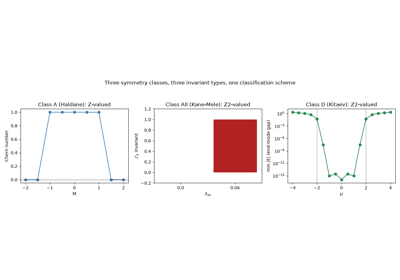
The Tenfold Way: Three Topological Invariants, One Classification Scheme
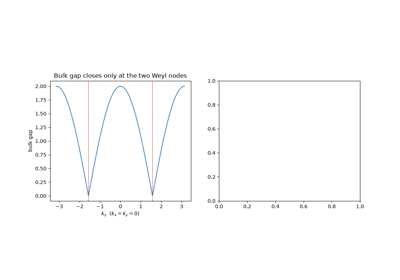
Weyl Semimetals: Momentum-Space Monopoles and Fermi Arcs
Electronic transport#
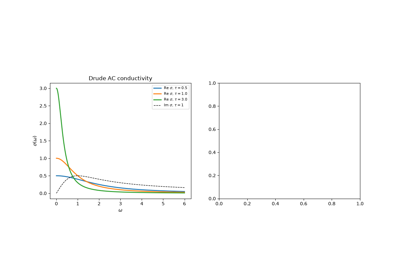
Drude’s classical electron gas (DC and AC conductivity, the Hall effect) and the Boltzmann equation with Fermi-Dirac statistics that corrected it (the Wiedemann-Franz law and the thermopower of a degenerate metal).
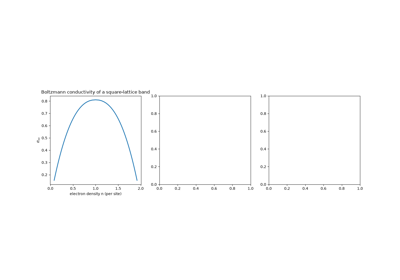
Sommerfeld’s electron gas: the Wiedemann-Franz law and thermopower