Note
Go to the end to download the full example code.
The TKNN Invariant: Exactly Quantized Chern Numbers#
Thouless, Kohmoto, Nightingale, and den Nijs showed that the quantized
Hall conductance is a topological invariant: the integral of the Berry
curvature of the occupied Bloch bands over the Brillouin zone, now called
the (first) Chern number \(C\). Because \(C\) can only change when
a bulk gap closes, it is exact and disorder-independent – the moment band
theory became topological band theory.
compute_berry_curvature() and
compute_chern_number() implement the
Fukui-Hatsugai-Suzuki lattice discretization of this integral, returning
exactly quantized integers for any gapped Bloch Hamiltonian.
import numpy as np

from physicskit.condensed.models import haldane_model
from physicskit.condensed.topology import compute_berry_curvature, compute_chern_number
from physicskit.condensed.visualizers import plot_berry_curvature
Any gapped two-band Bloch Hamiltonian – here, Haldane’s model#
The FHS algorithm needs nothing but a function H(k1, k2); it makes
no assumption about the model beyond a spectral gap.
H = lambda k1, k2: haldane_model(k1, k2, t=1.0, t2=0.2, phi=np.pi / 2, M=0.0)
Berry curvature concentrated near the gapped Dirac points#
The per-plaquette Berry curvature of the lower band is sharply peaked near the honeycomb lattice’s two (former) Dirac points, where the time-reversal-breaking mass gap is smallest.
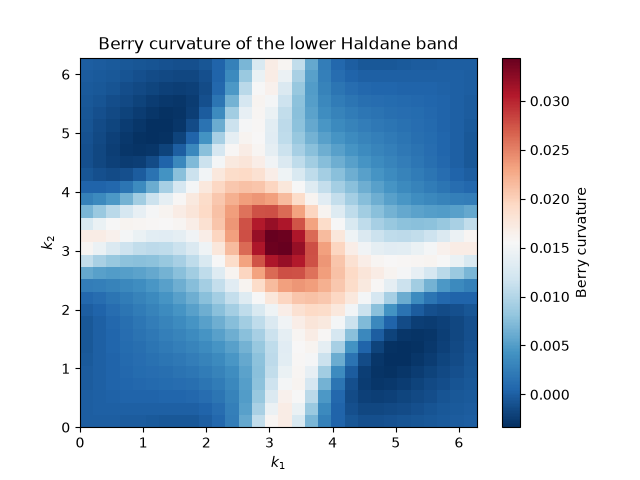
Text(0.5, 1.0, 'Berry curvature of the lower Haldane band')
Integrating the curvature gives an exact integer#
Summing the curvature over the whole Brillouin zone and dividing by \(2\pi\) returns an exact integer for every band – not approximately quantized, but exactly, by construction of the FHS link variables.
Chern numbers (per band): [1, -1]
raw curvature sum / 2*pi for the lower band: 1.0000000000
Check#
Total running time of the script: (0 minutes 0.075 seconds)