
Viscous Flow#
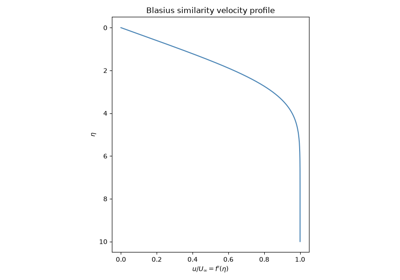
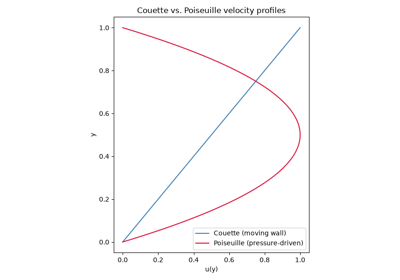
Viscosity is what potential flow leaves out, and these are the handful of problems simple enough that adding it back in still yields an exact, closed-form answer. Couette and Poiseuille flow show how the same viscous term produces a straight-line profile under a moving wall but a parabola under a pressure gradient; Stokes drag captures the opposite extreme, where viscosity so dominates inertia that a settling sphere never notices its own momentum; the Reynolds number sweep shows that same Stokes-drag physics recast to make a different point – that a single dimensionless ratio, not the sphere’s size or the fluid’s identity separately, decides the flow regime; and the Blasius boundary layer shows what happens in between – a thin viscous layer clinging to a wall in an otherwise fast, nearly inviscid stream, thickening as the square root of downstream distance. Watch how thin that layer stays even at a middling free-stream speed, and how the wall shear stress it predicts falls off as the flow moves downstream.
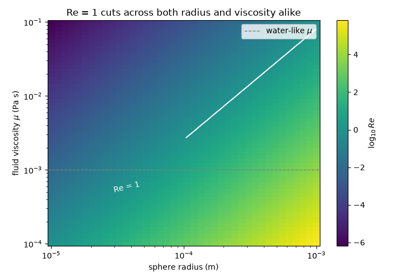
The Reynolds number: one ratio, regardless of size or fluid
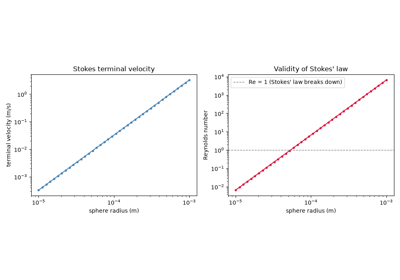
Stokes drag and the terminal velocity of a settling sphere