
Potential Flow#
Away from any boundary layer or wake, a great deal of real aerodynamics is governed by a flow with no vorticity at all: a velocity potential obeying Laplace’s equation, which is linear, so entire flow fields can be built by just adding together a handful of elementary solutions. The examples below build up from Bernoulli’s pressure-speed trade-off and a bare source/sink/doublet, through d’Alembert’s paradox of exactly zero drag on a circulation-free cylinder, to the textbook result that made potential theory indispensable to early aerodynamics – a spinning cylinder, or by extension a cambered airfoil, generates lift in direct proportion to its bound circulation, with no viscosity anywhere in the calculation. Watch, in the streamline plots, how a source and sink merge into a doublet as they’re brought together, and how adding circulation to a symmetric cylinder flow breaks its front-back symmetry and shifts its stagnation points – the geometric signature of lift.
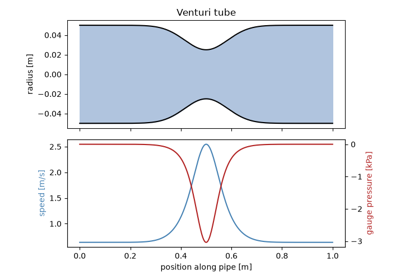
Bernoulli’s principle: faster flow, lower pressure
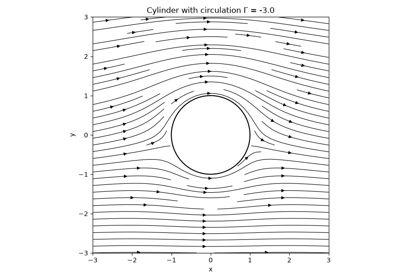
The Kutta-Joukowski lift theorem: a cylinder with circulation
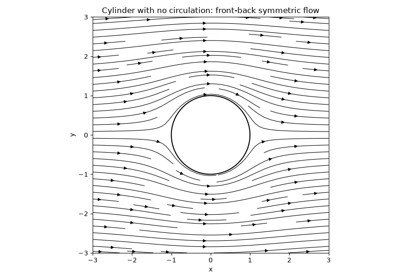
D’Alembert’s paradox: zero net drag on a cylinder in inviscid flow
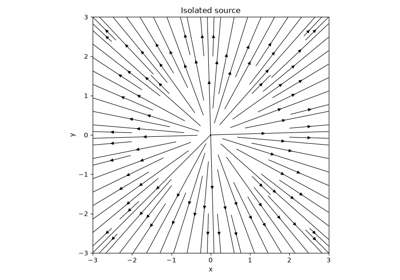
Source, sink, and doublet: building blocks of potential flow