
Note
Go to the end to download the full example code.
The Kutta-Joukowski lift theorem: a cylinder with circulation#
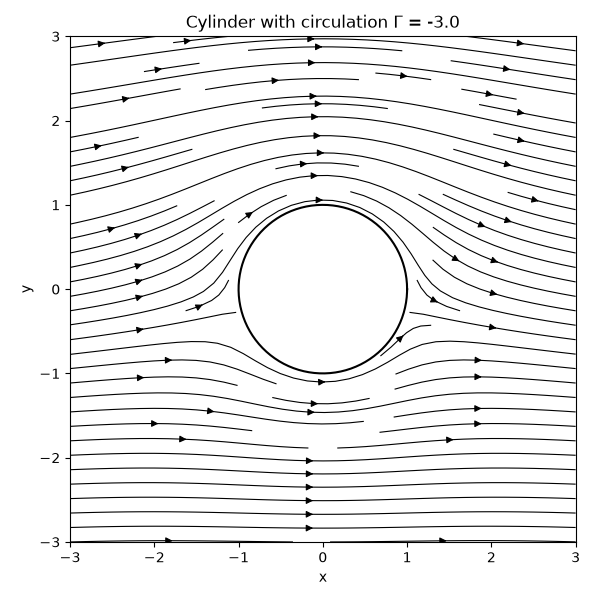
Kutta (1902) and Joukowski (1906) showed that the lift per unit span on any two-dimensional body in a uniform stream depends only on the circulation around it, \(L' = -\rho U_\infty \Gamma\), whatever the body’s shape. The simplest body to check it on is a circular cylinder.
Superposing a uniform stream of speed \(U_\infty\) with a doublet of
strength \(\kappa = 2\pi U_\infty R^2\) places a circular streamline of
radius \(R\) exactly at the origin – a solid cylinder, in
potential-flow terms. Adding a point vortex of circulation \(\Gamma\) at
the same location keeps that circle intact (a vortex centered on the circle
induces purely tangential velocity there) while breaking its front-back
symmetry, generating lift with no viscosity anywhere in the calculation.
This example builds that flow with
flow_past_cylinder(), plots
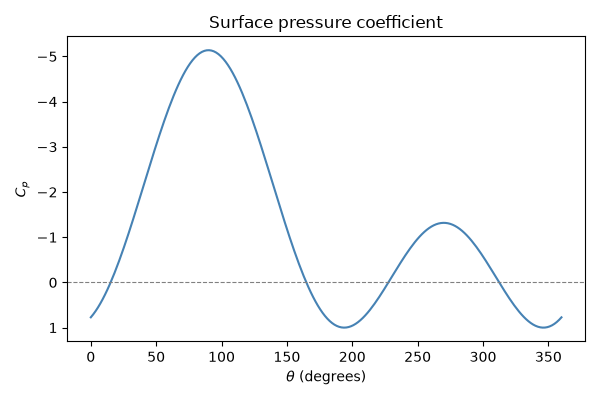
its surface pressure coefficient
and checks the resulting lift against the Kutta-Joukowski theorem,
(\(\Gamma>0\) counterclockwise; the clockwise \(\Gamma<0\) used
here speeds up the flow over the top and lifts upward, like an airfoil)
(kutta_joukowski_lift()), by
directly integrating that same pressure around the surface.
import matplotlib.pyplot as plt
import numpy as np

from physicskit.fluids.systems.potential_flow import flow_past_cylinder, kutta_joukowski_lift
from physicskit.fluids.visualizers.flow_fields import plot_streamlines
from physicskit.fluids.visualizers.potential_flow import plot_pressure_coefficient
Build the flow#
Circulation is chosen large enough to make the effect obvious; too much circulation would pull the (physically required) stagnation points off the cylinder surface entirely.
U_inf, R, rho = 1.0, 1.0, 1.0
Gamma = -3.0  # clockwise: faster flow over the top, upward lift
flow = flow_past_cylinder(U_inf=U_inf, radius=R, circulation=Gamma)

x = np.linspace(-3, 3, 300)
X, Y = np.meshgrid(x, x, indexing="ij")
u, v = flow.velocity(X, Y)
inside = X**2 + Y**2 < R**2
u[inside] = np.nan
v[inside] = np.nan

fig, ax = plot_streamlines(X, Y, u, v)
theta_circle = np.linspace(0, 2 * np.pi, 200)
ax.plot(R * np.cos(theta_circle), R * np.sin(theta_circle), color="black", lw=1.5)
ax.set_title(f"Cylinder with circulation $\\Gamma$ = {Gamma}")
fig.tight_layout()
Surface pressure coefficient#
Circulation shifts the two stagnation points (where \(C_p = 1\)) away from the front/back symmetry point they’d sit at with no circulation, and makes the low-pressure suction peak on top stronger than the one on the bottom – exactly the pressure asymmetry that produces lift.
Cross-checking the Kutta-Joukowski theorem#
Integrating the surface pressure directly should reproduce
kutta_joukowski_lift()’s
closed-form answer, \(L' = -\rho U_\infty \Gamma\).
theta_fine = np.linspace(0, 2 * np.pi, 4000, endpoint=False)
x_fine, y_fine = R * np.cos(theta_fine), R * np.sin(theta_fine)
Cp_fine = flow.pressure_coefficient(x_fine, y_fine)
p_fine = Cp_fine * (0.5 * rho * U_inf**2)
dtheta = theta_fine[1] - theta_fine[0]
lift_numeric = -np.sum(p_fine * np.sin(theta_fine) * R) * dtheta  # y-component of -oint p n dA
lift_theory = kutta_joukowski_lift(rho=rho, U_inf=U_inf, circulation=Gamma)

print(f"lift from pressure integral: {lift_numeric:.4f}")
print(f"lift from Kutta-Joukowski theorem (-rho * U_inf * Gamma): {lift_theory:.4f}")

plt.show()
lift from pressure integral: 3.0000
lift from Kutta-Joukowski theorem (-rho * U_inf * Gamma): 3.0000
Check#
Kutta-Joukowski: L = -rho U Gamma, from the surface pressure integral.
assert abs(lift_numeric - lift_theory) < 1e-9 and abs(lift_theory - 3.0) < 1e-12
Total running time of the script: (0 minutes 0.154 seconds)