
Note
Go to the end to download the full example code.
Weyl Semimetals: Momentum-Space Monopoles and Fermi Arcs#
Wan, Turner, Vishwanath, and Savrasov predicted that breaking inversion or
time-reversal symmetry in a 3D Dirac material splits each doubly-degenerate
Dirac point into a pair of nondegenerate Weyl nodes – momentum-space
sources and sinks of Berry curvature carrying opposite chirality, the
direct 3D generalization of the 2D TKNN invariant. A surface hosts open,
non-closed “Fermi arcs” of surface states connecting the surface
projections of opposite-chirality bulk nodes, later confirmed by ARPES on
TaAs.
weyl_semimetal_hamiltonian() implements
the minimal two-band cubic-lattice model with this physics,
whose mass term vanishes at exactly two points on the \(k_z\) axis for \(1 < m/t < 3\) – a pair of Weyl nodes of opposite chirality.
Weyl nodes at kz = +-1.5708 (m/t = 2.0)
The bulk gap closes at exactly two points#
Scanning the bulk gap along the kx = ky = 0 axis shows it dip to exactly zero at the two predicted node positions, and nowhere else.
kz_grid = np.linspace(-np.pi, np.pi, 400)
gap = [np.diff(np.linalg.eigvalsh(weyl_semimetal_hamiltonian(0.0, 0.0, kz, m, t)))[0] for kz in kz_grid]

fig, axes = plt.subplots(1, 2, figsize=(11, 4.3))
axes[0].plot(kz_grid, gap, color="steelblue")
axes[0].axvline(-k0, color="firebrick", lw=0.8, ls="--")
axes[0].axvline(k0, color="firebrick", lw=0.8, ls="--")
axes[0].set_xlabel(r"$k_z$  ($k_x=k_y=0$)")
axes[0].set_ylabel("bulk gap")
axes[0].set_title("Bulk gap closes only at the two Weyl nodes")
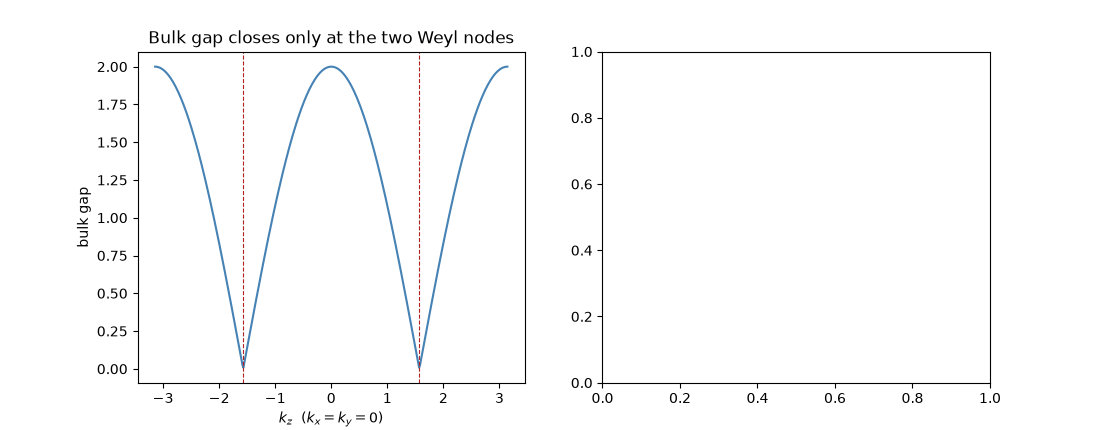
Text(0.5, 1.0, 'Bulk gap closes only at the two Weyl nodes')
A single chiral surface mode connects the two nodes#
Opening the lattice along x exposes a surface Brillouin zone in (ky, kz). Between the two nodes’ projections the slab hosts a single chiral mode crossing zero energy as a function of ky – the lattice signature of a Fermi arc; outside the node range the slab is fully gapped, exactly like a trivial 2D insulator’s edge.
ky_grid = np.linspace(0, 2 * np.pi, 300)
n_layers = 40
bands_inside = np.array([np.linalg.eigvalsh(weyl_semimetal_slab_hamiltonian(ky, 0.0, n_layers, m, t)) for ky in ky_grid])
bands_outside = np.array([np.linalg.eigvalsh(weyl_semimetal_slab_hamiltonian(ky, np.pi, n_layers, m, t)) for ky in ky_grid])

n_show = 6
mid = n_layers
for n in range(mid - n_show // 2, mid + n_show // 2):
    axes[1].plot(ky_grid, bands_inside[:, n], color="steelblue", lw=0.8)
    axes[1].plot(ky_grid, bands_outside[:, n], color="lightgray", lw=0.8)
axes[1].axhline(0, color="black", lw=0.5)
axes[1].plot([], [], color="steelblue", label=r"$k_z=0$ (between nodes): gapless")
axes[1].plot([], [], color="lightgray", label=r"$k_z=\pi$ (outside nodes): gapped")
axes[1].set_xlabel(r"$k_y$")
axes[1].set_ylabel("E")
axes[1].set_title("Slab spectrum near E=0")
axes[1].legend(fontsize=8)
fig.tight_layout()
Tracing the ky where the slab spectrum crosses zero energy, as a function of kz swept across the whole node range, would trace out the Fermi arc itself; here the two representative cuts already make the qualitative point – a single mode crossing zero between the nodes, a full gap outside them, exactly the surface signature ARPES resolved in TaAs.
plt.show()
Check#
Nodes at cos k0 = (m - 2t)/t (here k0 = pi/2), the bulk gap vanishes only there, and the surface is gapless between the nodes and gapped outside.
Total running time of the script: (0 minutes 0.297 seconds)