Note
Go to the end to download the full example code.
BCS Theory: The Superconducting Quasiparticle Gap#
Bardeen, Cooper, and Schrieffer explained superconductivity as a
condensate of Cooper pairs bound by an effective attraction, however weak.
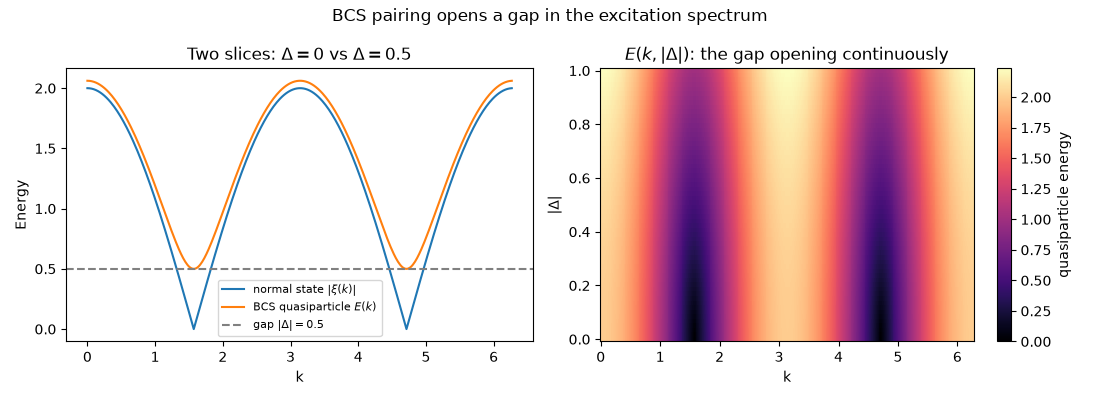
Pairing opens a gap \(\Delta\) in the single-particle excitation
spectrum: unlike the normal-state band \(|\xi(k)|\), which touches zero
at the Fermi points, the BCS quasiparticle band \(E(k) =
\sqrt{\xi(k)^2 + |\Delta(k)|^2}\) never does.
bdg_bcs_hamiltonian() builds the
Bogoliubov-de Gennes Hamiltonian in Nambu (particle-hole) space, and
bdg_spectrum() diagonalizes it
across the Brillouin zone.
import matplotlib.pyplot as plt
import numpy as np

from physicskit.condensed.correlated import bdg_bcs_hamiltonian, bdg_spectrum
The BdG Hamiltonian at a single momentum#
bdg_bcs_hamiltonian() builds \(H(k) = \xi(k)\tau_z +
\mathrm{Re}(\Delta)\tau_x - \mathrm{Im}(\Delta)\tau_y\) in Nambu space;
bdg_spectrum() sweeps it over the whole Brillouin zone. At the
Fermi momentum (\(\xi(k)=0\)), the two Nambu branches sit exactly at
\(\pm|\Delta|\).
H_kF = bdg_bcs_hamiltonian(k=np.pi / 2, mu=0.0, t=1.0, delta=0.5)
print(f"quasiparticle energies at the Fermi momentum: {np.linalg.eigvalsh(H_kF)}")
quasiparticle energies at the Fermi momentum: [-0.5 0.5]
Normal state vs. the paired condensate#
Setting the pairing amplitude delta=0 recovers the ordinary
normal-state band \(|\xi(k)|\), which is gapless at the Fermi
points. Turning on delta=0.5 opens a full gap.
The gap never closes#
The minimum of the BCS quasiparticle band equals exactly \(|\Delta|\), regardless of momentum – the defining signature of a fully gapped superconductor.
Watching the gap open continuously as pairing turns on#
The two curves above are just two slices of a whole family: sweeping
\(|\Delta|\) from zero and re-running bdg_spectrum() at every
value traces out the full \(E(k, |\Delta|)\) surface. At
\(\Delta=0\) the normal-state V-shaped touching at the Fermi
momentum is exact; turning on pairing lifts that V into a hyperbola with
minimum exactly \(|\Delta|\), for every \(\Delta\) at once.
delta_values = np.linspace(0.0, 1.0, 60)
E_surface = np.array([bdg_spectrum(mu=0.0, t=1.0, delta=d, n_k=400)[1] for d in delta_values])

fig, (ax1, ax2) = plt.subplots(1, 2, figsize=(11, 4))

ax1.plot(k, E_normal, label=r"normal state $|\xi(k)|$")
ax1.plot(k, E_super, label="BCS quasiparticle $E(k)$")
ax1.axhline(0.5, color="gray", ls="--", label=r"gap $|\Delta|=0.5$")
ax1.set_xlabel("k")
ax1.set_ylabel("Energy")
ax1.set_title(r"Two slices: $\Delta=0$ vs $\Delta=0.5$")
ax1.legend(fontsize=8)

pm = ax2.pcolormesh(k, delta_values, E_surface, cmap="magma", shading="auto")
ax2.set_xlabel("k")
ax2.set_ylabel(r"$|\Delta|$")
ax2.set_title(r"$E(k,|\Delta|)$: the gap opening continuously")
fig.colorbar(pm, ax=ax2, label="quasiparticle energy")

fig.suptitle("BCS pairing opens a gap in the excitation spectrum")
fig.tight_layout()

print(f"normal-state minimum energy: {E_normal.min():.4f} (gapless)")
print(f"BCS quasiparticle minimum energy: {E_super.min():.4f} (== |Delta| = 0.5)")
print(f"min(E) vs Delta matches |Delta| to: {np.max(np.abs(E_surface.min(axis=1) - delta_values)):.2e}")
normal-state minimum energy: 0.0000 (gapless)
BCS quasiparticle minimum energy: 0.5000 (== |Delta| = 0.5)
min(E) vs Delta matches |Delta| to: 3.22e-16
Check#
np.testing.assert_allclose(np.linalg.eigvalsh(H_kF), [-0.5, 0.5], atol=1e-12)
assert E_normal.min() < 0.02
assert abs(E_super.min() - 0.5) < 1e-3
# min_k E(k) = |Delta| for every pairing amplitude in the sweep
np.testing.assert_allclose(E_surface.min(axis=1)[1:], delta_values[1:], atol=1e-3)
Total running time of the script: (0 minutes 0.194 seconds)