Note
Go to the end to download the full example code.
The Haldane Model: A Chern Insulator with Zero Net Flux#
Duncan Haldane showed that the integer quantum Hall effect does not
require a net magnetic field at all. Threading complex second-neighbor
hopping \(t_2 e^{i\phi}\) through a honeycomb lattice, in a pattern
with zero net flux per unit cell but nonzero local (loop) curvature,
produces a Chern insulator with \(C=\pm1\) – the first quantum
anomalous Hall model, and the direct template for the
\(\mathbb{Z}_2\) topological insulators discovered two decades later.
haldane_model() gives the Bloch
Hamiltonian used to track the bulk Chern number across the phase
transition, and haldane_lattice_hamiltonian()
builds the same model in real space to expose the chiral edge states that
bulk-boundary correspondence predicts.
import matplotlib.pyplot as plt
import numpy as np

from physicskit.condensed.models import haldane_lattice_hamiltonian, haldane_model
from physicskit.condensed.tight_binding import build_ribbon
from physicskit.condensed.topology import compute_chern_number
Crossing the topological phase transition#
Scanning the sublattice (Semenoff) mass \(M\) across the critical value \(M_c = 3\sqrt{3}\,t_2|\sin\phi|\) drives the lower band’s Chern number from \(1\) to \(0\) exactly where the bulk gap closes – a topological invariant can only change value at a gap-closing transition.
Bulk-boundary correspondence: chiral edge states in a ribbon#
A nonzero Chern number in the bulk (M=0) forces gapless states to
cross the bulk gap on any boundary. Cutting the honeycomb lattice into a
finite-width, open ribbon with build_ribbon() and plotting its
spectrum vs. the remaining periodic momentum shows exactly this: bands
that thread the bulk gap rather than staying confined to the bulk bands.
H_bulk = haldane_lattice_hamiltonian(t=1.0, t2=t2, phi=phi, M=0.0)
H_ribbon = build_ribbon(H_bulk, open_direction=1, n_cells=20)
k_parallel = np.linspace(0, 2 * np.pi, 200)
ribbon_bands = np.array([np.linalg.eigvalsh(H_ribbon([k])) for k in k_parallel])

fig, (ax1, ax2) = plt.subplots(1, 2, figsize=(11, 4))

ax1.plot(M_values / M_c, chern, "o-")
ax1.axvline(1.0, color="gray", ls="--", label=r"$M_c=3\sqrt{3}\,t_2|\sin\phi|$")
ax1.set_xlabel(r"$M / M_c$")
ax1.set_ylabel("Chern number (lower band)")
ax1.set_title("Topological phase transition")
ax1.legend()

ax2.plot(k_parallel, ribbon_bands, color="C0", lw=0.8)
ax2.set_xlabel(r"$k_\parallel$")
ax2.set_ylabel("Energy")
ax2.set_title("Ribbon spectrum: chiral edge states cross the bulk gap")

fig.suptitle("Haldane model: Chern insulator from zero net flux")
fig.tight_layout()

min_over_k = np.min(np.abs(ribbon_bands), axis=1)
print(f"bulk gap (away from edge crossings): ~{np.median(min_over_k[min_over_k > 0.5]):.3f}")
print(f"minimum |E| reached by an edge-crossing state: {min_over_k.min():.4f}")
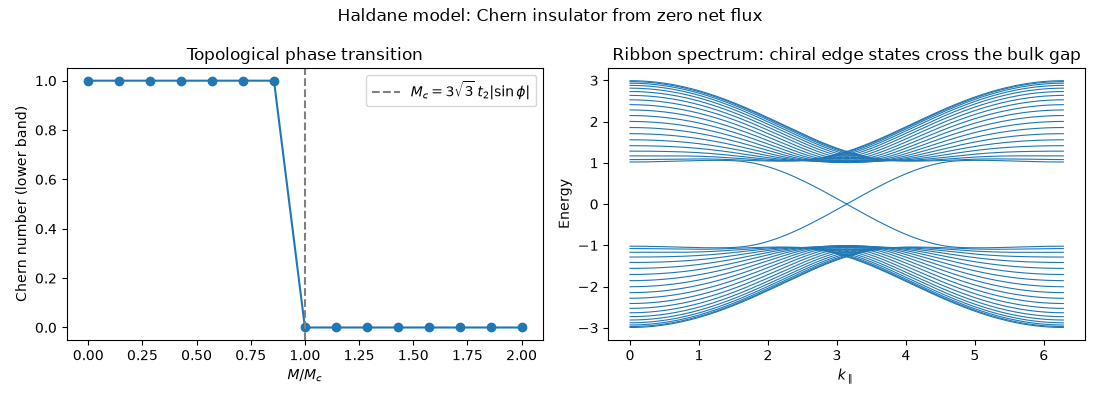
bulk gap (away from edge crossings): ~1.028
minimum |E| reached by an edge-crossing state: 0.0148
Check#
C = 1 below M_c = 3 sqrt(3) t2 |sin phi| and 0 above it; the edge bands of the C = 1 ribbon cross the bulk gap.
chern = np.array(chern)
assert np.all(chern[M_values < 0.95 * M_c] == 1)
assert np.all(chern[M_values > 1.05 * M_c] == 0)
assert min_over_k.min() < 0.05 < 0.5 < np.median(min_over_k[min_over_k > 0.5])
Total running time of the script: (0 minutes 0.293 seconds)