
Note
Go to the end to download the full example code.
The Hubbard Model: Mott Suppression of Itinerant Motion#
The Hubbard model is the minimal model of interacting electrons on a
lattice: band electrons that hop with amplitude \(t\), penalized by an
onsite Coulomb repulsion \(U\) whenever two opposite-spin electrons
share a site. As \(U/t \to \infty\) at half filling, double occupancy
is suppressed entirely and the itinerant metal is driven into a Mott
insulator of localized moments.
hubbard_1d_exact_diagonalization()
builds and diagonalizes the full Fock-space Hamiltonian in a fixed
\((n_\uparrow, n_\downarrow)\) sector for small clusters, exposing this
crossover directly in the ground-state energy.
import matplotlib.pyplot as plt
import numpy as np

from physicskit.condensed.correlated import hubbard_1d_exact_diagonalization
Exact diagonalization of a half-filled chain across U/t#
A 6-site chain at half filling (3 up, 3 down electrons), open boundary conditions, scanning the onsite repulsion from the noninteracting limit to the strongly correlated regime.
The itinerant-to-localized crossover#
At U=0 the ground state is a free-fermion Fermi sea, gaining a large
negative kinetic energy from delocalized hopping. As U/t grows, the
energy curve flattens: double occupancy is squeezed out and the
electrons freeze into singly occupied, localized moments – the
many-body signature of the Mott transition.
The charge gap: the direct diagnostic of a Mott insulator#
A flattening ground-state energy is suggestive, but the sharp, unambiguous signature of a Mott insulator is a nonzero charge gap: the energy cost to add or remove one electron from half filling, \(\Delta_c = E_0(N+1) + E_0(N-1) - 2E_0(N)\), evaluated by exact diagonalization in the neighboring particle-number sectors. In the thermodynamic limit a metal has \(\Delta_c=0\); a Mott insulator has \(\Delta_c>0\) growing with \(U\). This 6-site chain is far from that limit, so \(\Delta_c(U=0)\) is not actually zero – it is the ordinary finite-size level spacing of a free-fermion “particle in a box,” which only vanishes as the chain grows. What is still a genuine, interaction-driven effect at this size is how much further the gap opens as \(U\) turns on, well beyond that finite-size baseline – exactly the charge-transfer gap seen in real correlated insulators.
E_plus = [hubbard_1d_exact_diagonalization(n_sites, n_up=4, n_dn=3, t=1.0, U=U)["ground_state_energy"] for U in U_values]
E_minus = [hubbard_1d_exact_diagonalization(n_sites, n_up=2, n_dn=3, t=1.0, U=U)["ground_state_energy"] for U in U_values]
charge_gap = np.array(E_plus) + np.array(E_minus) - 2 * np.array(E0)

fig, axes = plt.subplots(1, 2, figsize=(11, 4))

axes[0].plot(U_values, E0, "o-")
axes[0].set_xlabel("U/t")
axes[0].set_ylabel(r"Ground-state energy $E_0$")
axes[0].set_title("Mott suppression: itinerant metal -> localized moments")

axes[1].plot(U_values, charge_gap, "o-", color="C1")
axes[1].axhline(charge_gap[0], color="gray", ls="--", lw=1, label=f"U=0 finite-size baseline ({charge_gap[0]:.2f})")
axes[1].set_xlabel("U/t")
axes[1].set_ylabel(r"charge gap $\Delta_c = E_0(N{+}1)+E_0(N{-}1)-2E_0(N)$")
axes[1].set_title("Charge gap grows well past its finite-size baseline")
axes[1].legend(fontsize=8)

fig.suptitle("The Hubbard model at half filling: energy flattens, charge gap opens")
fig.tight_layout()

slope_start = (E0[1] - E0[0]) / (U_values[1] - U_values[0])
slope_end = (E0[-1] - E0[-2]) / (U_values[-1] - U_values[-2])
print(f"dE0/dU near U=0: {slope_start:.4f}   dE0/dU near U=12: {slope_end:.4f} (flattening as U grows)")
ratio = charge_gap[-1] / charge_gap[0]
print(f"charge gap at U=0: {charge_gap[0]:.4f} (finite-size baseline, not a Mott gap)   at U=12: {charge_gap[-1]:.4f} ({ratio:.1f}x above baseline)")
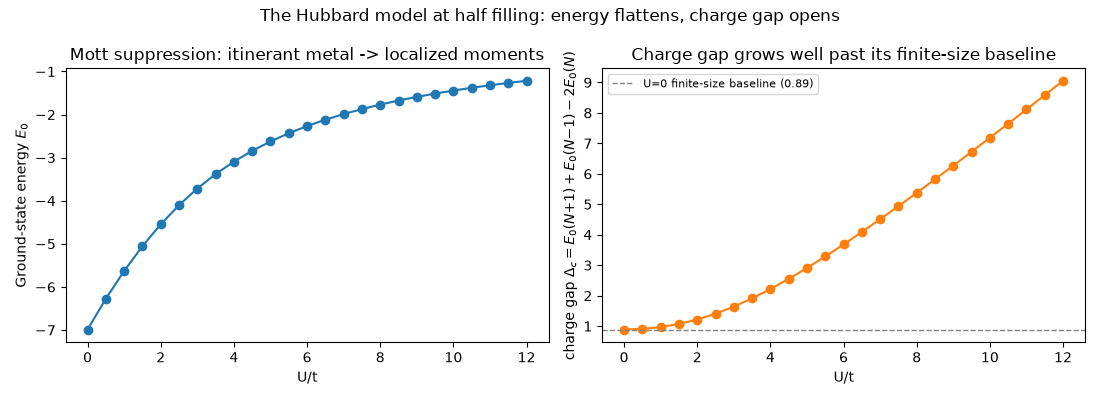
dE0/dU near U=0: 1.4294   dE0/dU near U=12: 0.1000 (flattening as U grows)
charge gap at U=0: 0.8901 (finite-size baseline, not a Mott gap)   at U=12: 9.0538 (10.2x above baseline)
Check#
E0 is concave in U (Hellmann-Feynman: dE0/dU = <double occupancy>, which falls as U grows), and the charge gap opens well past its U = 0 value.
Total running time of the script: (0 minutes 0.299 seconds)