
Note
Go to the end to download the full example code.
Grotthuss-Draper law: only absorbed light drives photochemistry#
The first law of photochemistry (Grotthuss 1817, Draper 1842) says that
light the sample does not absorb produces no chemical change. The
quantity that matters is therefore the absorbed photon flux,
\(I_{abs}=I_0(1-10^{-A})\), computed by
photons_absorbed(). Here two samples with
the same incident flux but different absorbances form product in
proportion to the light each one actually absorbs, not the light that
falls on it.
import matplotlib.pyplot as plt
import numpy as np

from chemistrykit.photochem import photons_absorbed

I0 = 1.0e-6  # incident photon flux, einstein/s
absorbance = np.linspace(0.0, 3.0, 200)
I_abs = photons_absorbed(I0, absorbance)
I_trans = I0 - I_abs

fig, ax = plt.subplots()
ax.plot(absorbance, I_abs / I0, label="absorbed (acts)")
ax.plot(absorbance, I_trans / I0, "--", label="transmitted (does nothing)")
ax.set_xlabel("Absorbance $A$ at the irradiation wavelength")
ax.set_ylabel(r"Fraction of incident flux $I_0$")
ax.set_title("Grotthuss-Draper: only the absorbed fraction is photochemically active")
ax.legend()
fig.tight_layout()
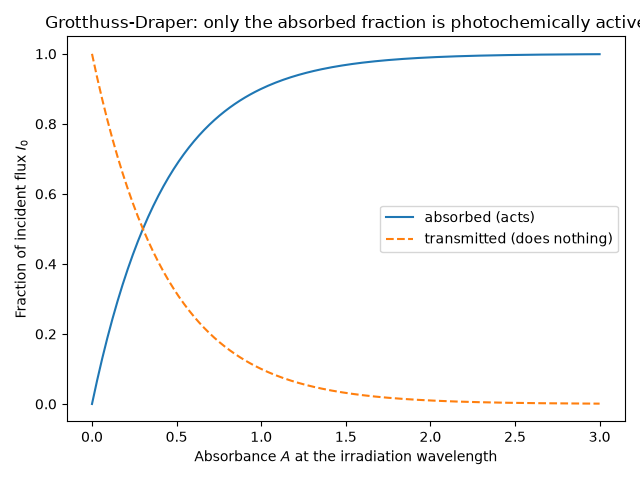
Same lamp, same exposure, same quantum yield: a weakly absorbing sample (A = 0.05) and a strongly absorbing one (A = 1.0). Product formed tracks the absorbed photons; a sample that absorbs nothing (A = 0) forms nothing, however bright the lamp.
A = 0.00: absorbed fraction = 0.000, product formed = 0.00e+00 mol
A = 0.05: absorbed fraction = 0.109, product formed = 3.26e-05 mol
A = 1.00: absorbed fraction = 0.900, product formed = 2.70e-04 mol
Total running time of the script: (0 minutes 0.044 seconds)