
Note
Go to the end to download the full example code.
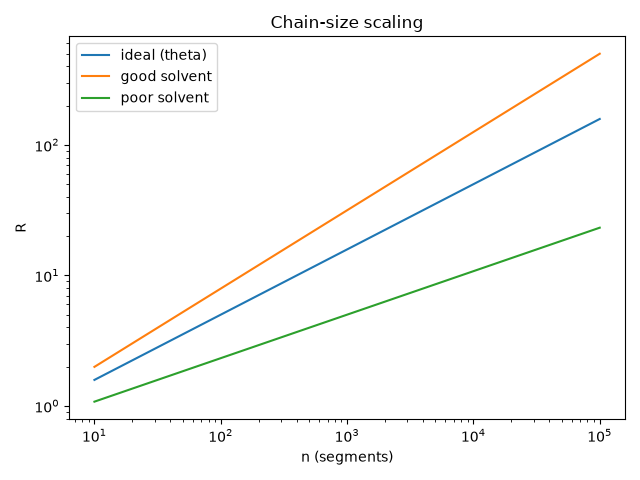
Flory’s solvent-quality exponents: ideal vs. real chain scaling#
Flory’s mean-field argument (Principles of Polymer Chemistry, 1953)
predicts how excluded volume changes a chain’s size scaling.
IdealChain gives
the exact random-walk result \(\langle R^2\rangle=nb^2\).
RealChain scales
instead as \(R\sim bn^\nu\), with the Flory exponent \(\nu\)
set by solvent quality: a good solvent swells the chain
(\(\nu\approx0.6\)), a poor solvent collapses it (\(\nu=1/3\)),
and the theta solvent reproduces the ideal chain exactly
(\(\nu=1/2\)).
import matplotlib.pyplot as plt
import numpy as np

from chemistrykit.polymer.systems.chain_statistics import IdealChain, RealChain, flory_exponent
from chemistrykit.polymer.visualizers.polymer_plots import plot_chain_scaling

b = 0.5  # segment length
n_values = np.logspace(1, 5, 30)

ideal = IdealChain()
theta = RealChain.theta_solvent()
good = RealChain.good_solvent()
poor = RealChain.poor_solvent()

print(f"Flory exponents: theta={flory_exponent('theta')}, good={flory_exponent('good'):.4f}, poor={flory_exponent('poor'):.4f}")
Flory exponents: theta=0.5, good=0.6000, poor=0.3333
The ideal chain’s <R^2> scales exactly linearly with n.
n1, n2 = 1000.0, 4000.0
ratio = ideal.mean_square_end_to_end(n2, b) / ideal.mean_square_end_to_end(n1, b)
print(f"\n<R^2>(4000) / <R^2>(1000) for the ideal chain: {ratio:.6f} (exactly 4.0)")

# theta-solvent RealChain reproduces the ideal chain's end-to-end distance exactly.
n_test = 5000.0
match = np.isclose(theta.end_to_end_distance(n_test, b), ideal.end_to_end_distance(n_test, b))
print(f"theta-solvent RealChain matches IdealChain exactly: {bool(match)}")
<R^2>(4000) / <R^2>(1000) for the ideal chain: 4.000000 (exactly 4.0)
theta-solvent RealChain matches IdealChain exactly: True
A good solvent swells the chain; a poor solvent collapses it, relative to the ideal chain of the same length.
At n=10000, b=0.5:
  ideal chain R = 50.00
  good-solvent R = 125.59  (swollen)
  poor-solvent R = 10.77  (collapsed)
Total running time of the script: (0 minutes 0.067 seconds)