Note
Go to the end to download the full example code.
Lewis’s shared electron pair: choosing between Lewis structures by formal charge#
G. N. Lewis (1916) described a covalent bond as a pair of electrons shared by two atoms, and each atom as seeking an octet of eight valence electrons. Often several octet-satisfying structures can be drawn for one molecule. Formal charge ranks them: split every bonding pair evenly, count the electrons each atom then owns, and compare with the free atom,
The preferred structure keeps formal charges small and puts any negative
charge on the more electronegative atom. This example builds competing
Lewis structures of \(\mathrm{CO_2}\), \(\mathrm{N_2O}\) and the
cyanate ion \(\mathrm{OCN^-}\) with
LewisStructure, checks each
atom’s octet, and compares their formal charges.
import matplotlib.pyplot as plt

from chemistrykit.periodic_table import electronegativity
from chemistrykit.structure.systems.lewis import LewisStructure

candidates = {
    "CO2": {
        "O=C=O": LewisStructure(["O", "C", "O"], {(0, 1): 2, (1, 2): 2}, {0: 2, 2: 2}),
        "O#C-O": LewisStructure(["O", "C", "O"], {(0, 1): 3, (1, 2): 1}, {0: 1, 2: 3}),
    },
    "N2O": {
        "N=N=O": LewisStructure(["N", "N", "O"], {(0, 1): 2, (1, 2): 2}, {0: 2, 2: 2}),
        "N#N-O": LewisStructure(["N", "N", "O"], {(0, 1): 3, (1, 2): 1}, {0: 1, 2: 3}),
        "N-N#O": LewisStructure(["N", "N", "O"], {(0, 1): 1, (1, 2): 3}, {0: 3, 2: 1}),
    },
    "OCN-": {
        "O=C=N": LewisStructure(["O", "C", "N"], {(0, 1): 2, (1, 2): 2}, {0: 2, 2: 2}),
        "O-C#N": LewisStructure(["O", "C", "N"], {(0, 1): 1, (1, 2): 3}, {0: 3, 2: 1}),
        "O#C-N": LewisStructure(["O", "C", "N"], {(0, 1): 3, (1, 2): 1}, {0: 1, 2: 3}),
    },
}


def octet_count(structure, atom):
    """Electrons around an atom in Lewis's picture: lone-pair electrons plus every shared pair."""
    shared = sum(2 * order for pair, order in structure.bond_orders.items() if atom in pair)
    return 2 * structure.lone_pairs.get(atom, 0) + shared


for molecule, structures in candidates.items():
    print(molecule)
    for label, s in structures.items():
        assert all(octet_count(s, a) == 8 for a in range(3)), label
        fc = s.formal_charges()
        print(f"  {label:6s} octets OK, formal charges {[f'{fc[a]:+.0f}' for a in range(3)]}, total {s.total_formal_charge():+.0f}")
CO2
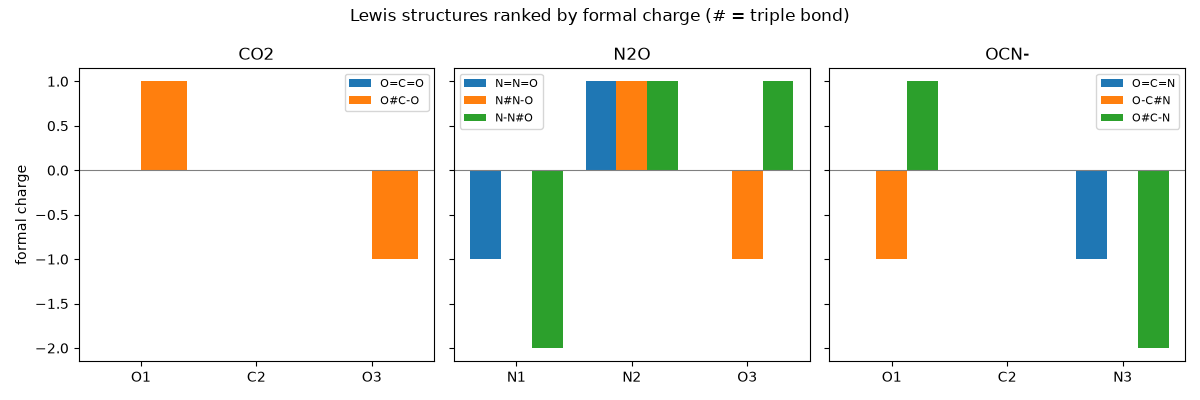
  O=C=O  octets OK, formal charges ['+0', '+0', '+0'], total +0
  O#C-O  octets OK, formal charges ['+1', '+0', '-1'], total +0
N2O
  N=N=O  octets OK, formal charges ['-1', '+1', '+0'], total +0
  N#N-O  octets OK, formal charges ['+0', '+1', '-1'], total +0
  N-N#O  octets OK, formal charges ['-2', '+1', '+1'], total +0
OCN-
  O=C=N  octets OK, formal charges ['+0', '+0', '-1'], total -1
  O-C#N  octets OK, formal charges ['-1', '+0', '+0'], total -1
  O#C-N  octets OK, formal charges ['+1', '+0', '-2'], total -1
Every candidate’s formal charges sum to the species’ net charge (0 for CO2 and N2O, -1 for cyanate), the standard consistency check. The preferred structure has the smallest total of absolute formal charges. Ties are broken by putting negative formal charge on the more electronegative atom (the smaller sum of FC times electronegativity). For cyanate, O=C=N and O-C#N tie on the first rule, and O-C#N wins because its -1 sits on oxygen:
def score(structure):
    fc = structure.formal_charges()
    return (sum(abs(v) for v in fc.values()), sum(fc[a] * electronegativity(sym) for a, sym in enumerate(structure.symbols)))


for molecule, structures in candidates.items():
    best = min(structures, key=lambda label: score(structures[label]))
    print(f"{molecule}: preferred Lewis structure {best}  (sum |FC| = {score(structures[best])[0]:.0f})")
assert min(candidates["OCN-"], key=lambda label: score(candidates["OCN-"][label])) == "O-C#N"
CO2: preferred Lewis structure O=C=O  (sum |FC| = 0)
N2O: preferred Lewis structure N#N-O  (sum |FC| = 2)
OCN-: preferred Lewis structure O-C#N  (sum |FC| = 1)
Formal charge on each atom for every candidate structure:
fig, axes = plt.subplots(1, 3, figsize=(12, 4), sharey=True)
for ax, (molecule, structures) in zip(axes, candidates.items(), strict=True):
    width = 0.8 / len(structures)
    for k, (label, s) in enumerate(structures.items()):
        fc = s.formal_charges()
        ax.bar([a + (k - (len(structures) - 1) / 2) * width for a in range(3)], [fc[a] for a in range(3)], width=width, label=label)
    ax.set_xticks(range(3), [f"{sym}{a + 1}" for a, sym in enumerate(next(iter(structures.values())).symbols)])
    ax.axhline(0.0, color="gray", linewidth=0.8)
    ax.set_title(molecule)
    ax.legend(fontsize=8)
axes[0].set_ylabel("formal charge")
fig.suptitle("Lewis structures ranked by formal charge (# = triple bond)")
fig.tight_layout()
plt.show()
Total running time of the script: (0 minutes 0.070 seconds)