Note
Go to the end to download the full example code.
Kossel’s ionic bond: oxidation states as the fully ionic limit#
Walther Kossel (1916) described bonding as the complete transfer of electrons from one atom to another, leaving ions with noble-gas configurations held together by electrostatic attraction. Oxidation states are the bookkeeping version of that picture: give every bonding pair entirely to the more electronegative atom (sharing only between identical atoms) and compare the electron count with the free atom.
For a salt such as NaCl or MgO this recovers the real ionic charges. For
covalent molecules it gives the charges the atoms would carry if the
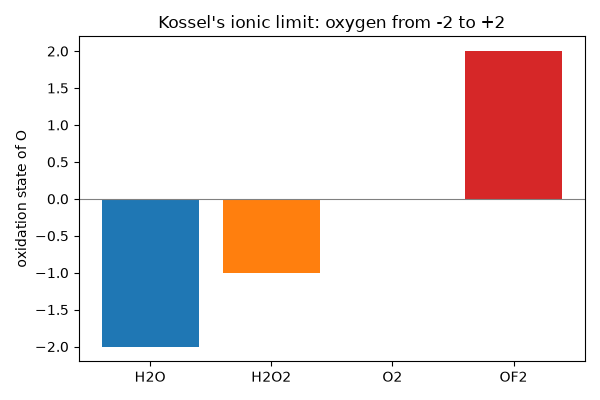
bonds were fully ionic. The example below follows oxygen through
\(\mathrm{H_2O}\), \(\mathrm{H_2O_2}\), \(\mathrm{O_2}\) and
\(\mathrm{OF_2}\), where it ranges from -2 to +2 depending on which
partner is more electronegative, using
oxidation_states().
import matplotlib.pyplot as plt

from chemistrykit.structure.systems.lewis import LewisStructure

ionic = {
    "NaCl": LewisStructure(["Na", "Cl"], {(0, 1): 1}, {1: 3}),
    "KF": LewisStructure(["K", "F"], {(0, 1): 1}, {1: 3}),
    "MgO": LewisStructure(["Mg", "O"], {(0, 1): 2}, {1: 2}),
    "CaO": LewisStructure(["Ca", "O"], {(0, 1): 2}, {1: 2}),
}
print("Salts: the ionic limit gives each ion's real charge")
for name, s in ionic.items():
    ox = s.oxidation_states()
    print(f"  {name:5s}: " + ", ".join(f"{sym} {ox[i]:+.0f}" for i, sym in enumerate(s.symbols)))
assert ionic["NaCl"].oxidation_states() == {0: 1.0, 1: -1.0}
assert ionic["MgO"].oxidation_states() == {0: 2.0, 1: -2.0}
Salts: the ionic limit gives each ion's real charge
  NaCl : Na +1, Cl -1
  KF   : K +1, F -1
  MgO  : Mg +2, O -2
  CaO  : Ca +2, O -2
Oxygen’s oxidation state in four molecules. Bonds to hydrogen give the electrons to oxygen, an O-O bond splits them evenly, and bonds to fluorine (the only element more electronegative than oxygen) give them away:
oxygen_compounds = {
    "H2O": (LewisStructure(["O", "H", "H"], {(0, 1): 1, (0, 2): 1}, {0: 2}), 0),
    "H2O2": (LewisStructure(["H", "O", "O", "H"], {(0, 1): 1, (1, 2): 1, (2, 3): 1}, {1: 2, 2: 2}), 1),
    "O2": (LewisStructure(["O", "O"], {(0, 1): 2}, {0: 2, 1: 2}), 0),
    "OF2": (LewisStructure(["O", "F", "F"], {(0, 1): 1, (0, 2): 1}, {0: 2, 1: 3, 2: 3}), 0),
}
oxygen_state = {}
for name, (s, o_index) in oxygen_compounds.items():
    oxygen_state[name] = s.oxidation_states()[o_index]
    print(f"{name:5s}: O oxidation state {oxygen_state[name]:+.0f}, formal charge on O {s.formal_charges()[o_index]:+.0f}")
assert [oxygen_state[k] for k in oxygen_compounds] == [-2.0, -1.0, 0.0, 2.0]
H2O  : O oxidation state -2, formal charge on O +0
H2O2 : O oxidation state -1, formal charge on O +0
O2   : O oxidation state +0, formal charge on O +0
OF2  : O oxidation state +2, formal charge on O +0
The formal charge on oxygen is zero in all four, because formal charge is Lewis’s even-sharing limit; the oxidation state is Kossel’s ionic limit, and only it follows the partner’s electronegativity.
fig, ax = plt.subplots(figsize=(6, 4))
names = list(oxygen_state)
ax.bar(names, [oxygen_state[n] for n in names], color=["C0", "C1", "C2", "C3"])
ax.axhline(0.0, color="gray", linewidth=0.8)
ax.set_ylabel("oxidation state of O")
ax.set_title("Kossel's ionic limit: oxygen from -2 to +2")
fig.tight_layout()
plt.show()
Total running time of the script: (0 minutes 0.030 seconds)