
Breakthroughs in Fluid Engineering#
These landmarks trace a conceptual development from a physical law to a useful engineering model. The order is a learning path, not a dated chronology or a claim that any idea had a single inventor. SI units apply unless documented otherwise.
Bernoulli: pressure, speed and height exchange energy#
An ideal streamline energy balance explains pressure changes in nozzles and elevation changes. Continuity supplies the corresponding velocity relation.
Use engineeringkit.fluid_engineering.bernoulli_pressure to explore the model.
Steady incompressible inviscid flow along a streamline is assumed; pumps and losses need extra terms.
Poiseuille: viscosity changes the answer#
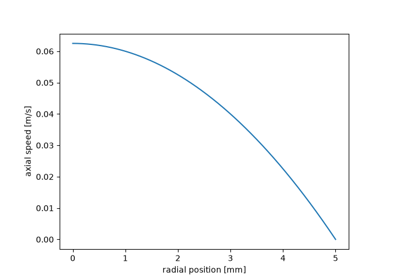
Viscous shear produces a parabolic velocity profile in a fully developed circular pipe. The fourth power of radius explains the sensitivity of flow to bore size.
Use engineeringkit.fluid_engineering.poiseuille_flow to explore the model.
Newtonian laminar flow with no slip is assumed; entrance effects and turbulence are excluded.
Reynolds and pipe correlations: similarity meets experiment#
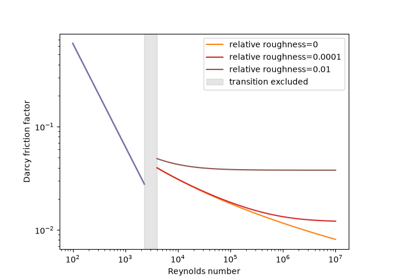
Reynolds number compares inertial and viscous effects. Darcy loss and roughness correlations extend pipe calculations beyond the laminar solution.
Use engineeringkit.fluid_engineering.colebrook_friction_factor to explore the model.
Use Darcy rather than Fanning friction factors. Transition flow is not reliably captured by a turbulent correlation.
Explore and verify#
Fluid engineering: flow regimes and signed quantities records units, conventions and independent checks. Compare the gallery output against the equations before extending a model.
Further reading#
University or agency teaching reference provides background beyond the implemented subset. The equations and examples here are concise original explanations, not reproductions of that reference.