
Note
Go to the end to download the full example code or to run this example in your browser via JupyterLite.
Colebrook’s turbulent friction factor (1939)#
Commercial pipes do not behave like Nikuradse’s sand: their roughness is uneven, and friction leaves the smooth law gradually rather than with Nikuradse’s dip. Cyril Colebrook, after experiments with Cedric White on pipes coated with mixed grains, added the smooth and rough laws inside one logarithm in 1939,
(colebrook_friction_factor()). The
equation is implicit in \(f\). This example solves it by the
fixed-point iteration engineers used by hand and compares it with the two
limits it joins.
import matplotlib.pyplot as plt
import numpy as np

from engineeringkit.fluid_engineering import (
    colebrook_friction_factor,
    nikuradse_friction_factor,
    smooth_pipe_friction_factor,
)
Fixed-point iteration#
With \(x = 1/\sqrt f\) the equation reads \(x = -2\log_{10}(\varepsilon/3.7D + 2.51x/Re)\). The right side changes slowly with \(x\), so substitution converges in a few steps.
Re, rel = 2e5, 1e-3
x = [3.0]
for _ in range(8):
    x.append(-2 * np.log10(rel / 3.7 + 2.51 * x[-1] / Re))
f_iter = 1 / np.array(x) ** 2
f_ref = colebrook_friction_factor(Re, rel)
for k, fk in enumerate(f_iter[:5]):
    print(f"step {k}: f = {fk:.6f}")
print(f"bracketed root: f = {f_ref:.6f}")

fig, (ax1, ax2) = plt.subplots(1, 2, figsize=(9, 3.8))
ax1.semilogy(np.abs(f_iter - f_ref) + 1e-17, marker="o")
ax1.set(xlabel="iteration", ylabel="|f - f*|", title="Substitution converges fast")
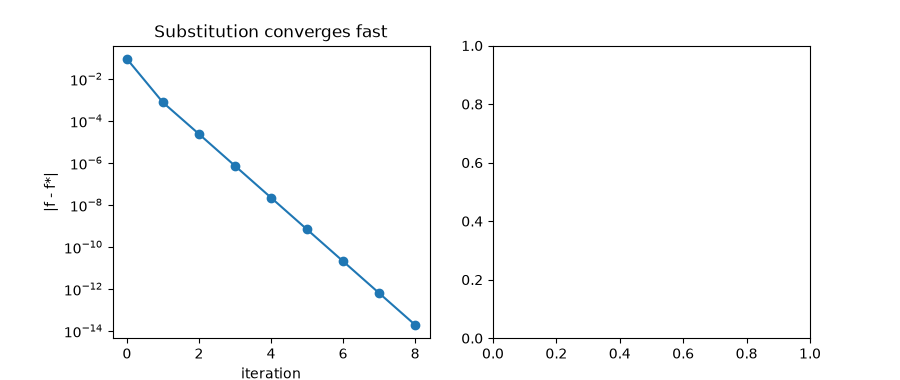
step 0: f = 0.111111
step 1: f = 0.020274
step 2: f = 0.021057
step 3: f = 0.021033
step 4: f = 0.021034
bracketed root: f = 0.021034

[Text(0.5, 12.633333333333331, 'iteration'), Text(58.222222222222214, 0.5, '|f - f*|'), Text(0.5, 1.0, 'Substitution converges fast')]
A smooth bridge between two laws#
Colebrook’s curve sits above both the smooth and the fully rough laws and approaches each at its end of the range. The largest excess is in the transition, where both mechanisms count.
Re_range = np.geomspace(4e3, 1e8, 200)
cb = colebrook_friction_factor(Re_range, rel)
smooth = smooth_pipe_friction_factor(Re_range)
rough = nikuradse_friction_factor(rel)
ax2.loglog(Re_range, cb, label="Colebrook, ε/D = 0.001")
ax2.loglog(Re_range, smooth, "k--", label="smooth")
ax2.axhline(rough, color="k", ls=":", label="fully rough")
ax2.set(xlabel="Reynolds number", ylabel="friction factor", title="Colebrook joins the limits")
ax2.legend(fontsize="small")
fig.tight_layout()

excess = cb / np.maximum(smooth, rough) - 1
print(f"largest excess over the larger limit: {excess.max():.0%} at Re = {Re_range[excess.argmax()]:.1e}")

assert abs(f_iter[-1] - f_ref) < 1e-10 * f_ref
assert np.all(cb >= np.maximum(smooth, rough) * (1 - 2e-3))
assert abs(cb[0] / smooth[0] - 1) < 0.12 and abs(cb[-1] / rough - 1) < 0.01

plt.show()
largest excess over the larger limit: 18% at Re = 6.6e+04
Total running time of the script: (0 minutes 0.080 seconds)
