
Note
Go to the end to download the full example code or to run this example in your browser via JupyterLite.
Nikuradse’s sand-roughened pipes (1933)#
Johann Nikuradse, in Prandtl’s laboratory at Göttingen, glued graded sand
to the inside of brass pipes and measured friction over six roughnesses,
from a radius 15 to 507 times the grain size, published in 1933. The
curves share the smooth-pipe law at low Reynolds number
(smooth_pipe_friction_factor()),
leave it once the grains poke through the viscous sublayer, and settle on a
constant that depends only on the roughness,
\(1/\sqrt f = 1.74 + 2\log_{10}(R/k_s)\)
(nikuradse_friction_factor()). This
example draws the two limits and finds where each roughness becomes fully
rough.
import matplotlib.pyplot as plt
import numpy as np

from engineeringkit.fluid_engineering import nikuradse_friction_factor, smooth_pipe_friction_factor
Smooth and fully rough limits#
Nikuradse’s radius-to-grain ratios \(R/k_s\) were 15, 30.6, 60, 126, 252 and 507, so \(k_s/D = 1/(2R/k_s)\).
ratios = np.array([15, 30.6, 60, 126, 252, 507])
rough = nikuradse_friction_factor(1 / (2 * ratios))
Re = np.geomspace(4e3, 1e7, 200)
smooth = smooth_pipe_friction_factor(Re)

fig, ax = plt.subplots(figsize=(6.5, 4.2))
ax.loglog(Re, smooth, "k", label="smooth (Prandtl-Kármán)")
for ratio, f_r in zip(ratios, rough):
    # Fully rough once the roughness Reynolds number Re (k/D) sqrt(f/8) exceeds 70.
    Re_rough = 70 / ((1 / (2 * ratio)) * np.sqrt(f_r / 8))
    ax.loglog([Re_rough, 1e7], [f_r, f_r], label=f"R/k = {ratio:g}")
    ax.plot(Re_rough, f_r, "o", color=ax.lines[-1].get_color())
    print(f"R/k = {ratio:5g}: f = {f_r:.4f}, fully rough above Re = {Re_rough:.2e}")
ax.set(xlabel="Reynolds number", ylabel="friction factor", title="Nikuradse's limits")
ax.legend(fontsize="small")
fig.tight_layout()
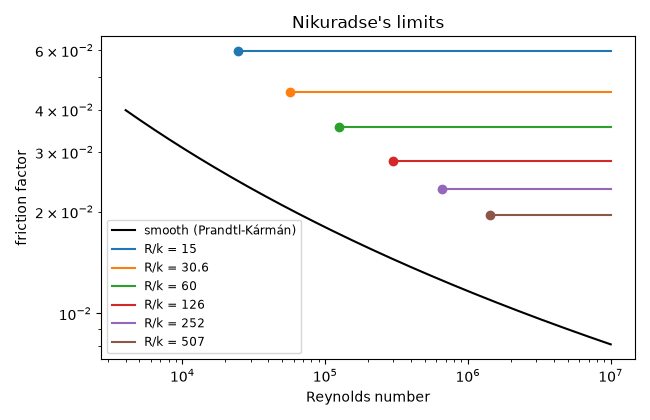
R/k =    15: f = 0.0597, fully rough above Re = 2.43e+04
R/k =  30.6: f = 0.0450, fully rough above Re = 5.71e+04
R/k =    60: f = 0.0356, fully rough above Re = 1.26e+05
R/k =   126: f = 0.0283, fully rough above Re = 2.96e+05
R/k =   252: f = 0.0234, fully rough above Re = 6.53e+05
R/k =   507: f = 0.0196, fully rough above Re = 1.44e+06
The rough limit does not depend on the Reynolds number at all; a pipe twice as rough relative to its size has about a third more friction. The smooth law falls without limit as the Reynolds number grows, so a pipe of any roughness eventually becomes rough.
crossing = Re[np.argmax(smooth < rough[-1])]
print(f"the smoothest pipe's rough limit meets the smooth law near Re = {crossing:.1e}")
assert np.all(np.diff(rough) < 0)
assert np.all(np.diff(smooth) < 0)
assert np.isclose(1 / np.sqrt(rough[0]), 1.74 + 2 * np.log10(15))

plt.show()
the smoothest pipe's rough limit meets the smooth law near Re = 6.8e+04
Total running time of the script: (0 minutes 0.071 seconds)
