
Breakthroughs in Reliability#
These landmarks trace a conceptual development from a physical law to a useful engineering model. The order is a learning path, not a dated chronology or a claim that any idea had a single inventor. SI units apply unless documented otherwise.
Survival analysis: failures become distributions#
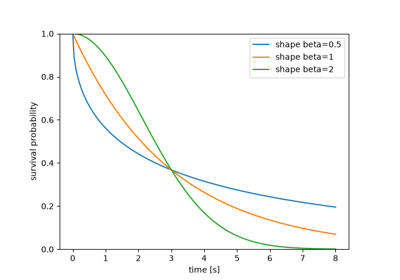
Reliability is the probability of surviving beyond a time. A constant hazard gives the exponential model, while Weibull shape permits increasing or decreasing hazard.
Use engineeringkit.reliability.weibull_reliability to explore the model.
Time and scale must share units; fitting a distribution and checking censoring are outside these algebraic helpers.
Redundancy: system architecture changes survival#
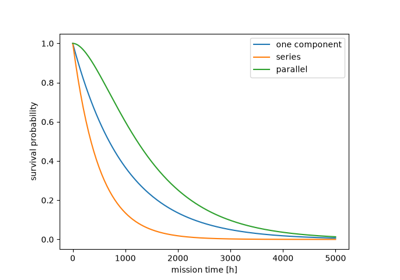
Series systems require every component to survive; parallel systems need at least one. Their simple product expressions make independence a critical modeling assumption.
Use engineeringkit.reliability.parallel_reliability to explore the model.
Common-cause failures violate independence and can sharply reduce the benefit of redundancy.
Repair: availability answers a different question#
A repairable system can fail repeatedly yet be available for most of its lifetime. Steady availability combines mean operating time and mean repair time.
Use engineeringkit.reliability.availability to explore the model.
This long-run alternating-renewal ratio is distinct from the probability of no failure during a mission.
Explore and verify#
Reliability: distributions, independence and rate units records units, conventions and independent checks. Compare the gallery output against the equations before extending a model.
Further reading#
University or agency teaching reference provides background beyond the implemented subset. The equations and examples here are concise original explanations, not reproductions of that reference.