
Note
Go to the end to download the full example code or to run this example in your browser via JupyterLite.
Esary and Proschan’s path and cut bounds (1963)#
Most block diagrams are neither series nor parallel; the classic example is
the bridge. James Esary and Frank Proschan (1963) described any coherent
system by its minimal path sets, the smallest groups of components whose
working keeps it working (minimal_path_sets()),
and its minimal cut sets, the smallest groups whose failure stops it
(minimal_cut_sets()). The system is a
parallel arrangement of its paths, or a series arrangement of its cuts.
Treating the paths or the cuts as independent gives bounds on the exact
reliability (esary_proschan_bounds(),
network_reliability()), and the cut
bound is very close for reliable components.
import matplotlib.pyplot as plt
import numpy as np

from engineeringkit.reliability import (
    esary_proschan_bounds,
    minimal_cut_sets,
    minimal_path_sets,
    network_reliability,
    parallel_reliability,
    series_reliability,
)
The bridge network#
Five components join source s to sink t; C bridges the two branches.
bridge = {"A": ("s", 1), "B": ("s", 2), "C": (1, 2), "D": (1, "t"), "E": (2, "t")}
paths, cuts = minimal_path_sets(bridge, "s", "t"), minimal_cut_sets(bridge, "s", "t")
print("minimal path sets:", paths)
print("minimal cut sets: ", cuts)
minimal path sets: [('A', 'D'), ('B', 'E'), ('A', 'C', 'E'), ('B', 'C', 'D')]
minimal cut sets:  [('A', 'B'), ('D', 'E'), ('A', 'C', 'E'), ('B', 'C', 'D')]
Exact reliability and the two bounds#
With identical components the exact result is \(2p^2 + 2p^3 - 5p^4 + 2p^5\). Removing C leaves two series pairs in parallel; shorting it leaves two parallel pairs in series. The bridge lies between the two.
p = np.linspace(0.01, 0.99, 99)
exact = np.array([network_reliability(bridge, dict.fromkeys(bridge, q), "s", "t") for q in p])
bounds = np.array([esary_proschan_bounds(bridge, dict.fromkeys(bridge, q), "s", "t") for q in p])
without_c = np.array([parallel_reliability(series_reliability(q, q), series_reliability(q, q)) for q in p])
shorted_c = np.array([series_reliability(parallel_reliability(q, q), parallel_reliability(q, q)) for q in p])

fig, axes = plt.subplots(1, 2, figsize=(9, 3.6))
axes[0].plot(p, exact, "k", label="exact")
axes[0].plot(p, bounds[:, 0], "--", label="cut-set lower bound")
axes[0].plot(p, bounds[:, 1], ":", label="path-set upper bound")
axes[0].set(xlabel="component reliability", ylabel="system reliability", title="Bridge network")
axes[0].legend(fontsize=8)
axes[1].semilogy(p, exact - bounds[:, 0] + 1e-18, label="exact - lower")
axes[1].semilogy(p, bounds[:, 1] - exact + 1e-18, label="upper - exact")
axes[1].set(xlabel="component reliability", ylabel="error of the bound", ylim=(1e-8, 1))
axes[1].legend(fontsize=8)
fig.tight_layout()

i = np.argmin(np.abs(p - 0.95))
print(f"p = 0.95: exact {exact[i]:.6f}, bounds [{bounds[i, 0]:.6f}, {bounds[i, 1]:.6f}]")

assert len(paths) == 4 and len(cuts) == 4
assert np.allclose(exact, 2 * p**2 + 2 * p**3 - 5 * p**4 + 2 * p**5)
assert np.all(bounds[:, 0] <= exact + 1e-12) and np.all(exact <= bounds[:, 1] + 1e-12)
assert np.all(without_c <= exact + 1e-12) and np.all(exact <= shorted_c + 1e-12)
assert exact[i] - bounds[i, 0] < 1e-4

plt.show()
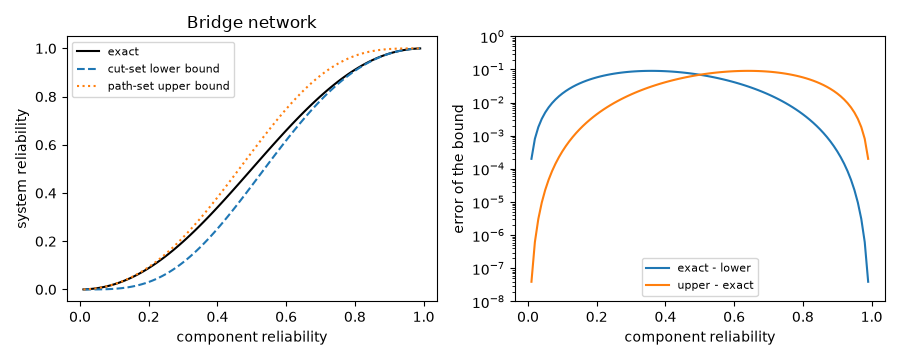
p = 0.95: exact 0.994781, bounds [0.994758, 0.999807]
Total running time of the script: (0 minutes 0.257 seconds)
