
Breakthroughs in Electrical Engineering#
These landmarks trace a conceptual development from a physical law to a useful engineering model. The order is a learning path, not a dated chronology or a claim that any idea had a single inventor. SI units apply unless documented otherwise.
Ohm and Kirchhoff: networks become solvable#
Component laws combined with current and voltage conservation make resistor networks quantitative. Equivalent sources simplify a network as seen from two terminals.
Use engineeringkit.electrical_engineering.ohms_law to explore the model.
A linear resistance and the stated passive-network assumptions are required.
Energy storage: circuits acquire memory#
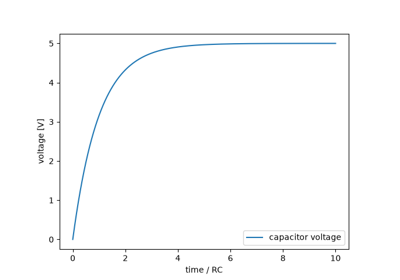
A capacitor stores charge, so its voltage cannot be determined by an instantaneous resistance law alone. The RC time constant sets the transient scale.
Use engineeringkit.electrical_engineering.rc_charging_voltage to explore the model.
Ideal constant components and a constant applied source are assumed.
Phasors: differential equations become impedance algebra#
Complex impedance encodes both amplitude and phase in sinusoidal steady state. Inductive and capacitive reactances cancel at series resonance.
Use engineeringkit.electrical_engineering.series_rlc_impedance to explore the model.
Phasors describe steady sinusoidal operation, not startup transients or nonlinear switching.
Explore and verify#
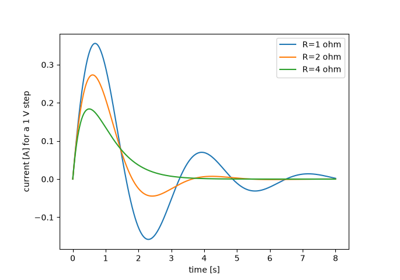
Electrical engineering: passive components and circuit responses records units, conventions and independent checks. Compare the gallery output against the equations before extending a model.
Further reading#
University or agency teaching reference provides background beyond the implemented subset. The equations and examples here are concise original explanations, not reproductions of that reference.