
Note
Go to the end to download the full example code or to run this example in your browser via JupyterLite.
Steinmetz’s induction motor equivalent circuit (1897)#
Tesla’s induction motor had no electrical connection to its rotor, which
made it hard to calculate. Charles Proteus Steinmetz treated it as a
transformer whose secondary is shorted through a resistance
\(R_2/s\) that depends on the slip \(s\) between the rotating
field and the rotor. The power absorbed by \(R_2/s\) is the air-gap
power, and the torque follows from it
(induction_motor_torque()).
The torque peaks at the breakdown slip, where \(R_2/s\) matches the
impedance in front of it
(induction_motor_breakdown()),
and the peak itself does not depend on the rotor resistance. This example
draws the torque-speed curve of a four-pole, 50 Hz motor, checks the
breakdown point and shows why wound-rotor motors add resistance to start.
import matplotlib.pyplot as plt
import numpy as np

from engineeringkit.electrical_engineering import induction_motor_breakdown, induction_motor_torque
The torque-speed curve#
A 400 V (231 V per phase), four-pole, 50 Hz motor: synchronous speed 1500 rpm.
v_phase, poles, f = 400 / np.sqrt(3), 4, 50.0
ws = 2 * np.pi * f / (poles / 2)
r1, x1, r2, x2, xm = 0.3, 0.6, 0.25, 0.6, 20.0
slip = np.linspace(1e-4, 1, 2000)
speed_rpm = (1 - slip) * ws * 60 / (2 * np.pi)
torque = induction_motor_torque(v_phase, slip, ws, r1, x1, r2, x2, xm)
s_max, t_max = induction_motor_breakdown(v_phase, ws, r1, x1, r2, x2, xm)
t_start = induction_motor_torque(v_phase, 1.0, ws, r1, x1, r2, x2, xm)
print(f"breakdown torque {t_max:.0f} N m at slip {s_max:.3f}; starting torque {t_start:.0f} N m")
assert np.isclose(t_max, torque.max(), rtol=1e-4)
breakdown torque 319 N m at slip 0.205; starting torque 142 N m
Rated operation#
At small slip the torque is nearly proportional to slip, so the speed droops only a few percent under load.
s_rated = 0.03
t_rated = induction_motor_torque(v_phase, s_rated, ws, r1, x1, r2, x2, xm)
p_out = t_rated * (1 - s_rated) * ws
print(f"at 3% slip: {t_rated:.0f} N m, {p_out / 1e3:.1f} kW mechanical (air-gap power minus rotor copper loss)")
assert np.isclose(p_out, t_rated * ws - s_rated * t_rated * ws)
at 3% slip: 106 N m, 16.1 kW mechanical (air-gap power minus rotor copper loss)
Starting with extra rotor resistance#
Choosing \(R_2\) so that the breakdown slip is 1 puts the peak torque at standstill.
r2_start = r2 / s_max
s_start, t_start_max = induction_motor_breakdown(v_phase, ws, r1, x1, r2_start, x2, xm)
print(f"rotor resistance {r2_start:.2f} ohm: breakdown at slip {s_start:.3f} with the same {t_start_max:.0f} N m")
assert np.isclose(s_start, 1) and np.isclose(t_start_max, t_max)

fig, ax = plt.subplots(figsize=(7, 3.8))
ax.plot(speed_rpm, torque, label=f"R2 = {r2} ohm")
ax.plot(speed_rpm, induction_motor_torque(v_phase, slip, ws, r1, x1, r2_start, x2, xm), label=f"R2 = {r2_start:.2f} ohm")
ax.plot((1 - s_max) * ws * 60 / (2 * np.pi), t_max, "ko")
ax.set(xlabel="speed [rpm]", ylabel="torque [N m]", title="Induction motor torque-speed curve")
ax.legend(fontsize="small")
fig.tight_layout()

plt.show()
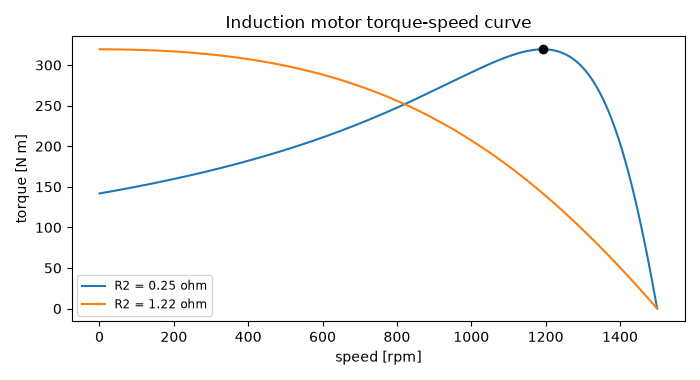
rotor resistance 1.22 ohm: breakdown at slip 1.000 with the same 319 N m
Total running time of the script: (0 minutes 0.071 seconds)
