
Breakthroughs in Heat Transfer#
These landmarks trace a conceptual development from a physical law to a useful engineering model. The order is a learning path, not a dated chronology or a claim that any idea had a single inventor. SI units apply unless documented otherwise.
Fourier: heat follows a temperature gradient#
A constitutive law for conduction makes thermal resistance networks possible. Geometry changes the resistance expression even when material conductivity is constant.
Use engineeringkit.heat_transfer.plane_wall_resistance to explore the model.
One-dimensional steady conduction and constant conductivity are assumed.
Transient models: internal gradients matter#
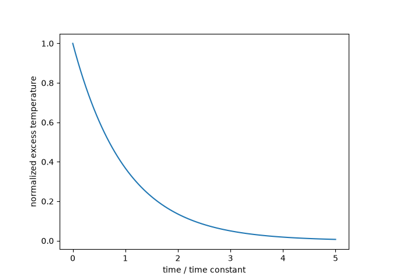
A lumped energy balance predicts exponential cooling when the body is nearly isothermal. The Biot number indicates whether internal conduction can support that approximation.
Use engineeringkit.heat_transfer.lumped_temperature to explore the model.
Check the Biot number and characteristic length; a small value supports, but does not replace, modeling judgment.
Radiation and exchangers: different mechanisms need different models#
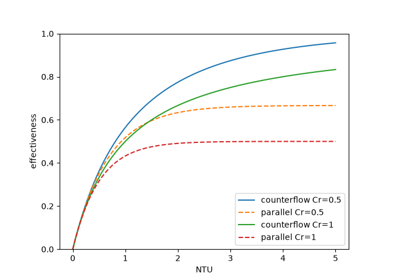
Stefan-Boltzmann radiation depends on absolute temperature to the fourth power. Heat-exchanger effectiveness relates finite stream capacities to the maximum possible heat transfer.
Use engineeringkit.heat_transfer.radiation_heat_rate to explore the model.
The radiation helper assumes a surface exchanging with a large surrounding enclosure; exchanger formulas assume their specified flow arrangement.
Explore and verify#
Heat transfer: absolute temperatures and resistance accounting records units, conventions and independent checks. Compare the gallery output against the equations before extending a model.
Further reading#
University or agency teaching reference provides background beyond the implemented subset. The equations and examples here are concise original explanations, not reproductions of that reference.