
Breakthroughs in Mechanical Engineering#
These landmarks trace a conceptual development from a physical law to a useful engineering model. The order is a learning path, not a dated chronology or a claim that any idea had a single inventor. SI units apply unless documented otherwise.
Newton: forces predict motion#
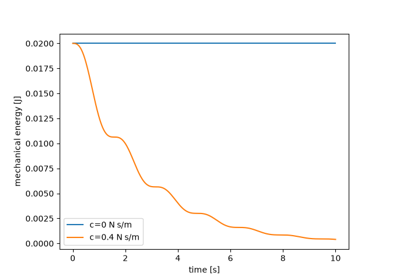
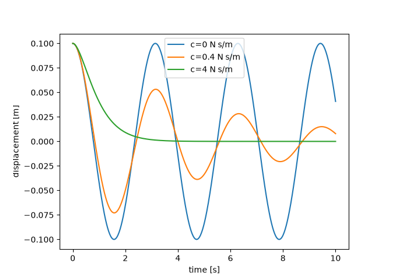
An equation of motion turns a free-body diagram into an initial-value problem. Mass, stiffness and damping distinguish inertia, stored energy and dissipation.
Use engineeringkit.mechanical_engineering.simulate_sdof to explore the model.
The single-degree-of-freedom model omits spatial modes and nonlinear contact.
Vibration theory: resonance becomes predictable#
Natural frequency and damping ratio provide a common description of mechanical oscillators. Frequency ratios explain why an isolator can amplify motion near resonance.
Use engineeringkit.mechanical_engineering.transmissibility to explore the model.
Steady harmonic response assumes a linear oscillator; the undamped resonance is singular.
Machine elements: motion and power are coupled#
Gear geometry links speed reduction to torque increase. Efficiency accounts for power losses without changing the tooth-count kinematics.
Use engineeringkit.mechanical_engineering.gear_output_torque to explore the model.
These calculations omit backlash, tooth contact stresses and transient drivetrain loads.
Explore and verify#
Mechanical engineering: power, vibration and mechanism geometry records units, conventions and independent checks. Compare the gallery output against the equations before extending a model.
Further reading#
University or agency teaching reference provides background beyond the implemented subset. The equations and examples here are concise original explanations, not reproductions of that reference.