
Note
Go to the end to download the full example code or to run this example in your browser via JupyterLite.
Rötscher’s bolted-joint diagram (1927)#
Nineteenth-century designers sized a bolt by dividing the load by its
root area. Friedrich Rötscher’s Die Maschinenelemente (1927) drew the
joint diagram that showed why a preloaded bolt does far better: bolt and
clamped members are two springs, one stretched and one squeezed by the
preload \(F_i\), and an external load \(P\) stretches the bolt
further only by as much as it relieves the members. The bolt sees only the
fraction \(C = k_b/(k_b + k_m)\) of the load
(bolted_joint()) until the
members separate. The members’ stiffness comes from cones of compressed
material spreading from under the head and nut
(member_stiffness()), the
bolt’s from its shank and threads in series
(bolt_stiffness()). Rötscher’s
1927 book could not be consulted; the date and attribution follow J. H.
Bickford, An Introduction to the Design and Behavior of Bolted Joints,
and the Bolt Council’s history of joint design.
import matplotlib.pyplot as plt
import numpy as np
from scipy.integrate import quad

from engineeringkit.mechanical_engineering import bolt_stiffness, bolted_joint, member_stiffness, preload_torque
Stiffness of an M12 bolt and two steel plates#
The frustum formula is the exact compliance of two 30-degree cones; check it by integrating \(dx/EA(x)\).
E, d, grip = 207e9, 0.012, 0.04
At, Ad = 84.3e-6, np.pi * d**2 / 4  # M12 x 1.75 tensile-stress area
lt, ld = 0.018, grip - 0.018
kb = bolt_stiffness(E, Ad, ld, At, lt)
km = member_stiffness(E, d, grip)
cone = 2 * quad(lambda x: 1 / (E * np.pi * ((0.75 * d + x * np.tan(np.pi / 6)) ** 2 - (d / 2) ** 2)), 0, grip / 2)[0]
print(f"kb = {kb / 1e9:.3f} GN/m, km = {km / 1e9:.3f} GN/m (cones integrated: {1 / cone / 1e9:.3f}), C = {kb / (kb + km):.3f}")
assert np.isclose(km, 1 / cone)
kb = 0.507 GN/m, km = 2.235 GN/m (cones integrated: 2.235), C = 0.185
Preload and the load factor#
Property class 8.8: proof strength 600 MPa. Preload to 75% of the proof load for a reusable joint, then apply a 15 kN separating load.
proof = 600e6 * At
Fi, P = 0.75 * proof, 15e3
joint = bolted_joint(kb, km, Fi, P)
print({key: round(value, 3) for key, value in joint.summary().items()})
print(f"load factor against proof: {joint.load_factor(proof):.2f}; wrench torque {preload_torque(Fi, d):.0f} N m (K = 0.2)")
# The bolt load grows by only C P, so the load factor is much larger than (proof - Fi)/P.
assert np.isclose(joint.bolt_load - Fi, joint.joint_constant * P)
assert joint.load_factor(proof) > (proof - Fi) / P
assert joint.separation_load > P

fig, (ax1, ax2) = plt.subplots(1, 2, figsize=(10, 4))
joint.plot(ax=ax1)
ax1.set(title="Joint diagram")
loads = np.linspace(1.0, 2 * joint.separation_load, 300)
ax2.plot(loads / 1e3, [bolted_joint(kb, km, Fi, p).bolt_load / 1e3 for p in loads], label="bolt tension")
ax2.plot(loads / 1e3, [bolted_joint(kb, km, Fi, p).member_load / 1e3 for p in loads], label="member clamp")
ax2.axvline(joint.separation_load / 1e3, color="gray", ls="--", label="separation")
ax2.set(xlabel="external load [kN]", ylabel="force [kN]")
ax2.legend()
fig.tight_layout()

plt.show()
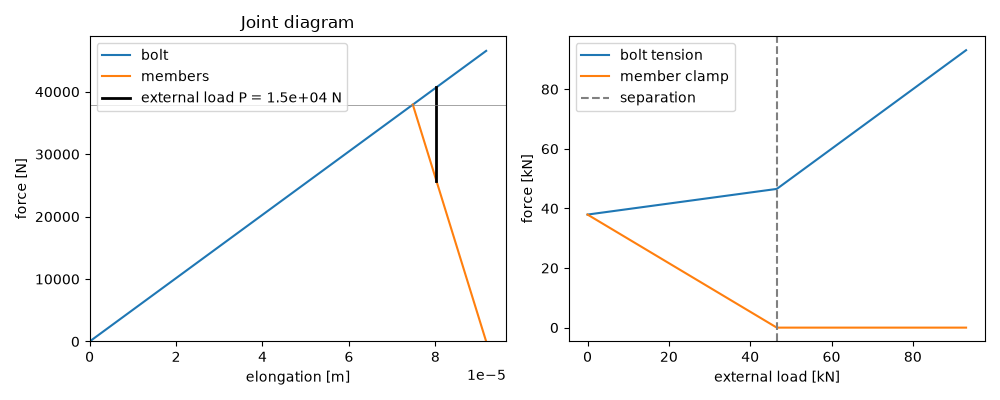
{'joint_constant': 0.185, 'bolt_load_N': 40709.774, 'member_load_N': 25709.774, 'separation_load_N': 46545.15, 'separation_factor': 3.103}
load factor against proof: 4.56; wrench torque 91 N m (K = 0.2)
Total running time of the script: (0 minutes 0.198 seconds)
