
Note
Go to the end to download the full example code or to run this example in your browser via JupyterLite.
Petroff’s law of bearing friction (1883)#
Railway axle bearings of the 1880s ran on oil, and their friction did not
behave like Coulomb’s: it grew with speed and with the oil’s viscosity, and
it fell as the load rose. Nikolai Petroff (1883) explained this by treating
the oil film as a thin layer sheared between the journal and its sleeve.
With the journal centred, the shear stress is \(\mu\omega r/c\) all
round, so the friction torque is \(T = 2\pi\mu\omega r^3 L/c\)
(petroff_friction_torque()) and
the friction coefficient follows
\(f = 2\pi^2 (\mu N/P)(r/c)\). The example checks Petroff’s thin-film
torque against the exact flow between concentric cylinders.
import matplotlib.pyplot as plt
import numpy as np

from engineeringkit.mechanical_engineering import petroff_friction_torque
Thin film against exact Couette flow#
Between cylinders of radii \(r\) and \(r + c\) the exact viscous torque is \(4\pi\mu L\omega r^2 (r + c)^2 / ((r + c)^2 - r^2)\). The relative difference from Petroff’s formula is about \(3c/2r\), so the thin-film model is good to a fraction of a percent at the usual \(c/r \approx 10^{-3}\).
viscosity, r, L, omega = 0.03, 0.025, 0.05, 2 * np.pi * 25
ratios = np.geomspace(1e-4, 0.3, 40)
exact = np.array([4 * np.pi * viscosity * L * omega * r**2 * (r + c) ** 2 / ((r + c) ** 2 - r**2) for c in ratios * r])
petroff = petroff_friction_torque(viscosity, r, L, ratios * r, omega)
error = np.abs(petroff / exact - 1)
print(f"c/r = 1e-3: Petroff {petroff[np.searchsorted(ratios, 1e-3)]:.5f} N m, exact {exact[np.searchsorted(ratios, 1e-3)]:.5f} N m")
assert np.all(np.diff(error) > 0) and np.allclose(error[:10], 1.5 * ratios[:10], rtol=1e-2)
c/r = 1e-3: Petroff 0.78775 N m, exact 0.78914 N m
The Petroff line#
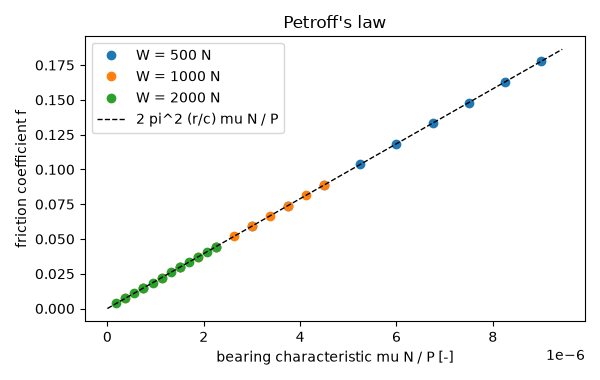
Divide the torque by load times radius. Plotted against the bearing characteristic \(\mu N/P\), every load and speed falls on one line of slope \(2\pi^2 r/c\).
c = 25e-6
loads = np.array([500.0, 1000.0, 2000.0])
speeds = np.linspace(5, 60, 12)
fig, ax = plt.subplots(figsize=(6, 3.8))
for W in loads:
    P = W / (2 * r * L)
    f = petroff_friction_torque(viscosity, r, L, c, 2 * np.pi * speeds) / (W * r)
    characteristic = viscosity * speeds / P
    ax.plot(characteristic, f, "o", label=f"W = {W:.0f} N")
    assert np.allclose(f, 2 * np.pi**2 * characteristic * r / c)
line = np.linspace(0, ax.get_xlim()[1], 2)
ax.plot(line, 2 * np.pi**2 * line * r / c, "k--", lw=1, label="2 pi^2 (r/c) mu N / P")
ax.set(xlabel="bearing characteristic mu N / P [-]", ylabel="friction coefficient f", title="Petroff's law")
ax.legend()
fig.tight_layout()

plt.show()
Total running time of the script: (0 minutes 0.033 seconds)
