
Note
Go to the end to download the full example code or to run this example in your browser via JupyterLite.
Coulomb’s friction and the power screw (1785)#
Charles-Augustin de Coulomb’s prize memoir Théorie des machines simples
(1781, published 1785) measured sliding friction and found it proportional
to the normal load and nearly independent of contact area and speed:
\(F = \mu N\). A screw thread is an inclined plane wrapped round a
cylinder. Unwrapping one turn gives a slope of lead angle
\(\tan\lambda = L/(\pi d_m)\), and Coulomb’s law on that slope gives the
torque to raise a load,
\(T = \tfrac12 W d_m\tan(\phi + \lambda)\) with \(\tan\phi = \mu\)
(screw_torque_raise()). The
example solves the force balance on the unwrapped thread directly and
shows why a self-locking screw is always less than 50% efficient.
import matplotlib.pyplot as plt
import numpy as np

from engineeringkit.mechanical_engineering import screw_torque_raise
The unwrapped thread#
A block carrying the axial load \(W\) is pushed up a slope \(\lambda\) by a horizontal force \(P\), the thread force at the mean radius. Balance along and normal to the slope, with friction \(\mu N\) opposing the motion, is linear in \(P\) and \(N\).
W, dm, lead = 20e3, 0.032, 0.006
lam = np.arctan(lead / (np.pi * dm))
for mu in (0.0, 0.08, 0.15):
    A = np.array([[np.cos(lam), -mu], [-np.sin(lam), 1.0]])
    P, N = np.linalg.solve(A, [W * np.sin(lam), W * np.cos(lam)])
    T = screw_torque_raise(W, dm, lead, mu)
    print(f"mu = {mu:.2f}: force balance T = {P * dm / 2:7.3f} N m, formula T = {T:7.3f} N m")
    assert np.isclose(P * dm / 2, T)
assert np.isclose(2 * np.pi * screw_torque_raise(W, dm, lead, 0.0), W * lead)
mu = 0.00: force balance T =  19.099 N m, formula T =  19.099 N m
mu = 0.08: force balance T =  44.913 N m, formula T =  44.913 N m
mu = 0.15: force balance T =  67.705 N m, formula T =  67.705 N m
Efficiency and self-locking#
Efficiency is the lifting work per turn over the input work, \(\eta = W L / (2\pi T) = \tan\lambda / \tan(\phi + \lambda)\). A screw holds its load without a brake when \(\phi \ge \lambda\); at that limit \(\eta = (1 - \tan^2\lambda)/2\), below one half.
leads = np.linspace(0.5e-3, 40e-3, 200)
fig, ax = plt.subplots(figsize=(6, 3.8))
for mu in (0.08, 0.15, 0.25):
    eta = W * leads / (2 * np.pi * screw_torque_raise(W, dm, leads, mu))
    locking = np.tan(np.arctan(leads / (np.pi * dm))) <= mu
    ax.plot(np.degrees(np.arctan(leads / (np.pi * dm))), eta, label=f"mu = {mu}")
    assert np.all(eta[locking] < 0.5)
ax.axhline(0.5, color="k", ls=":")
ax.set(xlabel="lead angle [deg]", ylabel="efficiency", title="Square-thread power screw")
ax.legend()
fig.tight_layout()

limit = W * lead / (2 * np.pi * screw_torque_raise(W, dm, lead, np.tan(lam)))
print(f"lead angle {np.degrees(lam):.2f} deg; efficiency at the self-locking limit {limit:.4f}")
assert np.isclose(limit, (1 - np.tan(lam) ** 2) / 2)

plt.show()
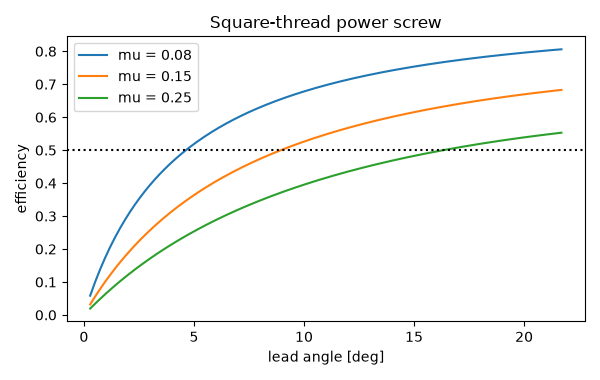
lead angle 3.42 deg; efficiency at the self-locking limit 0.4982
Total running time of the script: (0 minutes 0.030 seconds)
