
Breakthroughs in Structural Engineering#
These landmarks trace a conceptual development from a physical law to a useful engineering model. The order is a learning path, not a dated chronology or a claim that any idea had a single inventor. SI units apply unless documented otherwise.
Hooke: material response becomes measurable#
The proportional relation between stress and strain connects a material test to a structural displacement. It supplies the constitutive law that equilibrium alone cannot provide.
Use engineeringkit.structural_engineering.axial_deformation to explore the model.
Uniform sections, small strains and linear elasticity are assumed. Yielding requires a different constitutive model.
Euler: stability differs from strength#
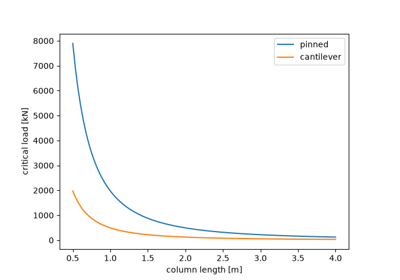
A slender column can lose stability before its material reaches a strength limit. Effective length captures the ideal support conditions and reveals the strong length dependence.
Use engineeringkit.structural_engineering.euler_buckling_load to explore the model.
The formula describes ideal elastic buckling; imperfections and inelastic behavior require additional analysis.
Energy methods: loads and displacements connect#
Castigliano and reciprocal-work ideas organize displacement calculations around stored energy. They also motivate stiffness methods, where compatibility and equilibrium are assembled across members.
Use engineeringkit.structural_engineering.strain_energy_axial to explore the model.
Linear elastic reciprocal behavior is assumed. The derivative must actually be evaluated before using castigliano_deflection.
Explore and verify#
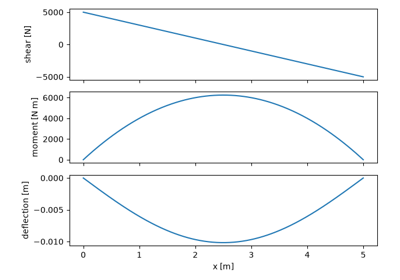
Structural engineering: loads, signs and linear elasticity records units, conventions and independent checks. Compare the gallery output against the equations before extending a model.
Further reading#
University or agency teaching reference provides background beyond the implemented subset. The equations and examples here are concise original explanations, not reproductions of that reference.