
Note
Go to the end to download the full example code or to run this example in your browser via JupyterLite.
Maney’s slope-deflection method (1915)#
George A. Maney (1915), studying secondary stresses in rigid frames at the University of Minnesota, wrote each member-end moment in terms of the rotations of its two ends and the rotation of its chord:
One equilibrium equation per free joint then gives the rotations
(slope_deflection()). Hardy
Cross’s moment distribution (1930) solves the same equations by
relaxation, and the stiffness method is their matrix form. Johnson’s
Modern Framed Structures credits Otto Mohr with the idea before Maney
found it independently. The example analyses a three-span bridge girder,
compares it with moment distribution, and lets the middle pier settle.
import matplotlib.pyplot as plt
import numpy as np

from engineeringkit.structural_engineering import moment_distribution, slope_deflection
Three spans, built in at the left abutment#
EI, w = 4e8, 25e3
spans = [10.0, 14.0, 10.0]
members = [(k, k + 1, L, EI, w) for k, L in enumerate(spans)]
result = slope_deflection(members, fixed_joints=(0,))
cross = moment_distribution(members, fixed_joints=(0,))
print("joint rotations [mrad]:", np.round(result.rotations * 1e3, 3))
print("end moments [kN m]:\n", np.round(result.end_moments / 1e3, 1))
print(f"moment distribution needed {cross.iterations} cycles for the same answer")
assert np.allclose(result.end_moments, cross.end_moments, atol=1e-3)
joint rotations [mrad]: [ 0.     0.858 -0.618 -0.993]
end moments [kN m]:
 [[-139.7  345.6]
 [-345.6  386.7]
 [-386.7    0. ]]
moment distribution needed 27 cycles for the same answer
The second pier settles 20 mm#
The two spans meeting at joint 2 turn: the left chord clockwise (\(\psi = \Delta/L\)), the right one counterclockwise.
delta = 0.02
psi = [0.0, delta / spans[1], -delta / spans[2]]
settled = slope_deflection(members, fixed_joints=(0,), chord_rotations=psi)
change = (settled.end_moments - result.end_moments) / 1e3
print("change in end moments from the settlement [kN m]:\n", np.round(change, 1))
for joint in (1, 2, 3):
    at = np.array([[i, j] for i, j, *_ in members]) == joint
    assert np.isclose(settled.end_moments[at].sum(), 0, atol=1e-6)

fig, ax = plt.subplots(figsize=(7, 3.5))
x0 = np.concatenate([[0], np.cumsum(spans)])
for k, L in enumerate(spans):
    x = np.linspace(0, L, 101)
    for moments, style, label in ((result.end_moments, "-", "level piers"), (settled.end_moments, "--", "pier 2 settled")):
        left, right = moments[k, 0], -moments[k, 1]  # sagging-positive moments at the span ends
        sag = left + (right - left) * x / L + w * x * (L - x) / 2
        ax.plot(x0[k] + x, sag / 1e3, style, color="C0" if style == "-" else "C3", label=label if k == 0 else None)
ax.axhline(0, color="gray", lw=0.5)
ax.set(xlabel="x [m]", ylabel="bending moment [kN m]", title="Three-span girder by slope-deflection")
ax.legend()
fig.tight_layout()

plt.show()
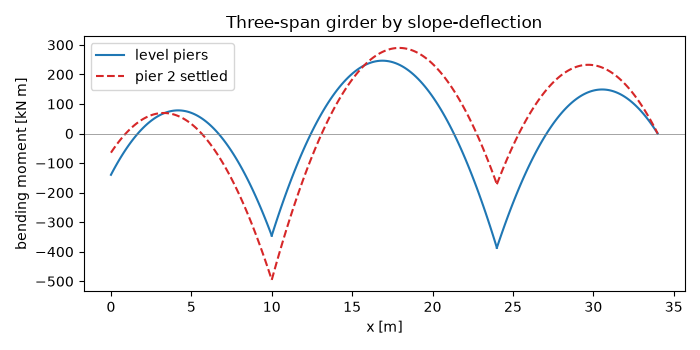
change in end moments from the settlement [kN m]:
 [[  74.9  149.8]
 [-149.8 -215.1]
 [ 215.1    0. ]]
Total running time of the script: (0 minutes 0.122 seconds)
