
Note
Go to the end to download the full example code or to run this example in your browser via JupyterLite.
Mohr’s unit-load method (1874)#
To find how far one joint of a truss moves, Otto Mohr (1874) applied the principle of virtual work with an imaginary unit load at that joint. The internal forces \(n\) it produces, working through the real member extensions \(NL/(AE)\), must equal the work of the unit load through the wanted displacement:
(unit_load_truss_deflection()).
Both sets of forces come from statics alone, so a determinate truss needs
no stiffness matrix. For beams the sum becomes \(\int mM/(EI)\,dx\)
(unit_load_beam_deflection()).
The example finds the midspan deflection of a Warren truss member by
member and checks it against the direct stiffness method.
import matplotlib.pyplot as plt
import numpy as np

from engineeringkit.structural_engineering import PlanarTruss, method_of_joints, unit_load_beam_deflection, unit_load_truss_deflection
A Warren truss carrying two panel loads#
nodes = np.array([[0, 0], [4, 0], [8, 0], [12, 0], [2, 3], [6, 3], [10, 3]], float)
members = ((0, 1), (1, 2), (2, 3), (0, 4), (4, 1), (1, 5), (5, 2), (2, 6), (6, 3), (4, 5), (5, 6))
fixed = [0, 1, 7]
E, A = 200e9, 2e-3
loads = np.zeros(14)
loads[[3, 5]] = -60e3
unit = np.zeros(14)
unit[5] = -1.0  # downward unit load at the midspan joint 2

N = method_of_joints(nodes, members, loads, fixed).member_forces
n = method_of_joints(nodes, members, unit, fixed).member_forces
lengths = np.array([np.hypot(*(nodes[j] - nodes[i])) for i, j in members])
contributions = n * N * lengths / (A * E)
delta = unit_load_truss_deflection(N, n, lengths, A, E)
print(f"midspan deflection by virtual work: {delta * 1e3:.3f} mm")

stiffness = PlanarTruss(nodes, members, E, A).solve(loads, fixed)
print(f"by the direct stiffness method:     {-stiffness.displacements[5] * 1e3:.3f} mm")
assert np.isclose(delta, -stiffness.displacements[5])

fig, ax = plt.subplots(figsize=(7, 3.5))
ax.bar([f"{i}-{j}" for i, j in members], contributions * 1e3)
ax.set(xlabel="member", ylabel="share of deflection [mm]", title="Where the midspan deflection comes from")
fig.tight_layout()
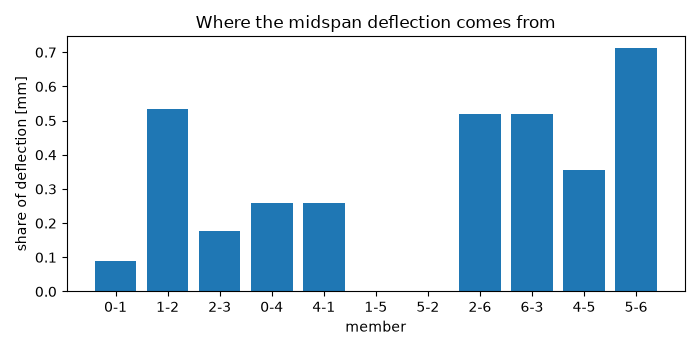
midspan deflection by virtual work: 3.429 mm
by the direct stiffness method:     3.429 mm
The same idea for a beam#
Midspan deflection of a simply supported beam under a uniform load: the unit load at midspan gives the triangle \(m = x/2\) up to midspan.
L, w, I = 6.0, 10e3, 5e-5
x = np.linspace(0, L, 601)
M = w * x * (L - x) / 2
m = np.minimum(x, L - x) / 2
beam = unit_load_beam_deflection(x, M, m, E, I)
print(f"beam midspan deflection {beam * 1e3:.3f} mm, 5wL^4/384EI = {5 * w * L**4 / (384 * E * I) * 1e3:.3f} mm")
assert np.isclose(beam, 5 * w * L**4 / (384 * E * I))

plt.show()
beam midspan deflection 16.875 mm, 5wL^4/384EI = 16.875 mm
Total running time of the script: (0 minutes 0.069 seconds)
