
Note
Go to the end to download the full example code or to run this example in your browser via JupyterLite.
Castigliano’s theorem (1879)#
In his 1873 engineering thesis at Turin, extended into a book in 1879, Alberto Castigliano showed that the partial derivative of the strain energy with respect to a load is the displacement at that load, in its direction: \(\delta = \partial U/\partial P\). For a beam in bending,
and when no load acts at the wanted point a dummy load is placed there
and set to zero after differentiating
(castigliano_deflection()).
The example finds the tip deflection of a tapered cantilever, where the
closed-form answer is awkward, and checks it by integrating the curvature
\(M/EI\) twice. It then uses a dummy load for the midspan deflection
of a uniformly loaded beam.
import matplotlib.pyplot as plt
import numpy as np
from scipy.integrate import cumulative_trapezoid

from engineeringkit.structural_engineering import (
    SimplySupportedBeam,
    castigliano_deflection,
    rectangular_second_moment,
    strain_energy_bending_constant_moment,
)
A tapered cantilever#
The depth falls linearly from 300 mm at the wall to 100 mm at the tip. A tip load \(P\) gives \(M = -P(L - x)\) and \(\partial M/\partial P = -(L - x)\).
E, L, P, b = 70e9, 2.0, 4e3, 0.05
x = np.linspace(0, L, 401)
depth = 0.3 - 0.2 * x / L
I = rectangular_second_moment(b, depth)
M = -P * (L - x)
tip = castigliano_deflection(x=x, moment=M, dmoment_dP=-(L - x), E=E, I=I)

slope = cumulative_trapezoid(M / (E * I), x=x, initial=0)
deflection = cumulative_trapezoid(slope, x=x, initial=0)
print(f"tip deflection by Castigliano {1e3 * tip:.3f} mm, by integrating the curvature {-1e3 * deflection[-1]:.3f} mm")
assert np.isclose(tip, -deflection[-1], rtol=1e-5)
uniform = P * L**3 / (3 * E * rectangular_second_moment(b, 0.3))
print(f"a uniform 300 mm beam would deflect {1e3 * uniform:.3f} mm")
tip deflection by Castigliano 2.876 mm, by integrating the curvature 2.876 mm
a uniform 300 mm beam would deflect 1.354 mm
Strain energy is the work of the load#
Over a short piece of beam the moment is nearly constant, so the energy sums \(M^2\,dx/(2EI)\); it equals \(P\delta/2\).
mid = 0.5 * (x[1:] + x[:-1])
depth_mid = 0.3 - 0.2 * mid / L
U = np.sum(strain_energy_bending_constant_moment(-P * (L - mid), np.diff(x), E, rectangular_second_moment(b, depth_mid)))
print(f"strain energy {U:.4f} J, P delta / 2 = {P * tip / 2:.4f} J")
assert np.isclose(U, P * tip / 2, rtol=1e-4)
strain energy 5.7524 J, P delta / 2 = 5.7524 J
A dummy load at midspan#
Ls, w, Is = 6.0, 5e3, 8e-5
xs = np.linspace(0, Ls, 401)
Ms = w * xs * (Ls - xs) / 2
dummy = np.where(xs <= Ls / 2, xs / 2, (Ls - xs) / 2)  # moment from a unit load at midspan
mid_defl = castigliano_deflection(x=xs, moment=Ms, dmoment_dP=dummy, E=200e9, I=Is)
exact = SimplySupportedBeam(Ls, 200e9, Is).solve_uniform_load(w, n=401).deflection[200]
print(f"midspan deflection {1e3 * mid_defl:.3f} mm, beam solution {-1e3 * exact:.3f} mm")
assert np.isclose(mid_defl, -exact)

fig, axes = plt.subplots(1, 2, figsize=(10, 3.5))
axes[0].plot(x, 1e3 * deflection)
axes[0].plot(L, -1e3 * tip, "o", label="Castigliano")
axes[0].set(xlabel="x [m]", ylabel="deflection [mm]", title="Tapered cantilever")
axes[0].legend()
axes[1].plot(xs, Ms / 1e3, label="M [kN m]")
axes[1].plot(xs, dummy, label="dM/dP [m]")
axes[1].set(xlabel="x [m]", title="Real and dummy-load moments")
axes[1].legend()
fig.tight_layout()

plt.show()
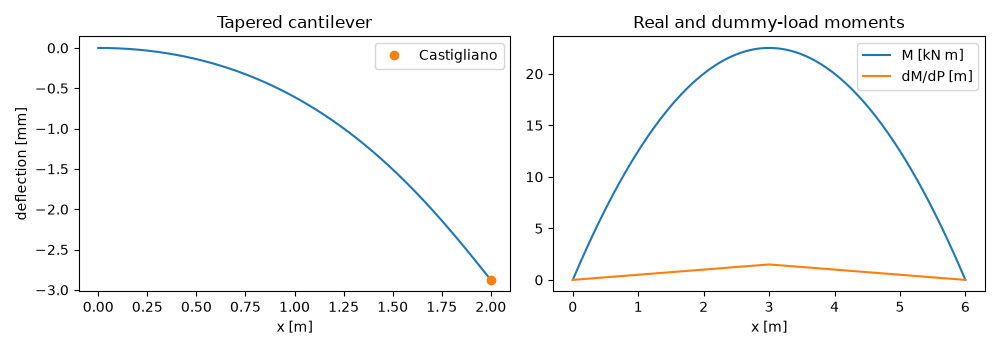
midspan deflection 5.273 mm, beam solution 5.273 mm
Total running time of the script: (0 minutes 0.052 seconds)
