
Breakthroughs in Materials#
These landmarks trace a conceptual development from a physical law to a useful engineering model. The order is a learning path, not a dated chronology or a claim that any idea had a single inventor. SI units apply unless documented otherwise.
Elasticity and yielding: deformation has regimes#
Hooke elasticity describes recoverable small strain. Multiaxial yield criteria replace a single normal-stress threshold with an equivalent stress measure.
Use engineeringkit.materials.von_mises_plane_stress to explore the model.
The plane-stress criterion is intended for isotropic ductile yielding and does not model subsequent plastic deformation.
Griffith and stress intensity: cracks alter strength#
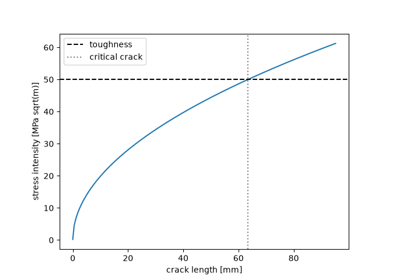
An energy balance explains why a crack can grow even when nominal stress is modest. Stress intensity combines applied tension, crack size and a geometry correction.
Use engineeringkit.materials.stress_intensity to explore the model.
Linear-elastic mode-I fracture requires suitable constraint and small-scale yielding; the caller supplies the geometry factor.
Fatigue: load history becomes part of the model#
Basquin describes an empirical stress-life relation, Paris describes stable crack growth, and Miner accumulates cycle fractions. Each answers a different fatigue question.
Use engineeringkit.materials.paris_crack_growth to explore the model.
Calibration units and validity ranges matter. Miner damage omits sequence effects and Paris growth omits threshold and rapid-fracture regimes.
Explore and verify#
Materials: elasticity, fracture and fatigue conventions records units, conventions and independent checks. Compare the gallery output against the equations before extending a model.
Further reading#
University or agency teaching reference provides background beyond the implemented subset. The equations and examples here are concise original explanations, not reproductions of that reference.