
Note
Go to the end to download the full example code or to run this example in your browser via JupyterLite.
Brinell’s hardness test (1900)#
Johan August Brinell, chief engineer of the Fagersta ironworks in Sweden,
showed his ball test at the 1900 Paris Exposition. A 10 mm hardened steel
ball pressed into the part with 3000 kgf leaves a dent of diameter
\(d\); the load divided by the curved area of the dent is the
hardness number (brinell_hardness()),
Indentation is plastic flow under a constrained punch, so for steels HB
tracks the tensile strength, \(S_{ut} \approx 3.45\,\mathrm{HB}\) MPa
(brinell_tensile_strength()): a test that
leaves only a small mark estimates the strength of a finished part.
import matplotlib.pyplot as plt
import numpy as np

from engineeringkit.materials import brinell_hardness, brinell_tensile_strength, vickers_hardness
From the dent to the number#
A 3000 kgf load and a dent 4.0 mm across give about 229 HB, the hardness of a normalised medium-carbon steel. The projected-area pressure, \(4P/\pi d^2\), is a few per cent higher than HB because the curved cap has more area than its shadow.
P, D = 3000 * 9.80665, 10e-3
HB = brinell_hardness(P, D, 4.0e-3)
mean_pressure = 4 * (P / 9.80665) / (np.pi * 4.0**2)
print(f"HB = {HB:.0f}, projected mean pressure {mean_pressure:.0f} kgf/mm^2, Sut ~ {brinell_tensile_strength(HB) / 1e6:.0f} MPa")
assert 1 < mean_pressure / HB < 1.05
HB = 229, projected mean pressure 239 kgf/mm^2, Sut ~ 789 MPa
Hardness against strength#
Dent diameters in Brinell’s valid range, \(0.24D\) to \(0.6D\), cover soft to hardened steels. The right-hand axis reads the strength estimate. A Vickers diamond, whose dents are geometrically similar at any load, gives a number close to HB on the same steel below about 400 HB.
d = np.linspace(2.4e-3, 6.0e-3, 50)
hb = brinell_hardness(P, D, d)
sut = brinell_tensile_strength(hb)
print(f"range {hb[-1]:.0f} to {hb[0]:.0f} HB, Sut {sut[-1] / 1e6:.0f} to {sut[0] / 1e6:.0f} MPa")
hv = vickers_hardness(30 * 9.80665, 0.50e-3)
print(f"Vickers, 30 kgf, 0.50 mm diagonal: {hv:.0f} HV")
assert np.all(np.diff(hb) < 0) and np.allclose(sut / hb, 3.45e6)

fig, ax = plt.subplots(figsize=(6, 3.8))
ax.plot(1e3 * d, hb)
ax.set(xlabel="dent diameter [mm]", ylabel="Brinell hardness HB", title="3000 kgf, 10 mm ball")
ax.secondary_yaxis("right", functions=(lambda h: 3.45 * h, lambda s: s / 3.45)).set_ylabel("estimated Sut [MPa]")
ax.grid(True, alpha=0.3)
fig.tight_layout()

plt.show()
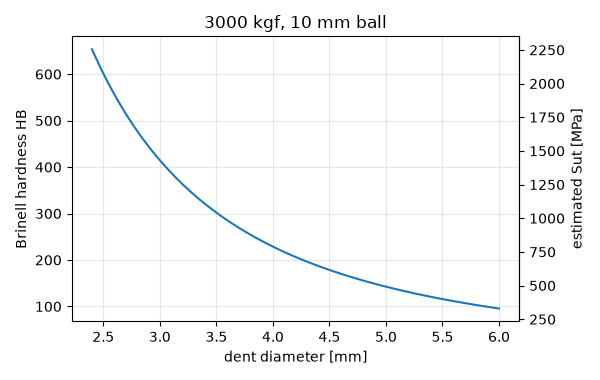
range 95 to 653 HB, Sut 329 to 2254 MPa
Vickers, 30 kgf, 0.50 mm diagonal: 223 HV
Total running time of the script: (0 minutes 0.090 seconds)
