
Note
Go to the end to download the full example code or to run this example in your browser via JupyterLite.
Norton’s power-law creep (1929)#
Steam turbines of the 1920s ran hot enough for their steel to stretch slowly
under constant load. Frederick Norton’s The Creep of Steel at High
Temperatures (1929) found that the steady creep rate rises as a power of
stress, \(\dot\varepsilon = A\sigma^n\), with \(n\) around 5. Its
temperature dependence is thermally activated,
\(e^{-Q/RT}\), with an activation energy close to that of
self-diffusion (Dorn, 1950s)
(arrhenius_creep_rate()). The example
recovers \(n\) and \(Q\) from simulated creep tests.
import matplotlib.pyplot as plt
import numpy as np

from engineeringkit.materials import arrhenius_creep_rate
from engineeringkit.materials.utils import power_law_fit
Creep tests at three temperatures#
Minimum creep rates of a ferritic steel with \(n = 5\) and \(Q = 280\) kJ/mol, measured with 15% scatter at five stresses and three temperatures.
A, Q, R, n = 1.8e-32, 280e3, 8.314, 5.0
stresses = np.geomspace(60e6, 200e6, 5)
temperatures = np.array([850.0, 900.0, 950.0])
rng = np.random.default_rng(11)
rates = arrhenius_creep_rate(A, Q, R, temperatures[:, None], stresses[None, :], n) * rng.lognormal(0, 0.15, (3, 5))
The stress exponent and the activation energy#
At each temperature the slope of \(\log\dot\varepsilon\) against \(\log\sigma\) is \(n\). At fixed stress the slope of \(\ln\dot\varepsilon\) against \(1/T\) is \(-Q/R\).
exponents = [power_law_fit(stresses, row)[1] for row in rates]
slope = np.polyfit(1 / temperatures, np.log(rates).mean(axis=1), 1)[0]
print(f"stress exponents {np.round(exponents, 2).tolist()}; activation energy {-slope * R / 1e3:.0f} kJ/mol")
assert np.allclose(exponents, n, atol=0.4) and abs(-slope * R / Q - 1) < 0.05

life = 0.01 / arrhenius_creep_rate(A, Q, R, 850.0, 100e6, n)
print(f"time to 1% creep strain at 850 K and 100 MPa: {life / 3600:.0f} h")

fig, ax = plt.subplots(figsize=(6, 3.8))
for T, row in zip(temperatures, rates):
    ax.loglog(stresses / 1e6, row, "o", label=f"{T:.0f} K")
    ax.loglog(stresses / 1e6, arrhenius_creep_rate(A, Q, R, T, stresses, n), "k-", lw=0.8)
ax.set(xlabel="stress [MPa]", ylabel="minimum creep rate [1/s]", title="Norton's law")
ax.legend()
fig.tight_layout()

plt.show()
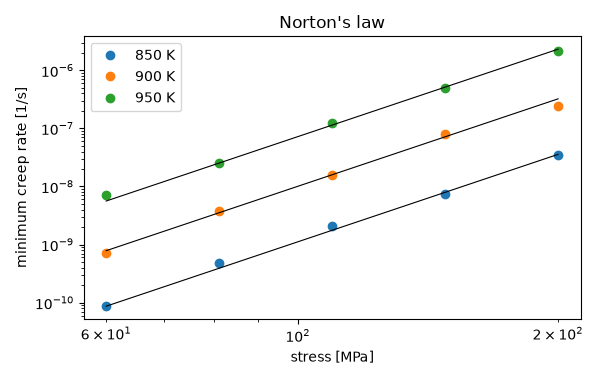
stress exponents [4.87, 4.88, 4.8]; activation energy 279 kJ/mol
time to 1% creep strain at 850 K and 100 MPa: 2487 h
Total running time of the script: (0 minutes 0.061 seconds)
