
Note
Go to the end to download the full example code or to run this example in your browser via JupyterLite.
Reissner and Stavsky: classical laminate theory (1961)#
A ply of aligned fibres is stiff along them and soft across, so composite parts stack plies at several angles. Eric Reissner and Yehuda Stavsky, at MIT, extended Kirchhoff’s plate theory to such stacks and found that in an unsymmetric laminate stretching and bending are coupled: pulling it makes it curl. The laminate relates force and moment resultants to midplane strains and curvatures through three matrices,
(classical_laminate()), built from each
ply’s rotated stiffness (transformed_stiffness()).
The example checks a quasi-isotropic carbon-epoxy layup, finds its ply
stresses, and shows the coupling of an unsymmetric one.
import matplotlib.pyplot as plt
import numpy as np

from engineeringkit.materials import classical_laminate, lamina_stiffness, transformed_stiffness
One ply turned through 90 degrees#
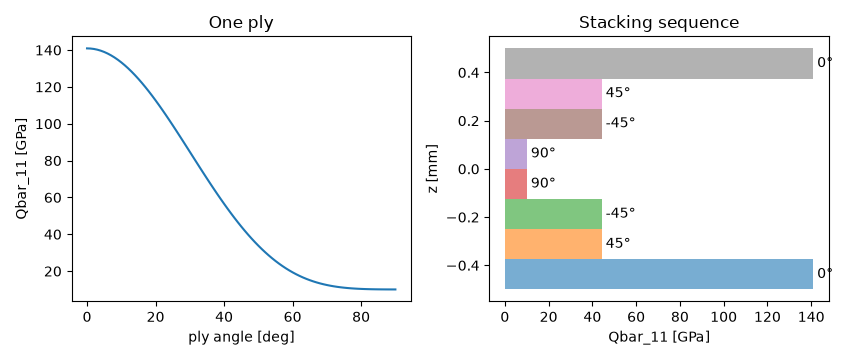
Carbon-epoxy has \(E_1 = 140\) GPa along the fibres and only \(E_2 = 10\) GPa across. The stiffness in the loading direction falls from \(Q_{11}\) to \(Q_{22}\) as the ply turns.
E1, E2, nu12, G12, t = 140e9, 10e9, 0.3, 5e9, 0.125e-3
Q = lamina_stiffness(E1, E2, nu12, G12)
angles = np.radians(np.linspace(0, 90, 91))
q11 = np.array([transformed_stiffness(Q, a)[0, 0] for a in angles])
print(f"Qbar_11 at 0, 45 and 90 deg: {q11[0] / 1e9:.1f}, {q11[45] / 1e9:.1f}, {q11[90] / 1e9:.1f} GPa")
assert np.isclose(q11[90], Q[1, 1])
Qbar_11 at 0, 45 and 90 deg: 140.9, 44.3, 10.1 GPa
A quasi-isotropic laminate#
Eight plies \([0/45/-45/90]_s\) have \(\mathbf B = 0\) because the stack is symmetric, and an in-plane stiffness that is the same in every direction: \(A_{11} = A_{22}\) and \(A_{66} = (A_{11} - A_{12})/2\), as for an isotropic sheet.
quasi = classical_laminate(E1, E2, nu12, G12, np.radians([0, 45, -45, 90, 90, -45, 45, 0]), t)
A = quasi.A
summary = quasi.summary()
print(f"Ex = {summary['Ex_Pa'] / 1e9:.1f} GPa, Ey = {summary['Ey_Pa'] / 1e9:.1f} GPa, Gxy = {summary['Gxy_Pa'] / 1e9:.1f} GPa")
assert np.allclose(quasi.B, 0, atol=1e-6) and np.isclose(A[2, 2], (A[0, 0] - A[0, 1]) / 2)

N = (100e3, 0.0, 0.0)  # 100 kN per metre of width along x
stresses = quasi.ply_stresses(N=N)
for angle, (s1, s2, t12) in zip((0, 45, -45, 90), stresses[:4]):
    print(f"{angle:4d} deg ply: sigma_1 = {s1 / 1e6:6.1f} MPa, sigma_2 = {s2 / 1e6:5.1f} MPa, tau_12 = {t12 / 1e6:5.1f} MPa")
assert stresses[0, 0] == stresses[:, 0].max()

fig, axs = plt.subplots(1, 2, figsize=(8.5, 3.6))
axs[0].plot(np.degrees(angles), q11 / 1e9)
axs[0].set(xlabel="ply angle [deg]", ylabel="Qbar_11 [GPa]", title="One ply")
quasi.plot(ax=axs[1])
fig.tight_layout()
Ex = 54.1 GPa, Ey = 54.1 GPa, Gxy = 20.6 GPa
   0 deg ply: sigma_1 =  258.9 MPa, sigma_2 =  -0.2 MPa, tau_12 =   0.0 MPa
  45 deg ply: sigma_1 =   91.7 MPa, sigma_2 =   8.3 MPa, tau_12 = -12.1 MPa
 -45 deg ply: sigma_1 =   91.7 MPa, sigma_2 =   8.3 MPa, tau_12 =  12.1 MPa
  90 deg ply: sigma_1 =  -75.5 MPa, sigma_2 =  16.9 MPa, tau_12 =  -0.0 MPa
Stretching makes an unsymmetric laminate curl#
Two plies, \([0/90]\), are not symmetric about the midplane: \(\mathbf B \neq 0\), and a pure tension gives a curvature.
cross = classical_laminate(E1, E2, nu12, G12, np.radians([0, 90]), t)
eps0, kappa = cross.midplane_response(N=N)
print(f"[0/90] under tension: strain {eps0[0]:.2e}, curvature {kappa[0]:.2f} 1/m")
assert not cross.summary()["symmetric"] and abs(kappa[0]) > 0

plt.show()
[0/90] under tension: strain 1.22e-02, curvature 126.67 1/m
Total running time of the script: (0 minutes 0.110 seconds)
