
Note
Go to the end to download the full example code or to run this example in your browser via JupyterLite.
Kelvin’s age of the Earth (1862)#
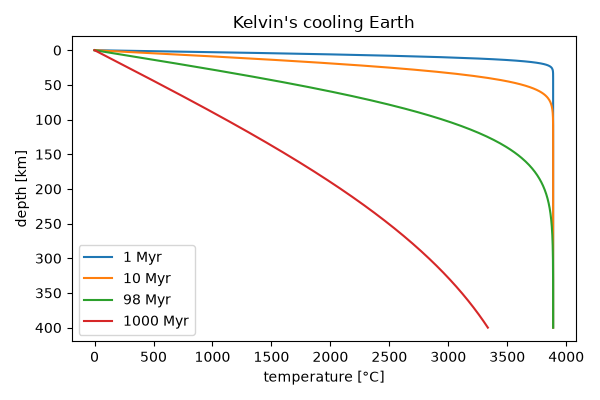
In 1862 William Thomson, later Lord Kelvin, treated the Earth as a
semi-infinite solid that began at a uniform molten temperature and has
cooled from its surface ever since. The temperature below the surface is
then \(T_s + (T_i - T_s)\operatorname{erf}(x/2\sqrt{\alpha t})\)
(semi_infinite_temperature()), and the
surface gradient \((T_i - T_s)/\sqrt{\pi\alpha t}\) falls with time. From
the gradient measured in mines, about 1 °F per 50 ft, he found an age of
about 98 million years. This example redoes his arithmetic in SI units and
checks the gradient against the profile itself.
import matplotlib.pyplot as plt
import numpy as np

from engineeringkit.heat_transfer import semi_infinite_temperature
Kelvin’s numbers#
An initial excess of 7000 °F, a gradient of 1 °F per 50 ft and a diffusivity of 400 ft² per year, converted to SI.
year = 365.25 * 86400
dT = 7000 * 5 / 9  # K
gradient = (5 / 9) / (50 * 0.3048)  # K/m
alpha = 400 * 0.3048**2 / year  # m^2/s
age = dT**2 / (np.pi * alpha * gradient**2)
print(f"diffusivity {alpha:.3e} m²/s, gradient {gradient * 1e3:.1f} mK/m")
print(f"age of the Earth: {age / year / 1e6:.0f} million years")
assert 95e6 < age / year < 100e6
diffusivity 1.178e-06 m²/s, gradient 36.5 mK/m
age of the Earth: 97 million years
The gradient from the profile#
Differentiate the error-function profile numerically at the surface and compare with the closed form.
Ts, Ti = 273.0, 273.0 + dT
dx = 1.0
numeric = (semi_infinite_temperature(Ti, Ts, dx, alpha, age) - semi_infinite_temperature(Ti, Ts, 0.0, alpha, age)) / dx
print(f"surface gradient from the profile {numeric * 1e3:.3f} mK/m")
assert np.isclose(numeric, gradient, rtol=1e-4)

depth = np.linspace(0, 400e3, 400)
fig, ax = plt.subplots(figsize=(6, 4))
for myr in [1, 10, 98, 1000]:
    ax.plot(semi_infinite_temperature(Ti, Ts, depth, alpha, myr * 1e6 * year) - 273.0, depth / 1e3, label=f"{myr} Myr")
ax.invert_yaxis()
ax.set(xlabel="temperature [°C]", ylabel="depth [km]", title="Kelvin's cooling Earth")
ax.legend()
fig.tight_layout()
surface gradient from the profile 36.454 mK/m
Why he was wrong#
Radioactive heating (discovered in 1896) and, above all, convection in the mantle, argued by John Perry in 1895, keep the interior hot. The radiometric age, 4.54 billion years, would need a surface gradient about \(\sqrt{4540/98}\) times smaller than the one measured.
print(f"the gradient for 4.54 Gyr would be {gradient * np.sqrt(age / (4.54e9 * year)) * 1e3:.1f} mK/m")

plt.show()
the gradient for 4.54 Gyr would be 5.3 mK/m
Total running time of the script: (0 minutes 0.037 seconds)
