
Note
Go to the end to download the full example code or to run this example in your browser via JupyterLite.
Fortescue’s symmetrical components (1918)#
An unbalanced three-phase system, such as one with a fault to ground,
couples all three phases and resisted hand calculation. Charles LeGeyt
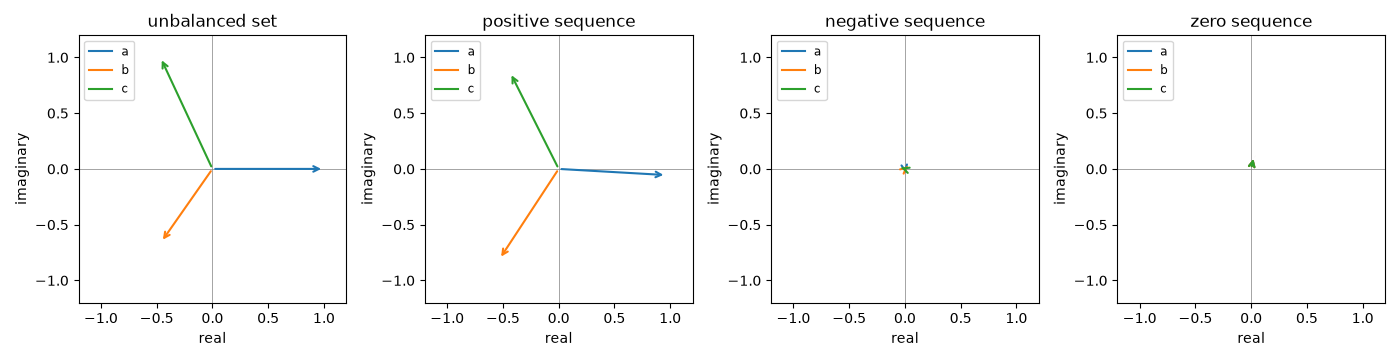
Fortescue of Westinghouse showed in 1918 that any three phasors are the
sum of three balanced sets: a zero-sequence set (three equal phasors), a
positive-sequence set (a-b-c rotation) and a negative-sequence set (a-c-b)
(symmetrical_components()).
In a symmetrical network the three sequences do not interact, so each is
solved as a single-phase circuit and the results recombined
(phase_components()). This
example decomposes an unbalanced set and computes a single-line-to-ground
fault the way protection engineers still do.
import matplotlib.pyplot as plt
import numpy as np

from engineeringkit.electrical_engineering import phase_components, phasor, symmetrical_components
from engineeringkit.electrical_engineering.visualizers import plot_phasors
Decomposing an unbalanced set#
va, vb, vc = phasor(1.0, 0.0), phasor(0.8, np.radians(-125)), phasor(1.1, np.radians(115))
v0, v1, v2 = symmetrical_components(va, vb, vc)
print(f"|V0| = {abs(v0):.3f}, |V1| = {abs(v1):.3f}, |V2| = {abs(v2):.3f} pu; unbalance V2/V1 = {abs(v2 / v1):.1%}")
zero, positive, negative = phase_components(v0, 0, 0), phase_components(0, v1, 0), phase_components(0, 0, v2)
assert np.allclose(np.add(np.add(zero, positive), negative), (va, vb, vc))
|V0| = 0.117, |V1| = 0.966, |V2| = 0.060 pu; unbalance V2/V1 = 6.2%
A single-line-to-ground fault#
Phase a shorts to ground at a bus whose sequence impedances are \(Z_1 = Z_2 = j0.2\) and \(Z_0 = j0.1\) pu, prefault voltage 1 pu. The boundary conditions \(I_b = I_c = 0\), \(V_a = 0\) connect the three sequence networks in series: \(I_0 = I_1 = I_2 = E/(Z_0 + Z_1 + Z_2)\).
E, Z1, Z2, Z0 = 1.0, 0.2j, 0.2j, 0.1j
I_seq = E / (Z0 + Z1 + Z2)
Ia, Ib, Ic = phase_components(I_seq, I_seq, I_seq)
V_seq = (-Z0 * I_seq, E - Z1 * I_seq, -Z2 * I_seq)
Va, Vb, Vc = phase_components(*V_seq)
print(f"fault current |Ia| = {abs(Ia):.2f} pu (a three-phase fault would give {abs(E / Z1):.2f} pu)")
print(f"healthy-phase voltages |Vb| = {abs(Vb):.3f}, |Vc| = {abs(Vc):.3f} pu")
assert np.isclose(Ia, 3 * E / (Z0 + Z1 + Z2))
assert abs(Ib) < 1e-12 and abs(Ic) < 1e-12 and abs(Va) < 1e-12

fig, axes = plt.subplots(1, 4, figsize=(14, 3.6))
labels = ["a", "b", "c"]
plot_phasors([va, vb, vc], labels=labels, ax=axes[0])
plot_phasors(positive, labels=labels, ax=axes[1])
plot_phasors(negative, labels=labels, ax=axes[2])
plot_phasors(zero, labels=labels, ax=axes[3])
for ax, title in zip(axes, ["unbalanced set", "positive sequence", "negative sequence", "zero sequence"]):
    ax.set_title(title)
    ax.set(xlim=(-1.2, 1.2), ylim=(-1.2, 1.2))
fig.tight_layout()

plt.show()
fault current |Ia| = 6.00 pu (a three-phase fault would give 5.00 pu)
healthy-phase voltages |Vb| = 0.917, |Vc| = 0.917 pu
Total running time of the script: (0 minutes 0.088 seconds)
