
Note
Go to the end to download the full example code or to run this example in your browser via JupyterLite.
James Thomson’s triangular notch (1858)#
James Thomson, engineer and elder brother of Lord Kelvin, reported to the
British Association in 1858 that a V-shaped notch measures small flows
better than a rectangular weir. The flow section keeps the same shape as
the head changes, so the discharge coefficient hardly varies, and the flow
grows as \(H^{5/2}\)
(v_notch_weir_flow()) instead of
\(H^{3/2}\) (rectangular_weir_flow()),
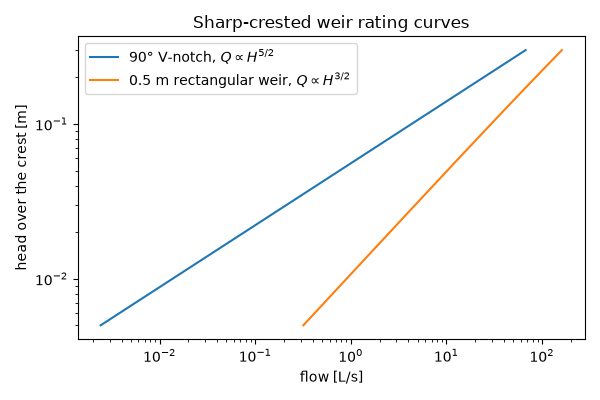
so a small flow still gives a readable head. This example compares the
rating curves of the two weirs and finds how precisely each must be read.
import matplotlib.pyplot as plt
import numpy as np

from engineeringkit.fluid_engineering import rectangular_weir_flow, rehbock_discharge_coefficient, v_notch_weir_flow
Rating curves#
A 90° notch and a 0.5 m rectangular weir standing 0.4 m above the bed of a laboratory flume, with Rehbock’s coefficient for the rectangle.
H = np.linspace(0.005, 0.3, 200)
P, b = 0.4, 0.5
Q_vee = v_notch_weir_flow(H)
Q_rect = rectangular_weir_flow(H, b, rehbock_discharge_coefficient(H, P))

fig, ax = plt.subplots(figsize=(6, 4))
ax.loglog(Q_vee * 1000, H, label="90° V-notch, $Q \\propto H^{5/2}$")
ax.loglog(Q_rect * 1000, H, label="0.5 m rectangular weir, $Q \\propto H^{3/2}$")
ax.set(xlabel="flow [L/s]", ylabel="head over the crest [m]", title="Sharp-crested weir rating curves")
ax.legend()
fig.tight_layout()
Head for a small flow#
For 2 L/s the notch stands several times higher than the rectangle, so a 1 mm reading error matters far less.
Q = 2e-3
h_vee = np.interp(Q, Q_vee, H)
h_rect = np.interp(Q, Q_rect, H)
for name, h, n in [("V-notch", h_vee, 2.5), ("rectangular", h_rect, 1.5)]:
    print(f"{name}: head {h * 1000:.1f} mm; a 1 mm error is a {100 * n * 1e-3 / h:.1f}% flow error")
V-notch: head 73.4 mm; a 1 mm error is a 3.4% flow error
rectangular: head 16.9 mm; a 1 mm error is a 8.9% flow error
The slopes of the log-log curves are the exponents of the head.
slope_vee = np.polyfit(np.log(H), np.log(Q_vee), 1)[0]
print(f"fitted exponent of the notch: {slope_vee:.3f}")

assert np.isclose(slope_vee, 2.5)
assert h_vee > 2.5 * h_rect

plt.show()
fitted exponent of the notch: 2.500
Total running time of the script: (0 minutes 0.188 seconds)
