
Note
Go to the end to download the full example code or to run this example in your browser via JupyterLite.
Stokes’s drag on a sphere (1851)#
George Gabriel Stokes, correcting pendulum experiments for the air dragged
along with the bob, solved the slow viscous flow past a sphere in a paper
read to the Cambridge Philosophical Society in December 1850 and printed in
1851. The drag is \(3\pi\mu dV\)
(stokes_drag()), so a small sphere
settles at \((\rho_p - \rho)gd^2/(18\mu)\)
(stokes_settling_velocity()). The
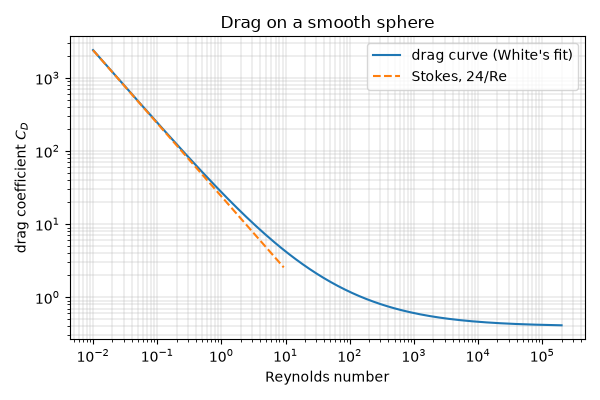
law fails once inertia matters, near \(Re = 1\); the measured drag
curve (sphere_drag_coefficient())
takes over. This example draws the curve and finds how fast sand grains of
different sizes fall through water
(terminal_velocity()).
import matplotlib.pyplot as plt
import numpy as np

from engineeringkit.fluid_engineering import (
    reynolds_number,
    sphere_drag_coefficient,
    stokes_drag,
    stokes_settling_velocity,
    terminal_velocity,
)
The sphere drag curve#
Stokes’s \(C_D = 24/Re\) is the straight line at the left; the curve levels off near 0.4 in Newton’s range before the drag crisis.
Re = np.geomspace(0.01, 2e5, 200)
fig, ax = plt.subplots(figsize=(6, 4))
ax.loglog(Re, sphere_drag_coefficient(Re), label="drag curve (White's fit)")
ax.loglog(Re[Re < 10], 24 / Re[Re < 10], "--", label="Stokes, 24/Re")
ax.set(xlabel="Reynolds number", ylabel="drag coefficient $C_D$", title="Drag on a smooth sphere")
ax.legend()
ax.grid(True, which="both", lw=0.3)
fig.tight_layout()
Settling sand#
Quartz sand (2650 kg/m³) falling through water at 20 °C. Stokes’s velocity is accurate for silt but overestimates coarse sand badly.
rho, mu, rho_p = 998.0, 1.0e-3, 2650.0
for d in [20e-6, 100e-6, 500e-6, 2e-3]:
    V = terminal_velocity(d, rho_p, rho, mu)
    V_stokes = stokes_settling_velocity(d, rho_p, rho, mu)
    print(f"d = {d * 1e6:6.0f} µm: V = {V * 1000:7.3f} mm/s, Stokes {V_stokes * 1000:9.3f} mm/s, Re = {reynolds_number(rho, V, d, mu):.3g}")
d =     20 µm: V =   0.359 mm/s, Stokes     0.360 mm/s, Re = 0.00717
d =    100 µm: V =   8.042 mm/s, Stokes     9.000 mm/s, Re = 0.803
d =    500 µm: V =  76.071 mm/s, Stokes   225.008 mm/s, Re = 38
d =   2000 µm: V = 247.453 mm/s, Stokes  3600.130 mm/s, Re = 494
The drag on a 20 µm silt grain at its settling speed equals its weight less its buoyancy.
d = 20e-6
V = stokes_settling_velocity(d, rho_p, rho, mu)
weight = (rho_p - rho) * 9.80665 * np.pi * d**3 / 6

assert np.isclose(stokes_drag(mu, V, d), weight)
assert np.isclose(terminal_velocity(d, rho_p, rho, mu), V, rtol=1e-2)
assert terminal_velocity(2e-3, rho_p, rho, mu) < 0.2 * stokes_settling_velocity(2e-3, rho_p, rho, mu)

plt.show()
Total running time of the script: (0 minutes 0.188 seconds)
