
Note
Go to the end to download the full example code.
The KAM theorem: which invariant tori survive a perturbation#
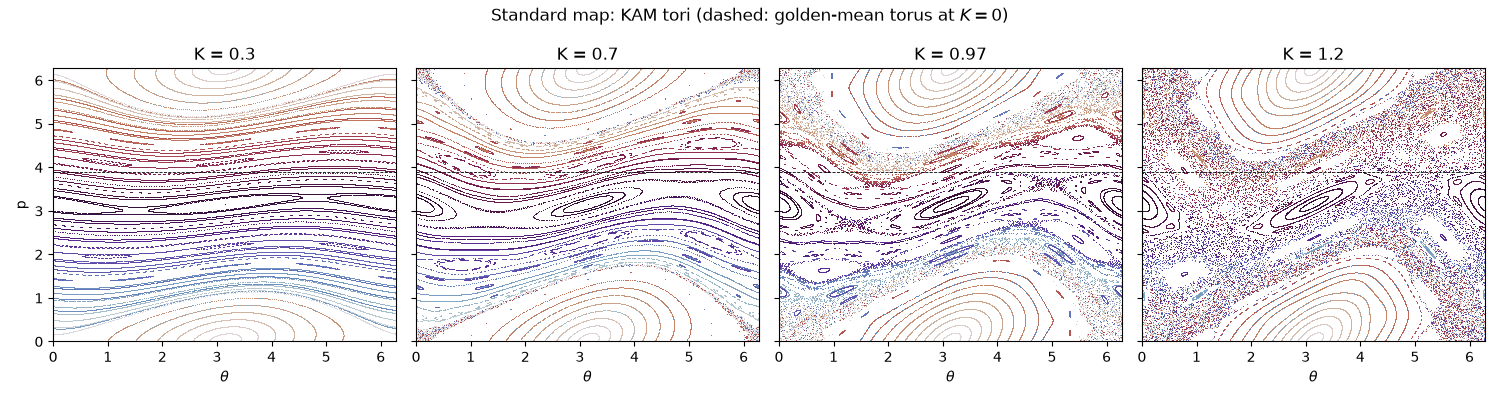
Kolmogorov (1954), Arnold (1963) and Moser (1962) proved that when an integrable Hamiltonian system is perturbed slightly, most of its invariant tori survive, merely deformed. The ones that break first are the resonant tori, whose frequency ratio is rational; the last to go are those with the “most irrational” ratio, poorly approximated by fractions, the golden mean above all.
The cleanest place to watch this is the Chirikov-Taylor standard map,
StandardMap, the surface of
section of a periodically kicked rotor:
At \(K=0\) every line \(p=\text{const}\) is an invariant torus with rotation number \(\nu=p/2\pi\). This example turns \(K\) on and follows which tori remain.
import matplotlib.pyplot as plt
import numpy as np

from physicskit.chaos.systems.maps import StandardMap

GOLDEN = (np.sqrt(5.0) - 1.0) / 2.0  # 0.618..., the most irrational number
Tori deform, resonances break up#
Orbits launched on a grid of momenta, for increasing kick strength. At small \(K\) almost every orbit still traces a curve that wraps all the way around in \(\theta\): a surviving KAM torus. The rational tori at \(\nu=0,\ 1/2,\ 1/3,\ 2/3\) are the first to go, replaced by chains of islands with thin chaotic layers. By \(K=1.2\) the last wrapping curves are gone.
Ks = [0.3, 0.7, 0.97, 1.2]
fig1, axes = plt.subplots(1, 4, figsize=(15, 4), sharey=True)
for ax, K in zip(axes, Ks):
    smap = StandardMap(k=K)
    for p0 in np.linspace(0.0, 2.0 * np.pi, 40, endpoint=False):
        for th0 in (0.0, np.pi):
            traj = smap.trajectory(np.array([th0, p0]), n_iter=600)
            ax.plot(traj[:, 0], traj[:, 1], ",", color=plt.cm.twilight(p0 / (2 * np.pi)))
    ax.axhline(2 * np.pi * GOLDEN, color="k", lw=0.6, ls="--")
    ax.set_title(f"K = {K}")
    ax.set_xlabel(r"$\theta$")
    ax.set_xlim(0, 2 * np.pi)
    ax.set_ylim(0, 2 * np.pi)
axes[0].set_ylabel("p")
fig1.suptitle(r"Standard map: KAM tori (dashed: golden-mean torus at $K=0$)")
fig1.tight_layout()
The golden torus is the last barrier#
A rotational KAM torus is a wall: no orbit can cross it. Start an orbit in the chaotic layer at the \(\nu=0\) resonance and record the largest distance it ever wanders from \(p=0\). As long as golden-mean tori survive, that distance stays below them; past Greene’s critical value \(K_c\approx0.9716\) the last wall is gone and the orbit reaches the \(\nu=1/2\) resonance at \(p=\pi\).
K_values = np.linspace(0.5, 1.3, 33)
reach = []
for K in K_values:
    traj = StandardMap(k=K).trajectory(np.array([1e-3, 0.0]), n_iter=200_000)
    p_centred = (traj[:, 1] + np.pi) % (2 * np.pi) - np.pi
    reach.append(np.max(np.abs(p_centred)))
reach = np.array(reach)

for K, r in zip(K_values[::4], reach[::4]):
    print(f"K = {K:.3f}: max |p| reached = {r:.3f}   ({'trapped' if r < 0.9 * np.pi else 'escaped to p = pi'})")

fig2, ax2 = plt.subplots(figsize=(6, 3.8))
ax2.plot(K_values, reach, "o-", color="steelblue", ms=4)
ax2.axvline(0.9716, color="firebrick", ls="--", label=r"$K_c\approx0.9716$ (golden torus breaks)")
ax2.axhline(np.pi, color="0.6", lw=0.8)
ax2.set_xlabel("kick strength K")
ax2.set_ylabel(r"max $|p|$ reached from $p\approx0$")
ax2.set_title("Crossing the last KAM torus")
ax2.legend(fontsize=8)
fig2.tight_layout()

plt.show()
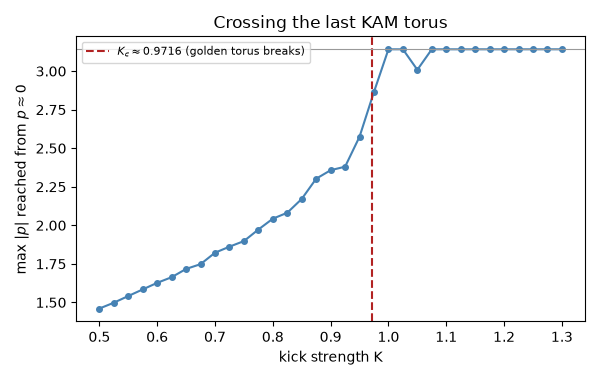
K = 0.500: max |p| reached = 1.460   (trapped)
K = 0.600: max |p| reached = 1.627   (trapped)
K = 0.700: max |p| reached = 1.822   (trapped)
K = 0.800: max |p| reached = 2.043   (trapped)
K = 0.900: max |p| reached = 2.358   (trapped)
K = 1.000: max |p| reached = 3.142   (escaped to p = pi)
K = 1.100: max |p| reached = 3.142   (escaped to p = pi)
K = 1.200: max |p| reached = 3.142   (escaped to p = pi)
K = 1.300: max |p| reached = 3.142   (escaped to p = pi)
Check#
KAM tori confine p until the last (golden-mean) torus breaks at Greene’s K_c = 0.9716; above it orbits from p ~ 0 reach p = pi (just above K_c only slowly, through the leaky cantori the torus leaves behind).
Total running time of the script: (0 minutes 0.376 seconds)