Note
Go to the end to download the full example code.
The critical rotation frequency for BEC vortex nucleation#
Following the first dilute-gas Bose-Einstein condensates in 1995 (Cornell, Wieman, Ketterle), experimentalists set condensates rotating and watched them nucleate quantized vortices above a critical rotation frequency, arranging themselves into a triangular Abrikosov-like lattice – exactly as Gross-Pitaevskii theory, by then over three decades old, had predicted. Both the vortex-free and single-vortex states compared here are relaxed (at zero rotation) via imaginary-time propagation of the Gross-Pitaevskii equation for a harmonically trapped condensate,
by gpe_relax(); the vortex state
starts from gpe_imprint_vortex()
multiplying in a single \(2\pi\) phase winding before relaxation.
Comparing the two relaxed states’ lab-frame energy \(E\) and angular
momentum \(L_z\) then gives the standard energetic nucleation
criterion,
the rotation frequency above which a vortex genuinely lowers the
rotating-frame energy \(E - \Omega L_z\), reproduced here from first
principles without ever simulating the rotating trap itself, and
count_vortices() confirms the
imprinted state carries exactly one quantum of circulation – the
single-vortex “unit cell” of the triangular lattices seen experimentally
above that threshold (worked through further in
Creating a Quantized Vortex in a Rotating BEC).
import matplotlib.pyplot as plt
import numpy as np

from physicskit.fields import count_vortices, gpe_energy, gpe_imprint_vortex, gpe_relax, harmonic_trap_grid, plot_bec_density, plot_bec_phase
Relax the vortex-free ground state and a state seeded with one vortex#
n, length, g = 64, 12.0, 4.0
X, Y, KX, KY, K2 = harmonic_trap_grid(n, length)
V = 0.5 * (X**2 + Y**2)
psi_seed = np.exp(-0.5 * (X**2 + Y**2)).astype(complex)
psi_vortex_free = gpe_relax(psi_seed, V, g, dtau=5e-4, steps=1500, X=X, Y=Y, K2=K2)
psi_vortex = gpe_relax(gpe_imprint_vortex(psi_seed, X, Y, [(0.0, 0.0)]), V, g, dtau=5e-4, steps=1500, X=X, Y=Y, K2=K2)
Compare their lab-frame energy and angular momentum#
Above \(\Omega_c = \Delta E/\Delta L_z\), nucleating a vortex lowers the rotating-frame energy – the textbook criterion, reproduced here from first principles, and the single-vortex “unit cell” of the triangular lattices seen experimentally above that threshold.
Omega_c = (E1["total"] - E0["total"]) / (E1["angular_momentum"] - E0["angular_momentum"])
winding = count_vortices(psi_vortex)

fig, ax = plot_bec_density(X, Y, psi_vortex)
ax.set_title(f"relaxed single-vortex state, Omega_c = {Omega_c:.3f}")
fig.tight_layout()

print(f"critical rotation frequency Omega_c = {Omega_c:.4f}")
print(f"quantized circulation in the relaxed vortex state: {np.sum(np.abs(winding))} (expected: 1)")
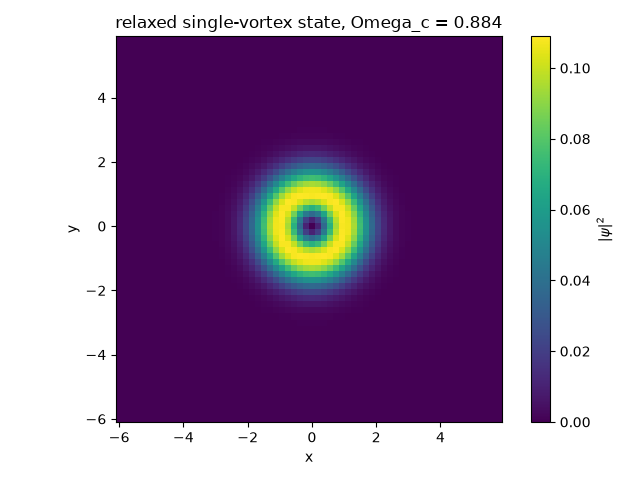
critical rotation frequency Omega_c = 0.8844
quantized circulation in the relaxed vortex state: 1 (expected: 1)
The vortex-free ground state and the vortex’s phase singularity#
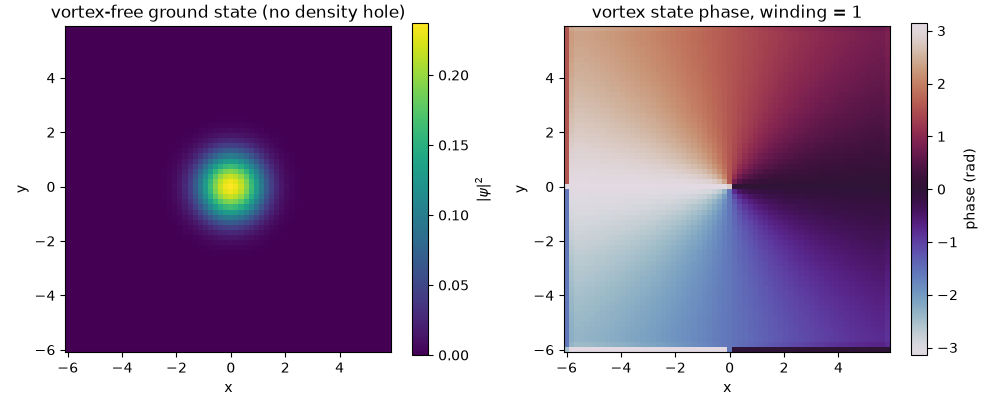
The single density panel above only shows the relaxed vortex state; the vortex-free ground state relaxed alongside it (used to compute \(\Omega_c\)) is a smooth, hole-free cloud by contrast, and the vortex state’s phase winds by exactly \(2\pi\) around the density zero visible above – the two complementary views of the same single quantized vortex, side by side.
fig2, (ax_density0, ax_phase) = plt.subplots(1, 2, figsize=(10, 4))
plot_bec_density(X, Y, psi_vortex_free, ax=ax_density0)
ax_density0.set_title("vortex-free ground state (no density hole)")
plot_bec_phase(X, Y, psi_vortex, ax=ax_phase)
ax_phase.set_title(f"vortex state phase, winding = {np.sum(np.abs(winding))}")
fig2.tight_layout()
Check#
The relaxed vortex carries one quantum of circulation, L_z = hbar per particle; it costs energy, so it becomes favourable in a frame rotating faster than Omega_c = dE / dL_z, which lies below the trap frequency.
Total running time of the script: (0 minutes 0.374 seconds)