
Note
Go to the end to download the full example code.
The Ehrenfest urn: reversibility, recurrence, and the arrow of time#
Two objections were raised against Boltzmann’s H-theorem soon after he proposed it: Loschmidt argued that time-reversible microscopic dynamics cannot produce genuinely irreversible macroscopic behavior, and Zermelo noted that any bounded mechanical system must (by Poincare recurrence) eventually return arbitrarily close to its initial state. The Ehrenfests’ 1907 urn model resolves both at once, in the simplest possible setting.
\(N\) labeled balls are split between two boxes; at each discrete time step, one of the \(N\) balls, chosen uniformly at random, is moved to the other box. This single rule is exactly reversible (running it backward is itself a valid Ehrenfest step) and, since the system has only finitely many configurations, must eventually recur exactly. Writing \(n\) for the number of balls in the left box, the Boltzmann entropy of that macrostate is
since \(W(n)\) counts the ball-labelings compatible with occupancy \(n\); \(W(n)\), and hence the entropy, is maximized at the balanced occupancy \(n = N/2\) and falls off sharply toward either extreme.
This example starts every one of \(N = 500\) balls in the left box (\(n = 0\), the state of minimum \(W\) and hence minimum entropy – a maximally non-equilibrium state) and watches the occupancy relax toward \(N/2\) while the entropy climbs monotonically toward its maximum, even though the underlying per-ball dynamics is exactly reversible: for any macroscopic \(N\) the expected Poincare recurrence time is astronomically long, while relaxation to (statistical) equilibrium is essentially immediate.
import matplotlib.pyplot as plt
import numpy as np

from physicskit.statphys.chapters.ehrenfest_urn import EhrenfestUrn
from physicskit.statphys.visualizers.urn_render import plot_ehrenfest_history
Relaxation from a maximally ordered initial state#
urn = EhrenfestUrn(n_balls=500, seed=0)
history = urn.run(n_steps=5000)

plot_ehrenfest_history(history, n_balls=urn.n_balls)
plt.tight_layout()

print(f"Entropy: S(0)={history['entropy'][0]:.2f}, S(final)={history['entropy'][-1]:.2f}")
print(f"Maximum possible entropy (N/2 balls per box): {EhrenfestUrn(n_balls=500, n_left_init=250).entropy():.2f}")
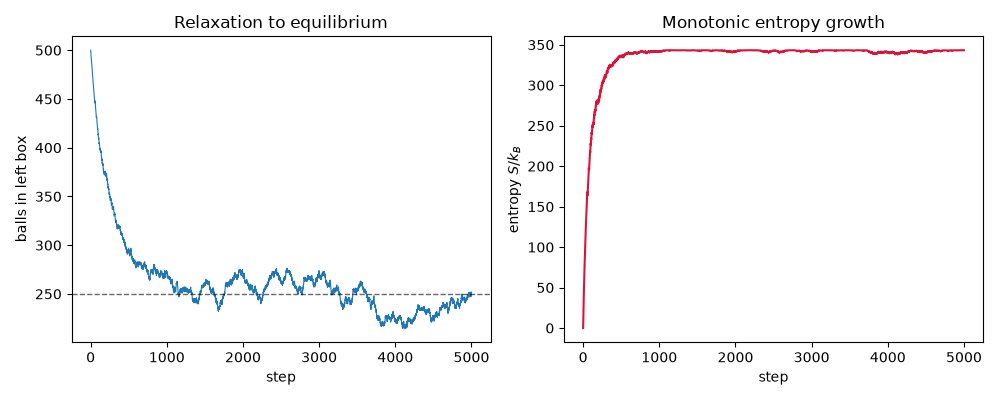
Entropy: S(0)=0.00, S(final)=343.24
Maximum possible entropy (N/2 balls per box): 343.24
A finite-size collapse: relaxation is fast for any N#
The single N=500 trace above already looks fast, but “fast compared to what?” only has an answer once N is varied. Rescaling the occupancy by N and time by N (the natural unit: on average N/2 of the N balls need to switch box) collapses every system size onto the same relaxation shape, while the fluctuation band around equilibrium visibly narrows as N grows – the same law of large numbers that makes a macroscopic urn’s approach to equilibrium look deterministic even though the underlying per-ball dynamics is exactly reversible.
N_values = [50, 200, 800, 3200]
fig, axes = plt.subplots(1, 2, figsize=(11, 4.5))
for N in N_values:
    scan_urn = EhrenfestUrn(n_balls=N, seed=0)
    n_steps = 8 * N
    scan_history = scan_urn.run(n_steps=n_steps)
    t_rescaled = scan_history["t"] / N
    occupancy_rescaled = scan_history["n_left"] / N
    axes[0].plot(t_rescaled, occupancy_rescaled, linewidth=0.8, label=f"N={N}")
    axes[1].plot(t_rescaled, scan_history["entropy"] / N, linewidth=0.8, label=f"N={N}")
axes[0].axhline(0.5, color="k", linestyle="--", linewidth=1, alpha=0.6)
axes[0].set_xlabel("t / N")
axes[0].set_ylabel("(balls in left box) / N")
axes[0].set_title("Relaxation collapses onto one curve in t/N")
axes[0].legend(fontsize=8)
axes[1].set_xlabel("t / N")
axes[1].set_ylabel("entropy per ball, $S/(N k_B)$")
axes[1].set_title("Larger N: relatively smaller entropy fluctuations")
plt.tight_layout()
plt.show()

print(
    "\nRescaled relaxation is essentially N-independent, while the "
    f"root-mean-square late-time fluctuation in n_left/N shrinks with N "
    f"(std over last 20% of run, N={N_values[-1]}): "
    f"{np.std(scan_history['n_left'][int(0.8 * n_steps) :] / N):.4f}"
)
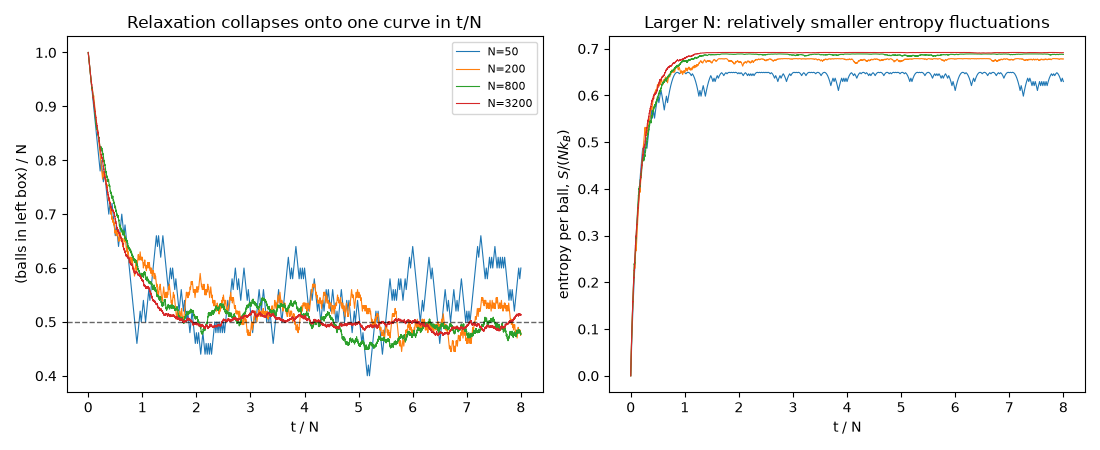
Rescaled relaxation is essentially N-independent, while the root-mean-square late-time fluctuation in n_left/N shrinks with N (std over last 20% of run, N=3200): 0.0090
Check#
The urn relaxes to the maximum-entropy state N/2 per box, and the late-time fluctuations of n_left/N are binomial, sqrt(N/4)/N = 1/(2 sqrt(N)).
Total running time of the script: (0 minutes 0.210 seconds)