
Note
Go to the end to download the full example code.
Oort and Lindblad’s differential rotation: the Oort constants#
Lindblad argued the Milky Way could not rotate rigidly; Oort (1927) supplied the observational test: if the Galaxy rotates differentially, nearby stars’ radial velocities and proper motions vary with Galactic longitude \(l\) in a double-sine pattern set by just two numbers,
fixed by the local value and slope of the rotation curve
\(\Omega(R)=v_c(R)/R\). This example builds a rotation curve from
circular_velocity() and
nfw_enclosed_mass(), computes
\(A\) and \(B\) numerically at the Sun’s Galactocentric radius,
and reproduces the double-sine streaming pattern in radial velocity and
proper motion that Oort actually measured.
import matplotlib.pyplot as plt
import numpy as np

from physicskit.astro.galactic_dynamics import circular_velocity, nfw_enclosed_mass
A rotation curve, and the Sun’s place on it#
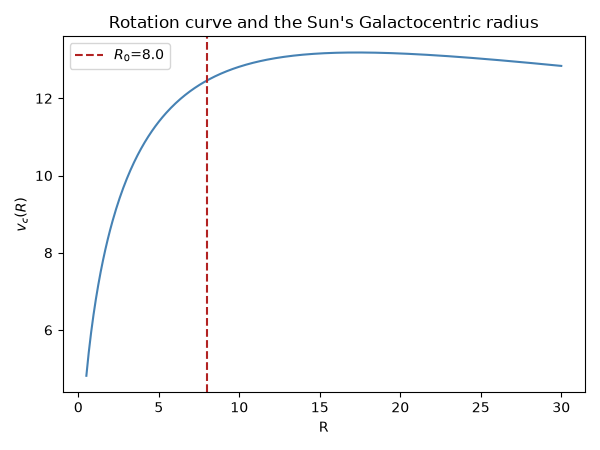
An NFW-halo-dominated rotation curve, in \(G=1\) units, standing in for the Milky Way’s; \(R_0\) marks the Sun’s Galactocentric radius.
Oort’s constants from the local rotation curve#
\(\Omega(R)=v_c(R)/R\); its value and slope at \(R_0\) fix \(A\) and \(B\) directly, via a simple centered finite difference on a fine local grid.
h = 1e-4
Omega_R0 = v_c(R0) / R0
dOmega_dR = (v_c(R0 + h) / (R0 + h) - v_c(R0 - h) / (R0 - h)) / (2 * h)

A = -0.5 * R0 * dOmega_dR
B = A - Omega_R0
print(f"Omega(R0)   = {Omega_R0:.6f}")
print(f"dOmega/dR   = {dOmega_dR:.6f}")
print(f"Oort A = {A:.6f}")
print(f"Oort B = {B:.6f}")
print(f"(A - B = Omega(R0) exactly, by construction: {A - B:.6f} vs {Omega_R0:.6f})")

fig1, ax1 = plt.subplots(figsize=(6, 4.5))
ax1.plot(R_values, v_values, color="steelblue")
ax1.axvline(R0, color="firebrick", ls="--", label=f"$R_0$={R0}")
ax1.set_xlabel("R")
ax1.set_ylabel(r"$v_c(R)$")
ax1.set_title("Rotation curve and the Sun's Galactocentric radius")
ax1.legend()
fig1.tight_layout()
Omega(R0)   = 1.557934
dOmega/dR   = -0.166081
Oort A = 0.664323
Oort B = -0.893611
(A - B = Omega(R0) exactly, by construction: 1.557934 vs 1.557934)
The double-sine streaming pattern#
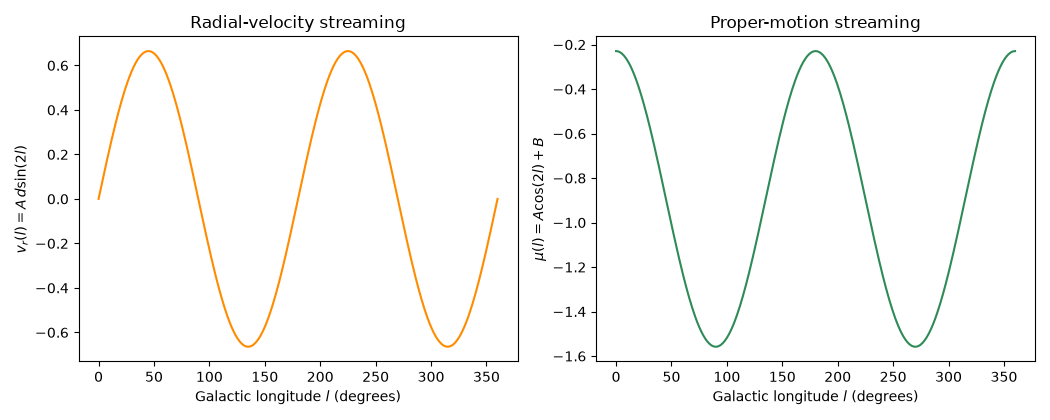
To leading order in \((R-R_0)/R_0\) for stars near the Sun, the line-of-sight (radial) velocity and the proper motion vary with Galactic longitude \(l\) as \(v_r(l)=Ad\sin(2l)\) and \(\mu(l)=A\cos(2l)+B\), for a star at fixed distance \(d\) – exactly the pattern Oort found in existing stellar radial velocities, confirming differential rotation.
l_values = np.linspace(0.0, 2.0 * np.pi, 400)
d = 1.0  # a fixed, small distance from the Sun (local approximation)
v_r = A * d * np.sin(2 * l_values)
mu = A * np.cos(2 * l_values) + B

fig2, (ax2, ax3) = plt.subplots(1, 2, figsize=(10.5, 4.2))
ax2.plot(np.degrees(l_values), v_r, color="darkorange")
ax2.set_xlabel("Galactic longitude $l$ (degrees)")
ax2.set_ylabel(r"$v_r(l) = A\,d\sin(2l)$")
ax2.set_title("Radial-velocity streaming")

ax3.plot(np.degrees(l_values), mu, color="seagreen")
ax3.set_xlabel("Galactic longitude $l$ (degrees)")
ax3.set_ylabel(r"$\mu(l) = A\cos(2l) + B$")
ax3.set_title("Proper-motion streaming")
fig2.tight_layout()

plt.show()
Check#
A = (v/R - dv/dR) / 2 and B = -(v/R + dv/dR) / 2 from the rotation curve itself; a curve falling more slowly than Keplerian gives A > 0 > B.
Total running time of the script: (0 minutes 0.085 seconds)