
Note
Go to the end to download the full example code.
The figure-eight three-body choreography#
For two centuries after Newton, every known periodic three-body solution
demanded either a special mass ratio (Lagrange’s equilateral triangle)
or a rigidly symmetric configuration (Euler’s collinear solutions).
Moore found something qualitatively different in 1993: three equal
masses chasing one another endlessly around a single figure-eight
curve, a genuine choreography with no distinguished body – proven to
exist by Chenciner and Montgomery in 2000.
figure_eight_initial_conditions() returns
exactly this initial condition; this example integrates it with
NBodySystem, checks that the
configuration is genuinely periodic by finding the time at which body 1
first returns closest to its own starting point, and checks that energy
and angular momentum stay conserved over one full period.
import matplotlib.pyplot as plt
import numpy as np

from physicskit.astro.nbody import NBodySystem, figure_eight_initial_conditions
from physicskit.astro.visualizers import animate_nbody_trajectories, plot_nbody_trajectories
Integrate one and a bit periods#
positions0, velocities0, masses = figure_eight_initial_conditions()

dt, n_steps = 0.002, 3500  # generously more than one period, found below
system = NBodySystem(positions0, velocities0, masses)
E0 = system.total_energy()
L0 = system.total_angular_momentum()
history = system.simulate(dt, n_steps)
E1 = system.total_energy()
L1 = system.total_angular_momentum()

print(f"energy:            E0={E0:.8f}, E1={E1:.8f}, relative drift={abs((E1 - E0) / E0):.2e}")
print(f"angular momentum:  L0_z={L0[2]:.8f}, L1_z={L1[2]:.8f}")
energy:            E0=-1.28714199, E1=-1.28714423, relative drift=1.74e-06
angular momentum:  L0_z=0.00000000, L1_z=0.00000000
Finding the period numerically#
Rather than trust a hardcoded literature value, find the period directly: track body 1’s distance back to its own initial position after a short initial exclusion window, and take the time of its first sharp local minimum.
t = np.arange(n_steps + 1) * dt
dist_to_start = np.linalg.norm(history[:, 0, :] - positions0[0], axis=1)
search = t > 1.0  # skip the initial departure from the starting point
i_period = np.argmin(dist_to_start[search]) + np.argmax(search)
T_period = t[i_period]
print(f"\nnumerically found period: T = {T_period:.6f} (return distance = {dist_to_start[i_period]:.2e})")

fig0, ax0 = plt.subplots(figsize=(6, 3.5))
ax0.plot(t, dist_to_start)
ax0.axvline(T_period, color="firebrick", ls="--", label=f"period T={T_period:.4f}")
ax0.set_xlabel("t")
ax0.set_ylabel("|body 1 - its own start|")
ax0.set_title("Finding the choreography's period")
ax0.legend()
fig0.tight_layout()
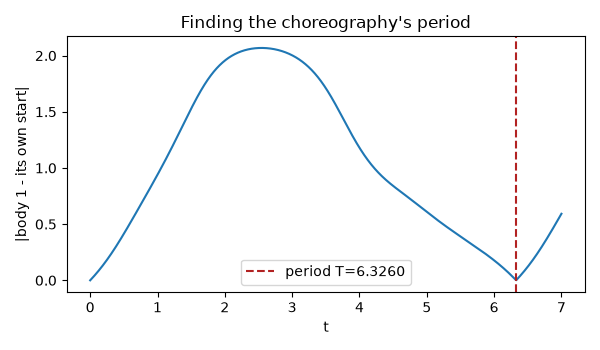
numerically found period: T = 6.326000 (return distance = 5.05e-05)
The choreography itself#
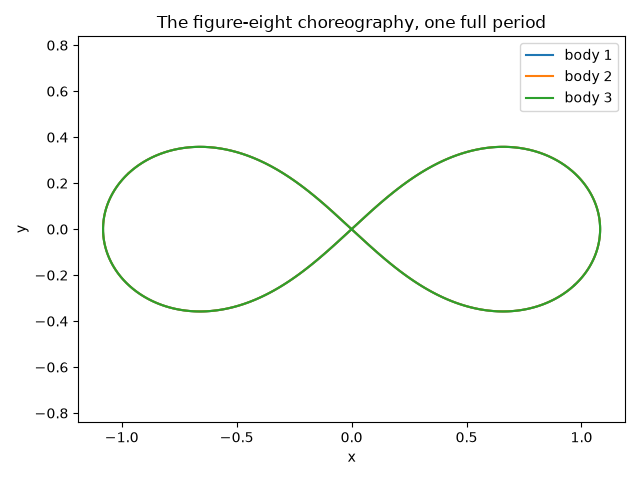
All three equal masses trace the same figure-eight curve, each lagging the next by exactly a third of the period – no body plays a distinguished role.
n_steps_one_period = int(round(T_period / dt))
fig1, ax1 = plot_nbody_trajectories(history[: n_steps_one_period + 1])
ax1.set_title("The figure-eight choreography, one full period")
fig1.tight_layout()

anim = animate_nbody_trajectories(history[: n_steps_one_period + 1], trail=n_steps_one_period, title="Figure-eight choreography")

plt.show()
Check#
The Chenciner-Montgomery figure eight: period 6.32591, energy -1.28714, zero angular momentum, closed after one period.
Total running time of the script: (4 minutes 2.677 seconds)