
Note
Go to the end to download the full example code.
Chandrasekhar’s white dwarf mass limit#
Chandrasekhar (1931) showed that electron degeneracy pressure cannot support an arbitrarily massive white dwarf: as the star’s mass grows, the degenerate electrons are forced relativistic, softening the pressure-density relation until, above a critical mass, no equilibrium exists at all,
the standard coefficient from the \(n=3\) relativistic-degenerate
polytrope. chandrasekhar_mass()
returns exactly this limit; this example plots it against the mean
molecular weight per electron \(\mu_e\), and demonstrates the
special property of the \(n=3\) polytrope behind it directly with
PolytropicStar: unlike any
other polytropic index, its mass does not depend on the star’s central
density.
import matplotlib.pyplot as plt
import numpy as np

from physicskit.astro.stellar_structure import PolytropicStar, chandrasekhar_mass
The mass limit vs. composition#
\(\mu_e=2.0\) for a carbon/oxygen white dwarf (equal numbers of protons and neutrons, so one electron per two nucleons); helium/hydrogen compositions have smaller \(\mu_e\) and hence a (slightly) higher limit.
mu_e_values = np.linspace(1.7, 2.2, 100)
M_ch = np.array([chandrasekhar_mass(mu) for mu in mu_e_values])

fig1, ax1 = plt.subplots(figsize=(6, 4.5))
ax1.plot(mu_e_values, M_ch, color="steelblue")
ax1.axvline(2.0, color="0.6", ls="--", lw=1)
ax1.scatter([2.0], [chandrasekhar_mass(2.0)], color="firebrick", zorder=5, label=f"carbon/oxygen WD ($\\mu_e$=2): {chandrasekhar_mass(2.0):.3f} $M_\\odot$")
ax1.set_xlabel(r"mean molecular weight per electron, $\mu_e$")
ax1.set_ylabel(r"$M_{\rm Ch}$ ($M_\odot$)")
ax1.set_title("Chandrasekhar mass vs. composition")
ax1.legend(fontsize=8)
fig1.tight_layout()

print(f"Chandrasekhar mass, mu_e=2.0 (C/O white dwarf): {chandrasekhar_mass(2.0):.4f} solar masses")
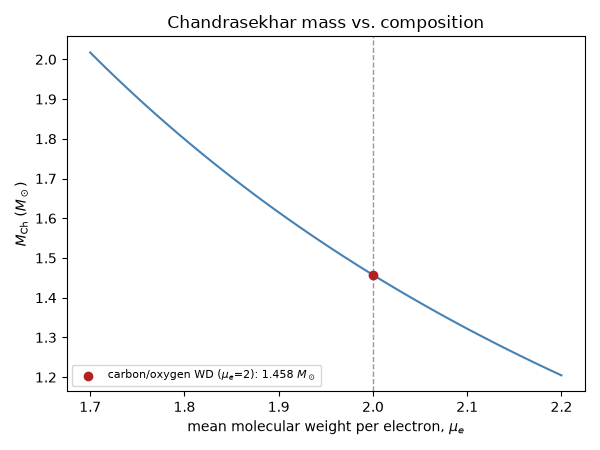
Chandrasekhar mass, mu_e=2.0 (C/O white dwarf): 1.4575 solar masses
Why n=3 is special: mass independent of central density#
For any polytropic index except n=3, a star’s mass depends on its central density; \(n=3\) is the one index – corresponding to fully relativistic electron degeneracy, \(P\propto\rho^{4/3}\) – for which it does not. Building two n=3 stars with the same polytropic constant K but very different central densities demonstrates this directly.
K = 1.0
star_low = PolytropicStar(n=3.0, K=K, rho_c=1.0)
star_high = PolytropicStar(n=3.0, K=K, rho_c=1000.0)
print(f"\nn=3 polytrope, rho_c=1:    mass = {star_low.mass:.8f}, radius = {star_low.radius:.6f}")
print(f"n=3 polytrope, rho_c=1000: mass = {star_high.mass:.8f}, radius = {star_high.radius:.6f}")
print(f"masses agree to a relative difference of {abs(star_low.mass - star_high.mass) / star_low.mass:.2e}, despite a 1000x density difference")
print("(radius, by contrast, does shrink as rho_c increases -- only the mass is density-independent for n=3)")

# For comparison, an n=1.5 polytrope's mass *does* depend on rho_c.
star15_low = PolytropicStar(n=1.5, K=K, rho_c=1.0)
star15_high = PolytropicStar(n=1.5, K=K, rho_c=1000.0)
print("\nfor contrast, n=1.5 polytrope masses at the same two densities:")
print(f"  rho_c=1:    mass = {star15_low.mass:.6f}")
print(f"  rho_c=1000: mass = {star15_high.mass:.6f}  (these differ substantially, unlike the n=3 case)")

fig2, ax2 = plt.subplots(figsize=(5.5, 4.2))
rho_c_values = np.logspace(0, 3, 20)
masses_n3 = [PolytropicStar(n=3.0, K=K, rho_c=rc).mass for rc in rho_c_values]
masses_n15 = [PolytropicStar(n=1.5, K=K, rho_c=rc).mass for rc in rho_c_values]
ax2.semilogx(rho_c_values, masses_n3, "o-", color="firebrick", label="n=3 (mass ~ constant)")
ax2.semilogx(rho_c_values, masses_n15, "o-", color="steelblue", label="n=1.5 (mass varies)")
ax2.set_xlabel(r"central density $\rho_c$")
ax2.set_ylabel("mass")
ax2.set_title("Only n=3 gives a density-independent mass")
ax2.legend(fontsize=8)
fig2.tight_layout()

plt.show()
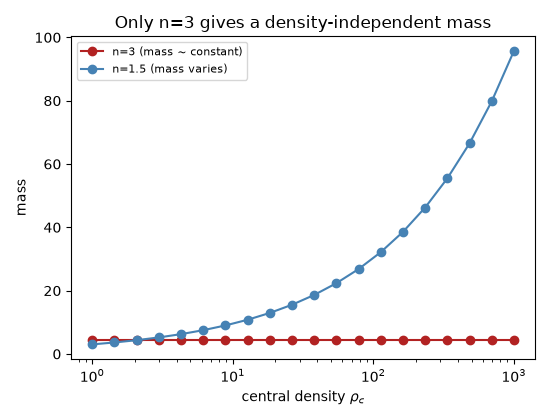
n=3 polytrope, rho_c=1:    mass = 4.55466852, radius = 3.891130
n=3 polytrope, rho_c=1000: mass = 4.55466852, radius = 0.389113
masses agree to a relative difference of 5.85e-16, despite a 1000x density difference
(radius, by contrast, does shrink as rho_c increases -- only the mass is density-independent for n=3)

for contrast, n=1.5 polytrope masses at the same two densities:
  rho_c=1:    mass = 3.026381
  rho_c=1000: mass = 95.702557  (these differ substantially, unlike the n=3 case)
Check#
M_Ch = 1.457 Msun (2 / mu_e)^2; an n = 3 polytrope’s mass is independent of rho_c, while an n = 1.5 one scales as rho_c^((3 - n) / 2n) = rho_c^(1/2).
assert abs(chandrasekhar_mass(2.0) - 1.457) < 0.005
np.testing.assert_allclose(M_ch, chandrasekhar_mass(2.0) * (2.0 / mu_e_values) ** 2, rtol=1e-10)
np.testing.assert_allclose(masses_n3, star_low.mass, rtol=1e-10)
assert abs(star15_high.mass / star15_low.mass - 1000**0.5) < 1e-6 * 1000**0.5
Total running time of the script: (0 minutes 0.206 seconds)