
Note
Go to the end to download the full example code.
Sine-Gordon solitons: kink propagation and a kink-antikink breather#
SineGordonChain is a
discretized chain of \(N\) coupled pendulums (the Frenkel-Kontorova
model) with free (Neumann-like) ends, so a topological kink can
propagate off either end. The potential energy is
giving the lattice equation of motion \(m\ddot q_i = k(q_{i+1} - 2q_i + q_{i-1}) - \sin q_i\). In the continuum limit (\(m = k = 1\)) this becomes the sine-Gordon equation \(\partial_t^2 q - \partial_x^2 q + \sin q = 0\), whose exact traveling-wave (kink) solution is the Lorentz-boosted profile
with \(w = \sqrt{k/m} = 1\) the natural soliton width, \(v\)
the boost velocity (\(|v| < 1\), the natural wave speed), and the
sign giving a kink (+) or antikink (-).
kink()
builds this continuum-limit initial condition on the discrete lattice
for a topological kink (or antikink) with a chosen boost velocity –
width must equal sqrt(k/m) (1, for the default k=m=1) for this
to actually be a valid soliton profile, not an arbitrary shape.
A single kink keeps its shape as it propagates (a genuine soliton), though on this discrete lattice it settles to an effective speed below its nominal boost velocity – lattice discreteness itself acts as a drag on the continuum soliton solution, a real effect in Frenkel-Kontorova-type chains, not a bug.
A kink and antikink launched toward each other at a slow-to-moderate speed do not simply pass through: they form a breather, a bound, periodically-collapsing-and-reforming oscillating state – one of the celebrated exact solutions of the (continuum) sine-Gordon equation, visible here as the discrete analogue.
import matplotlib.pyplot as plt
import numpy as np

from physicskit.classical.systems.chains import SineGordonChain

n = 300
A single kink: shape-preserving propagation#
q0, p0 = SineGordonChain.kink(n, center=60, width=1.0, velocity=0.4, polarity=1)
solo = SineGordonChain(n=n, q0=q0, p0=p0)
e0 = solo.energy()
result_solo = solo.integrate((0, 300), dt=0.005, method="yoshida4")
drift_solo = np.max(np.abs(result_solo.energy - e0)) / abs(e0)

front_start = np.interp(np.pi, result_solo.q[0], np.arange(n))
front_end = np.interp(np.pi, result_solo.q[-1], np.arange(n))
effective_speed = (front_end - front_start) / result_solo.t[-1]
print(f"solo kink: energy drift = {drift_solo:.3e}, nominal boost velocity = 0.4, effective lattice speed = {effective_speed:.3f}")

fig1, ax1 = plt.subplots(figsize=(8, 4.5))
for frac in (0.0, 0.33, 0.66, 1.0):
    idx = int(frac * (len(result_solo.t) - 1))
    ax1.plot(np.arange(n), result_solo.q[idx], label=f"t={result_solo.t[idx]:.0f}")
ax1.set_xlabel("lattice site")
ax1.set_ylabel(r"$q_i$")
ax1.set_title("A single kink keeps its shape while it propagates")
ax1.legend()
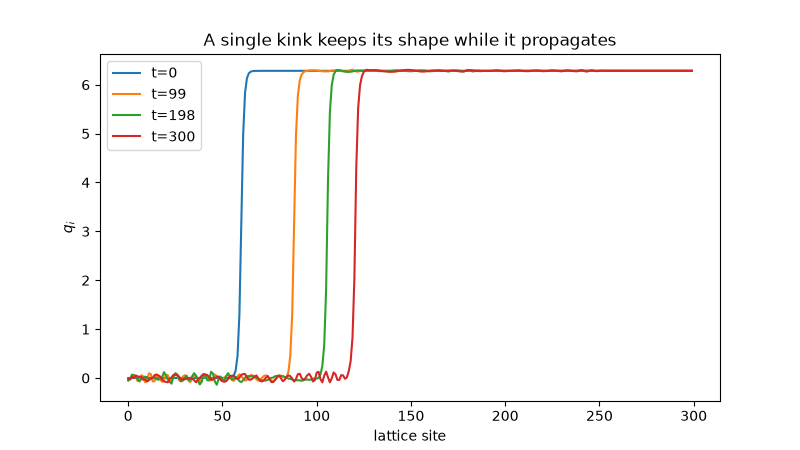
solo kink: energy drift = 2.094e-11, nominal boost velocity = 0.4, effective lattice speed = 0.202

<matplotlib.legend.Legend object at 0x16a4ade20>
Kink + antikink collision: a breather, not a pass-through#
q_k, p_k = SineGordonChain.kink(n, center=100, width=1.0, velocity=0.4, polarity=1)
q_ak, p_ak = SineGordonChain.kink(n, center=200, width=1.0, velocity=-0.4, polarity=-1)
chain = SineGordonChain(n=n, q0=q_k + q_ak, p0=p_k + p_ak)
e0b = chain.energy()
result = chain.integrate((0, 600), dt=0.005, method="yoshida4")
drift = np.max(np.abs(result.energy - e0b)) / abs(e0b)
print(f"collision: energy drift = {drift:.3e}")

fig2, ax2 = plt.subplots(figsize=(7, 5.5))
extent = [0, n, result.t[-1], result.t[0]]
im = ax2.imshow(result.q[::100], aspect="auto", extent=extent, cmap="twilight", vmin=-2 * np.pi, vmax=2 * np.pi)
ax2.set_xlabel("lattice site")
ax2.set_ylabel("t")
ax2.set_title("Kink + antikink collision forms a breather (bound, oscillating), not a pass-through")
fig2.colorbar(im, ax=ax2, label=r"$q_i(t)$")

plt.show()
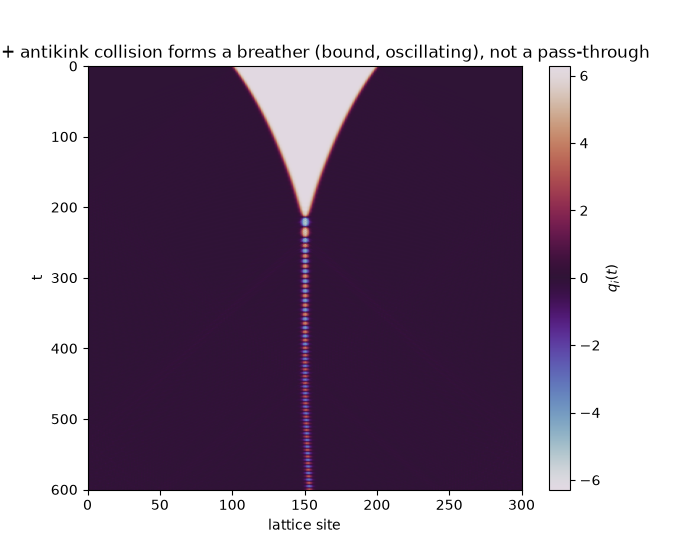
collision: energy drift = 1.708e-10
Check#
The kink carries one quantum 2 pi of topological charge and travels at conserved energy; on this discrete lattice a slow kink-antikink pair captures into a breather that stays localized at the collision point.
assert abs(result_solo.q[-1][0]) < 0.05 and abs(result_solo.q[-1][-1] - 2 * np.pi) < 1e-6
assert drift_solo < 1e-9 and drift < 1e-9 and effective_speed > 0
excited = np.where(np.abs(result.q[-1]) > 1)[0]
assert excited.size > 0 and np.ptp(excited) < 20 and abs(excited.mean() - 150) < 10
Total running time of the script: (0 minutes 2.568 seconds)