
Note
Go to the end to download the full example code.
Fresnel diffraction and the Poisson/Arago spot#
Augustin-Jean Fresnel combined Huygens’ wavelet construction with Young’s principle of interference into a quantitative near-field diffraction theory. Simeon Poisson pointed out – intending it as a reductio ad absurdum – that Fresnel’s own theory predicted a bright spot at the center of the shadow of a circular obstacle; Francois Arago promptly observed the “Poisson spot” in the laboratory, turning a supposed refutation into the theory’s most dramatic confirmation.
fresnel_diffraction() implements the
near-field quadratic-phase (paraxial) propagator that predicts this
effect, computed as a single Fourier transform of the field
\(U_0(x,y)\) immediately after the obstacle:
with wavenumber \(k = 2\pi/\lambda\) and propagation distance
\(z\). Here \(U_0\) is generated by
circular_aperture(), inverted so that it is
1 everywhere except a disk of radius disk_radius – the
complementary transmittance of an opaque circular obstacle – and
propagated a distance z = 200 mm at wavelength wavelength =
0.5e-3 mm. Wavelets diffracting around the rim of the disk travel
equal path lengths to the axis and interfere constructively there,
reproducing the on-axis bright spot Arago observed.
import numpy as np
from physicskit.optics.visualizers import plot_diffraction_pattern
from physicskit.optics.wave import circular_aperture, fresnel_diffraction, intensity
An opaque circular obstacle: transmittance 1 everywhere except the disk#
wavelength = 0.5e-3 # mm
dx = 0.004
N = 512
disk_radius = 0.15
disk = (1.0 - circular_aperture((N, N), dx=dx, radius=disk_radius)).astype(complex)
U = fresnel_diffraction(disk, wavelength=wavelength, z=200.0, dx=dx)
fig, ax = plot_diffraction_pattern(U, dx=dx, log_scale=True)
ax.set_title("Poisson/Arago spot: bright point at the center of the shadow")
fig.tight_layout()
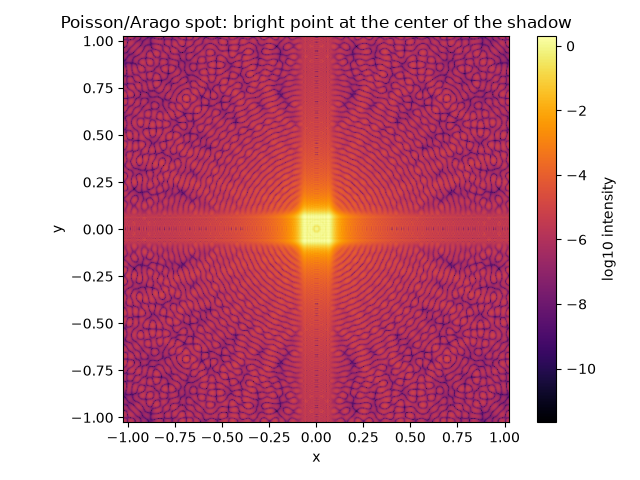
The unobstructed on-axis intensity (no disk at all) is the baseline a “reductio ad absurdum” argument implicitly compares against: Poisson’s point was that Fresnel’s theory predicts a bright spot in the shadow of the disk, comparably bright to the unobstructed beam – not simply “some nonzero intensity.”
I_shadow = intensity(U)
center = I_shadow[N // 2, N // 2]

unobstructed = np.ones((N, N), dtype=complex)
U_open = fresnel_diffraction(unobstructed, wavelength=wavelength, z=200.0, dx=dx)
I_open_center = intensity(U_open)[N // 2, N // 2]

print(f"disk radius: {disk_radius} mm")
print(f"intensity at the center of the disk's geometric shadow: {center:.4f}")
print(f"intensity with no disk at all (unobstructed reference): {I_open_center:.4f}")
print("a bright spot at the center of the shadow, comparable to the")
print("unobstructed beam, is exactly the 'absurd' prediction Arago confirmed.")
disk radius: 0.15 mm
intensity at the center of the disk's geometric shadow: 1.0338
intensity with no disk at all (unobstructed reference): 1.2977
a bright spot at the center of the shadow, comparable to the
unobstructed beam, is exactly the 'absurd' prediction Arago confirmed.
Check#
Fresnel’s theory, as Poisson pointed out: the centre of an opaque disk’s shadow is bright – as bright as the unobstructed beam, up to the finite window.
assert center / I_open_center > 0.6
Total running time of the script: (0 minutes 0.103 seconds)