
Note
Go to the end to download the full example code.
Wigner’s phase-space distribution: negativity of a Fock state#
Eugene Wigner introduced a quasi-probability distribution \(W(x,p)\)
that represents a quantum state jointly over the dimensionless quadratures
\(x = (a+a^\dagger)/\sqrt2\) and \(p = (a-a^\dagger)/(i\sqrt2)\),
reproducing the correct marginal probability densities upon integration
along either axis, while permitting negative values elsewhere – a
signature with no classical phase-space analogue.
compute_wigner_function() evaluates
\(W(x,p) = \sum_{n,m}\rho_{nm}K_{nm}(x,p)\) on a phase-space grid from
the density matrix \(\rho=\lvert\psi\rangle\langle\psi\rvert\) of an
arbitrary Fock-basis state vector; for a number (Fock) state
\(\lvert n\rangle\) (diagonal \(\rho\)) this reduces to the
closed form
with \(L_n\) the Laguerre polynomial – for the single-photon state
\(n=1\) studied below, \(W_1(0,0) = -1/\pi\), the negative dip at
the phase-space origin. wigner_negativity()
integrates \(\max(0,-W)\) over phase space to quantify the negative
volume that marks a state as nonclassical – zero for any classical state,
strictly positive for a single-photon Fock state.
import matplotlib.pyplot as plt
import numpy as np

from physicskit.optics.quantum_optics import compute_wigner_function, fock_state, wigner_negativity
The single-photon Fock state \(|1\rangle\), and its Wigner function#
The Wigner function of \(|1\rangle\) dips below zero right at the phase-space origin – a region no classical probability distribution could occupy – and its integrated negative volume N_W is decisively nonzero, unlike any classical (or coherent, or thermal) state.
fig, ax = plt.subplots(figsize=(5, 4))
vmax = np.abs(W).max()
im = ax.contourf(x, p, W.T, levels=40, cmap="RdBu_r", vmin=-vmax, vmax=vmax)
fig.colorbar(im, ax=ax, label="W(x, p)")
ax.set_xlabel("x")
ax.set_ylabel("p")
ax.set_title("Wigner function of |n=1>: negative rings, no classical analogue")
fig.tight_layout()

i0, j0 = np.argmin(np.abs(x)), np.argmin(np.abs(p))
print(f"Wigner negativity N_W = {N_W:.4f}  (zero for any classical state)")
print(f"W(0, 0) = {W[i0, j0]:.4f}  (exact value: -1/pi = {-1 / np.pi:.4f})")

vac = fock_state(0, cutoff)
W_vac = compute_wigner_function(vac, x, p)
N_W_vac = wigner_negativity(W_vac, x, p)
print(f"for comparison, the vacuum |0> (classical): N_W = {N_W_vac:.6f}")
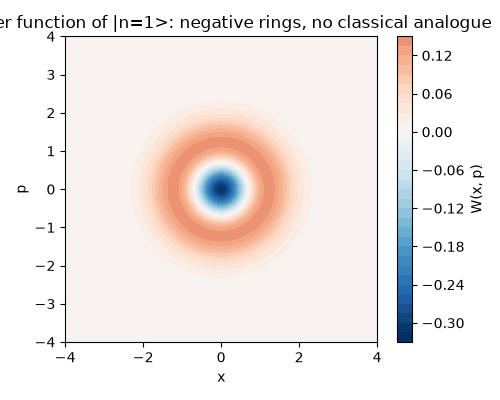
Wigner negativity N_W = 0.2131  (zero for any classical state)
W(0, 0) = -0.3183  (exact value: -1/pi = -0.3183)
for comparison, the vacuum |0> (classical): N_W = 0.000000
Check#
W_1(0, 0) = -1/pi; the negative volume of |1>’s Wigner function is 2/sqrt(e) - 1 (Kenfack and Zyczkowski); the vacuum has none.
Total running time of the script: (0 minutes 0.075 seconds)